Wegener Alice, Broens Els M, van der Graaf-van Bloois Linda, Zomer Aldert L, Visser Caroline E, van Zeijl Jan, van der Meer Coby, Kusters Johannes G, Friedrich Alex W, Kampinga Greetje A, Sips Gregorius J, Smeets Leonard, van Kerckhoven Manfred E J, Timmerman Arjen J, Wagenaar Jaap A, Duim Birgitta
Department of Infectious Diseases and Immunology, Faculty of Veterinary Medicine, Utrecht University, Yalelaan 1, 3584 CL Utrecht, The Netherlands.
Amsterdam UMC Location AMC, Meibergdreef 9, 1105 AZ Amsterdam, The Netherlands.
Antibiotics (Basel). 2021 Jul 14;10(7):854. doi: 10.3390/antibiotics10070854.
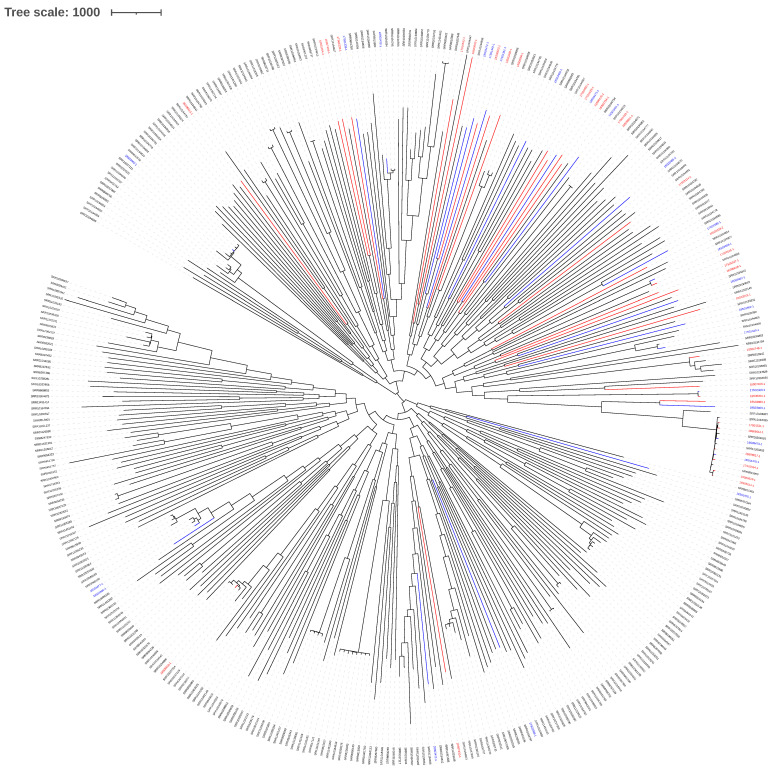
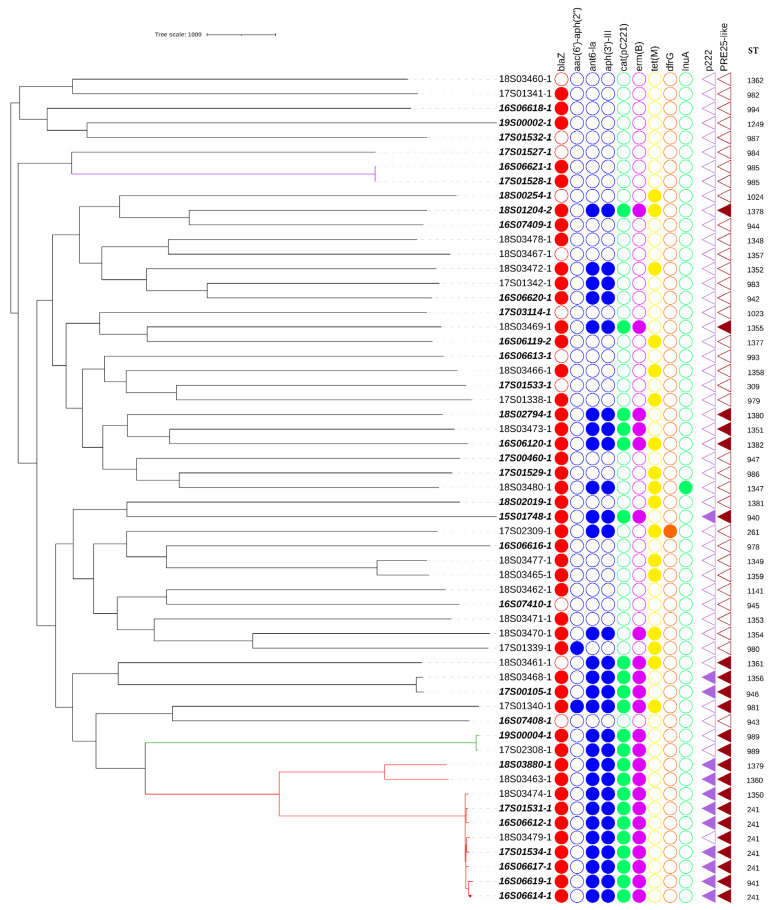
is an important pathogen in dogs that occasionally causes infections in humans as an opportunistic pathogen of elderly and immunocompromised people. This study compared the genomic relatedness and antimicrobial resistance genes using genome-wide association study (GWAS) to examine host association of canine and human isolates. Canine ( = 25) and human ( = 32) methicillin-susceptible (MSSP) isolates showed a high level of genetic diversity with an overrepresentation of clonal complex CC241 in human isolates. This clonal complex was associated with carriage of a plasmid containing a bacteriocin with cytotoxic properties, a CRISPR-cas domain and a pRE25-like mobile element containing five antimicrobial resistance genes. Multi-drug resistance (MDR) was predicted in 13 (41%) of human isolates and 14 (56%) of canine isolates. CC241 represented 54% of predicted MDR isolates from humans and 21% of predicted MDR canine isolates. While it had previously been suggested that certain host-specific genes were present the current GWAS analysis did not identify any genes that were significantly associated with human or canine isolates. In conclusion, this is the first genomic study showing that MSSP is genetically diverse in both hosts and that multidrug resistance is important in dog and human-associated isolates.
是犬类中的一种重要病原体,偶尔会作为老年人和免疫功能低下人群的机会性病原体导致人类感染。本研究使用全基因组关联研究(GWAS)比较了基因组相关性和抗菌抗性基因,以检查犬类和人类分离株与宿主的关联。犬类(n = 25)和人类(n = 32)的甲氧西林敏感金黄色葡萄球菌(MSSP)分离株显示出高度的遗传多样性,其中人类分离株中克隆复合体CC241的比例过高。这个克隆复合体与携带一种含有具有细胞毒性的细菌素、一个CRISPR - cas结构域和一个含有五个抗菌抗性基因的pRE25样移动元件的质粒有关。预测13株(41%)人类分离株和14株(56%)犬类分离株具有多药耐药性(MDR)。CC241占人类预测MDR分离株的54%,占犬类预测MDR分离株的21%。虽然之前有人认为存在某些宿主特异性基因,但目前的GWAS分析未发现任何与人类或犬类分离株显著相关的基因。总之,这是第一项基因组研究,表明MSSP在两种宿主中都具有遗传多样性,并且多药耐药性在与犬类和人类相关的分离株中很重要。