School of Biomedical Engineering and Imaging Sciences, Faculty of Life Sciences and Medicine, School of Life Course Sciences, King's College London, London, UK.
School of Biomedical Engineering and Imaging Sciences, Faculty of Life Sciences and Medicine, School of Life Course Sciences, King's College London, London, UK; MRC Unit for Lifelong Health and Ageing, Department of Population Health Sciences and Centre for Medical Image Computing, Department of Computer Science, University College London, London, UK.
Lancet Child Adolesc Health. 2021 Oct;5(10):708-718. doi: 10.1016/S2352-4642(21)00198-X. Epub 2021 Aug 3.
In children, SARS-CoV-2 infection is usually asymptomatic or causes a mild illness of short duration. Persistent illness has been reported; however, its prevalence and characteristics are unclear. We aimed to determine illness duration and characteristics in symptomatic UK school-aged children tested for SARS-CoV-2 using data from the COVID Symptom Study, one of the largest UK citizen participatory epidemiological studies to date.
In this prospective cohort study, data from UK school-aged children (age 5-17 years) were reported by an adult proxy. Participants were voluntary, and used a mobile application (app) launched jointly by Zoe Limited and King's College London. Illness duration and symptom prevalence, duration, and burden were analysed for children testing positive for SARS-CoV-2 for whom illness duration could be determined, and were assessed overall and for younger (age 5-11 years) and older (age 12-17 years) groups. Children with longer than 1 week between symptomatic reports on the app were excluded from analysis. Data from symptomatic children testing negative for SARS-CoV-2, matched 1:1 for age, gender, and week of testing, were also assessed.
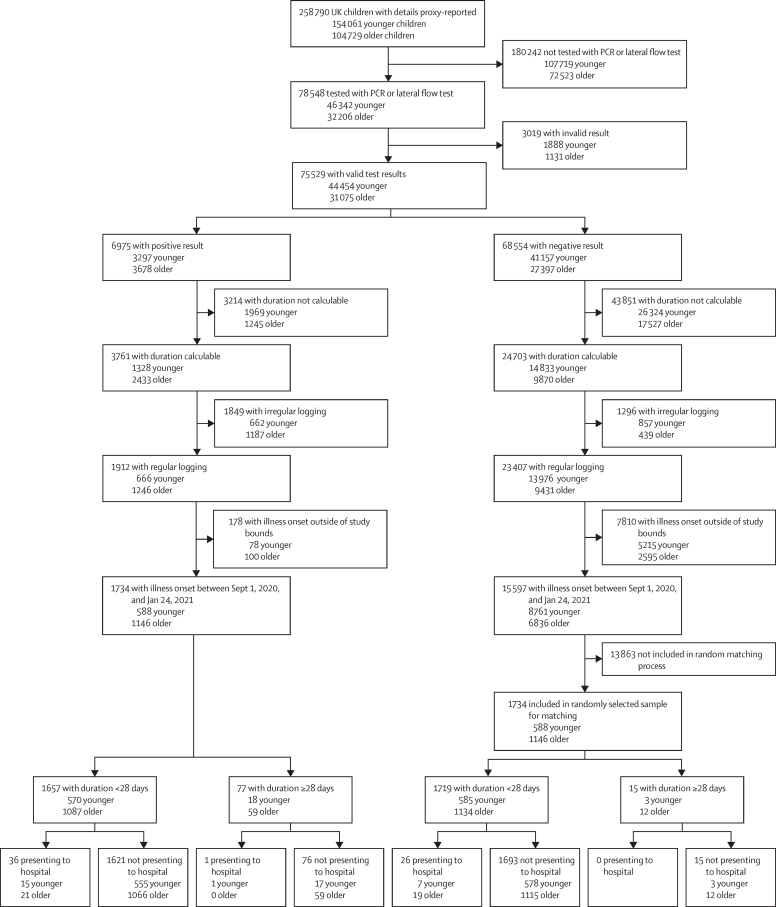
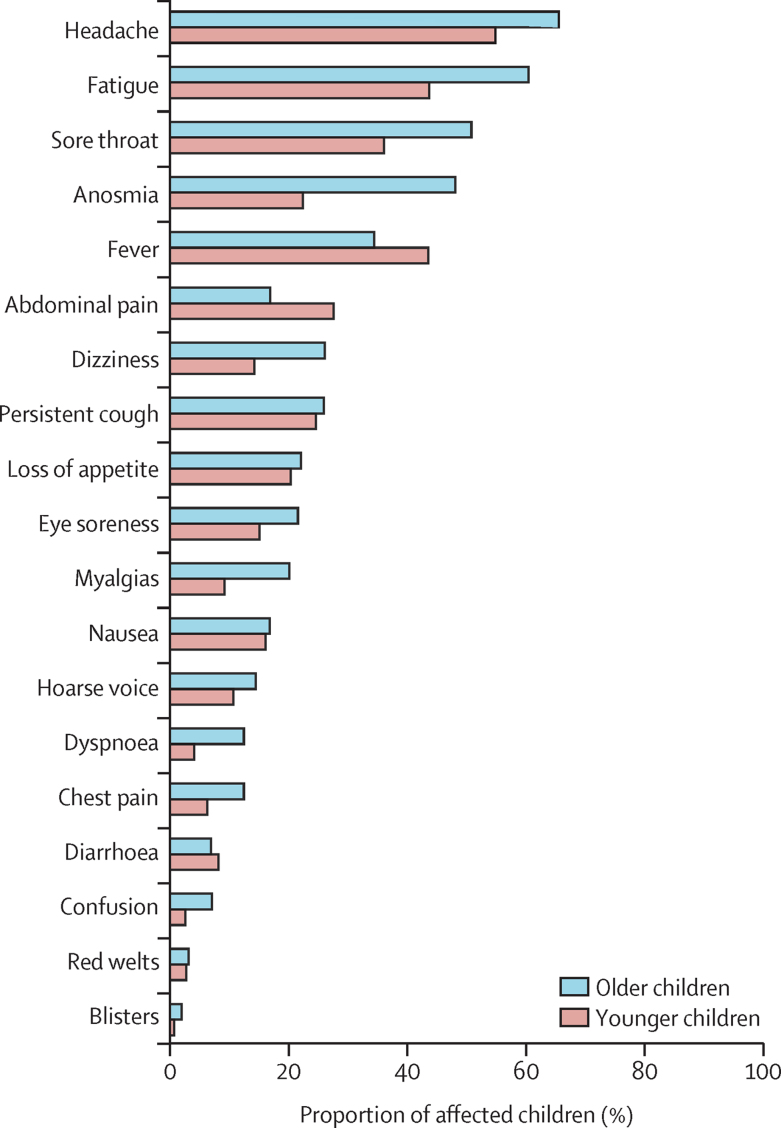
258 790 children aged 5-17 years were reported by an adult proxy between March 24, 2020, and Feb 22, 2021, of whom 75 529 had valid test results for SARS-CoV-2. 1734 children (588 younger and 1146 older children) had a positive SARS-CoV-2 test result and calculable illness duration within the study timeframe (illness onset between Sept 1, 2020, and Jan 24, 2021). The most common symptoms were headache (1079 [62·2%] of 1734 children), and fatigue (954 [55·0%] of 1734 children). Median illness duration was 6 days (IQR 3-11) versus 3 days (2-7) in children testing negative, and was positively associated with age (Spearman's rank-order r 0·19, p<0·0001). Median illness duration was longer for older children (7 days, IQR 3-12) than younger children (5 days, 2-9). 77 (4·4%) of 1734 children had illness duration of at least 28 days, more commonly in older than younger children (59 [5·1%] of 1146 older children vs 18 [3·1%] of 588 younger children; p=0·046). The commonest symptoms experienced by these children during the first 4 weeks of illness were fatigue (65 [84·4%] of 77), headache (60 [77·9%] of 77), and anosmia (60 [77·9%] of 77); however, after day 28 the symptom burden was low (median 2 symptoms, IQR 1-4) compared with the first week of illness (median 6 symptoms, 4-8). Only 25 (1·8%) of 1379 children experienced symptoms for at least 56 days. Few children (15 children, 0·9%) in the negatively tested cohort had symptoms for at least 28 days; however, these children experienced greater symptom burden throughout their illness (9 symptoms, IQR 7·7-11·0 vs 8, 6-9) and after day 28 (5 symptoms, IQR 1·5-6·5 vs 2, 1-4) than did children who tested positive for SARS-CoV-2.
Although COVID-19 in children is usually of short duration with low symptom burden, some children with COVID-19 experience prolonged illness duration. Reassuringly, symptom burden in these children did not increase with time, and most recovered by day 56. Some children who tested negative for SARS-CoV-2 also had persistent and burdensome illness. A holistic approach for all children with persistent illness during the pandemic is appropriate.
Zoe Limited, UK Government Department of Health and Social Care, Wellcome Trust, UK Engineering and Physical Sciences Research Council, UK Research and Innovation London Medical Imaging and Artificial Intelligence Centre for Value Based Healthcare, UK National Institute for Health Research, UK Medical Research Council, British Heart Foundation, and Alzheimer's Society.
在儿童中,SARS-CoV-2 感染通常是无症状的,或者导致病程短暂的轻度疾病。有报告称存在持续性疾病,但这种疾病的流行率和特征尚不清楚。我们旨在通过使用来自 COVID Symptom Study 的数据,确定有症状的英国学龄儿童的疾病持续时间和特征,该研究是迄今为止英国最大的公民参与性流行病学研究之一。
在这项前瞻性队列研究中,由成人代理报告英国学龄儿童(5-17 岁)的数据。参与者是自愿的,并使用由 Zoe Limited 和伦敦国王学院联合推出的移动应用程序(app)。对 SARS-CoV-2 检测呈阳性且可以确定疾病持续时间的儿童进行了疾病持续时间和症状流行率、持续时间和负担的分析,并评估了年龄较小(5-11 岁)和年龄较大(12-17 岁)组的情况。在应用程序中报告症状的时间间隔超过 1 周的儿童被排除在分析之外。还评估了 SARS-CoV-2 检测阴性的有症状儿童的匹配对照数据,这些儿童在年龄、性别和检测周数上与阳性组进行了 1:1 匹配。
2020 年 3 月 24 日至 2021 年 2 月 22 日,有 258790 名 5-17 岁的儿童由成人代理报告,其中 75529 名儿童有 SARS-CoV-2 检测结果。在研究时间段内(2020 年 9 月 1 日至 2021 年 1 月 24 日),有 1734 名儿童(588 名年龄较小的儿童和 1146 名年龄较大的儿童)的 SARS-CoV-2 检测呈阳性且可以计算疾病持续时间。最常见的症状是头痛(1734 名儿童中有 1079 名,62.2%)和疲劳(1734 名儿童中有 954 名,55.0%)。与 SARS-CoV-2 检测阴性的儿童相比,中位疾病持续时间为 6 天(IQR 3-11)和 3 天(2-7),且与年龄呈正相关(Spearman 秩相关 r0.19,p<0.0001)。年龄较大的儿童(7 天,IQR 3-12)的中位疾病持续时间长于年龄较小的儿童(5 天,2-9)。1734 名儿童中有 77 名(4.4%)的疾病持续时间至少为 28 天,年龄较大的儿童比年龄较小的儿童更常见(1146 名年龄较大的儿童中有 59 名[5.1%],588 名年龄较小的儿童中有 18 名[3.1%];p=0.046)。这些儿童在疾病的前 4 周内最常见的症状是疲劳(77 名儿童中有 65 名,84.4%)、头痛(77 名儿童中有 60 名,77.9%)和嗅觉丧失(77 名儿童中有 60 名,77.9%);然而,在第 28 天之后,症状负担较低(中位数 2 个症状,IQR 1-4),与疾病的第一周(中位数 6 个症状,4-8)相比。只有 1379 名儿童中的 25 名(1.8%)经历了至少 56 天的症状。在未接受 SARS-CoV-2 检测的队列中,很少有儿童(15 名儿童,0.9%)出现至少 28 天的症状;然而,与 SARS-CoV-2 检测阳性的儿童相比,这些儿童在整个疾病过程中(9 个症状,IQR 7.7-11.0 vs 8,6-9)和第 28 天之后(5 个症状,IQR 1.5-6.5 vs 2,1-4)的症状负担更大。
尽管儿童 COVID-19 通常病程短暂,症状负担低,但一些 COVID-19 患儿的疾病持续时间较长。令人放心的是,这些儿童的症状负担并没有随着时间的推移而增加,大多数在第 56 天内康复。一些 SARS-CoV-2 检测阴性的儿童也出现了持续且症状较重的疾病。在大流行期间,对所有持续性疾病的儿童采取整体方法是合适的。
Zoe Limited、英国卫生部和社会保健部、惠康信托基金会、英国工程和物理科学研究理事会、英国伦敦医学成像和人工智能中心的价值为基础的医疗保健、英国国家卫生研究院、英国医学研究理事会、英国心脏基金会和阿尔茨海默病协会。