Lee Jae-Hoon, Lee Yun-Yeol, Lee Jangho, Jang Young-Jin, Jang Hae-Won
Korea Food Research Institute, 245 Nongsaengmyeong-ro, Iseo-myeon, Wanju-Gun, Jeollabuk-do 55365, Korea.
Major of Food Science & Technology, Seoul Women's University, Seoul 01797, Korea.
Foods. 2021 Jul 13;10(7):1619. doi: 10.3390/foods10071619.
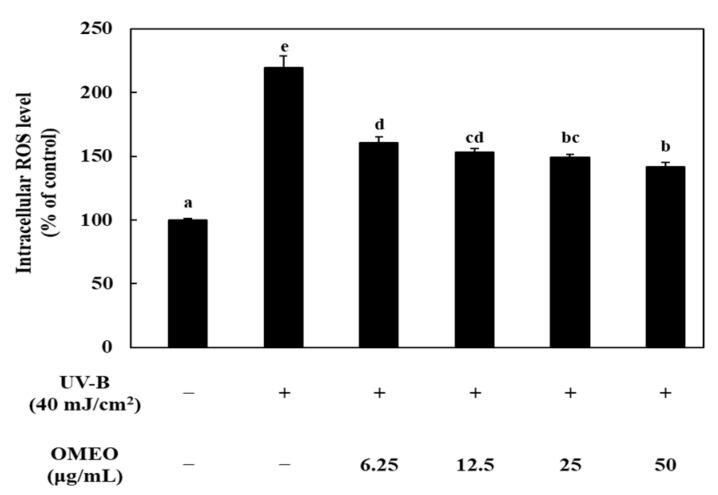
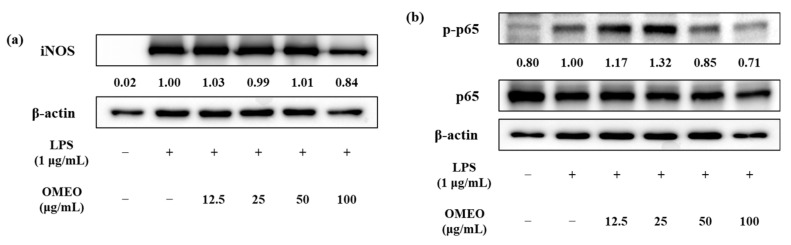
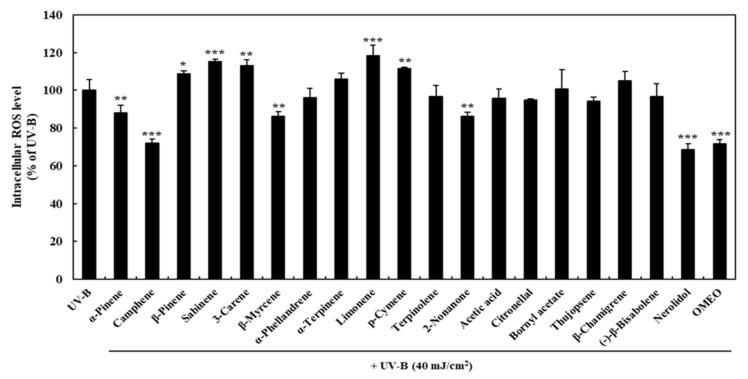
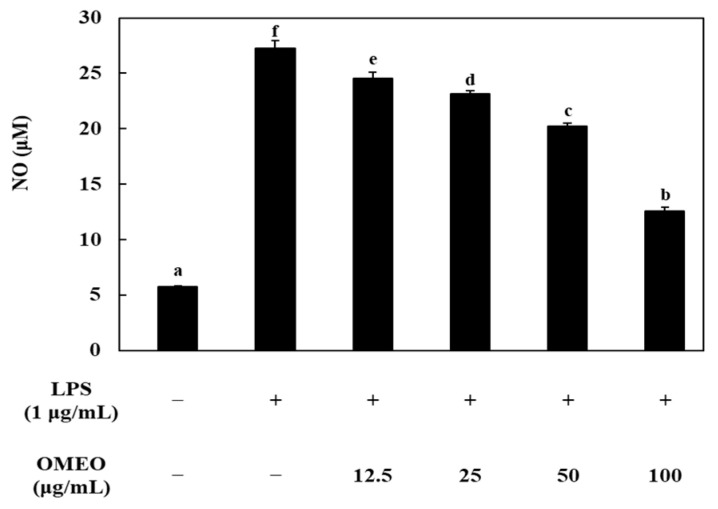
(Turcz.) Baill., which is known as omija in South Korea, is mainly cultivated in East Asia. The present study aimed to investigate the chemical composition of essential oil from the omija (OMEO) fruit obtained by supercritical fluid extraction using CO and to confirm the antioxidant and anti-inflammatory activity of OMEO using HaCaT human keratinocyte and RAW 264.7 murine macrophages. As a result of the chemical composition analysis of OMEO using gas chromatography-mass spectrometry, a total of 41 compounds were identified. The detailed analysis results are sesquiterpenoids (16), monoterpenoids (14), ketones (4), alcohols (3), aldehydes (2), acids (1), and aromatic hydrocarbons (1). OMEO significantly reduced the increased ROS levels in HaCaT keratinocytes induced by UV-B irradiation ( < 0.05). It was confirmed that 5 compounds (α-pinene, camphene, β-myrcene, 2-nonanone, and nerolidol) present in OMEO exhibited inhibitory activity on ROS production. Furthermore, OMEO showed excellent anti-inflammatory activity in RAW 264.7 macrophages induced by lipopolysaccharide. OMEO effectively inhibited NO production ( < 0.05) by suppressing the expression of the iNOS protein. Finally, OMEO was investigated for exhibition of anti-inflammatory activity by inhibiting the activation of NF-κB pathway. Taken together, OMEO could be used as a functional food ingredient with excellent antioxidant and anti-inflammatory activity.
(Turcz.)Baill.,在韩国被称为五味子,主要种植于东亚地区。本研究旨在探究通过超临界流体萃取法使用CO从五味子果实中获得的精油(OMEO)的化学成分,并利用HaCaT人角质形成细胞和RAW 264.7小鼠巨噬细胞来确认OMEO的抗氧化和抗炎活性。通过气相色谱-质谱联用仪对OMEO进行化学成分分析,共鉴定出41种化合物。详细分析结果为倍半萜类化合物(16种)、单萜类化合物(14种)、酮类(4种)、醇类(3种)、醛类(2种)、酸类(1种)和芳香烃类(1种)。OMEO显著降低了UV-B照射诱导的HaCaT角质形成细胞中升高的ROS水平(P<0.05)。已证实OMEO中存在的5种化合物(α-蒎烯、莰烯、β-月桂烯、2-壬酮和橙花叔醇)对ROS产生具有抑制活性。此外,OMEO在脂多糖诱导的RAW 264.7巨噬细胞中表现出优异的抗炎活性。OMEO通过抑制iNOS蛋白的表达有效抑制了NO的产生(P<0.05)。最后,研究了OMEO通过抑制NF-κB途径的激活来发挥抗炎活性。综上所述,OMEO可作为具有优异抗氧化和抗炎活性的功能性食品成分。