Christgen Matthias, Cserni Gábor, Floris Giuseppe, Marchio Caterina, Djerroudi Lounes, Kreipe Hans, Derksen Patrick W B, Vincent-Salomon Anne
Institute of Pathology, Hannover Medical School, Hannover, Carl-Neuberg-Str. 1, 30625 Hannover, Germany.
Department of Pathology, University of Szeged, 6725 Szeged, Hungary.
Cancers (Basel). 2021 Jul 22;13(15):3695. doi: 10.3390/cancers13153695.
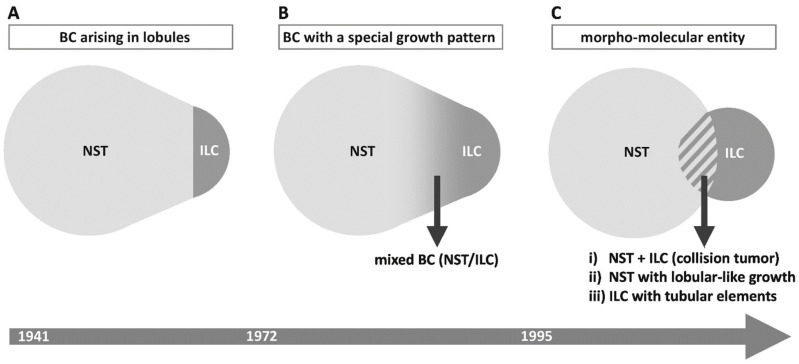
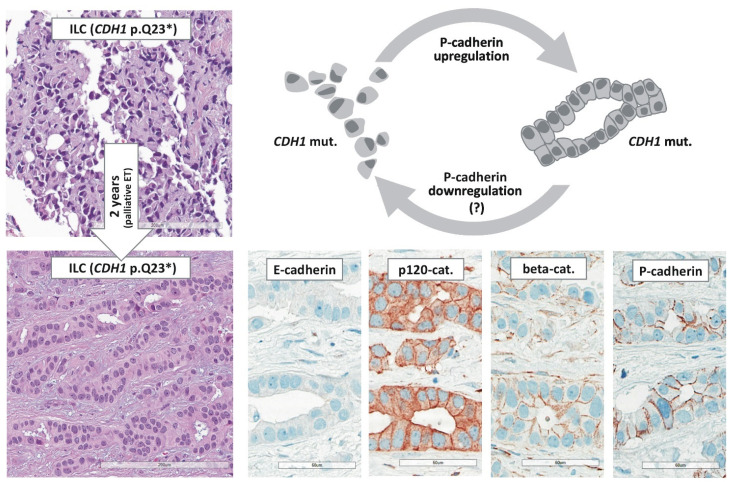
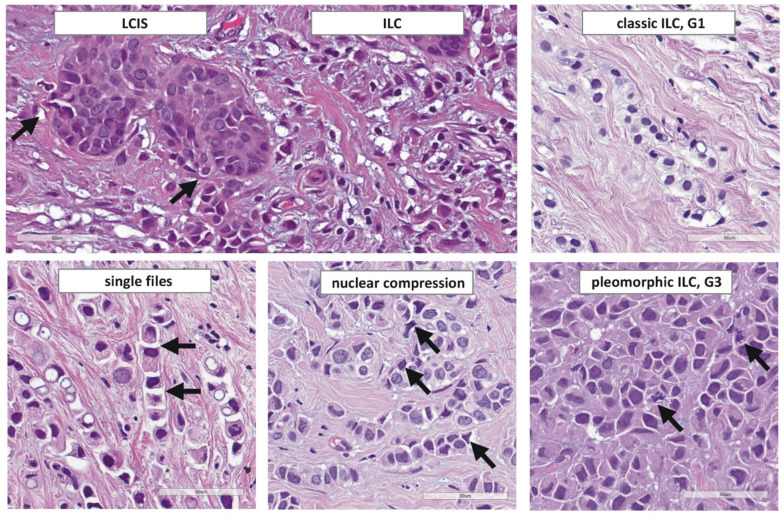
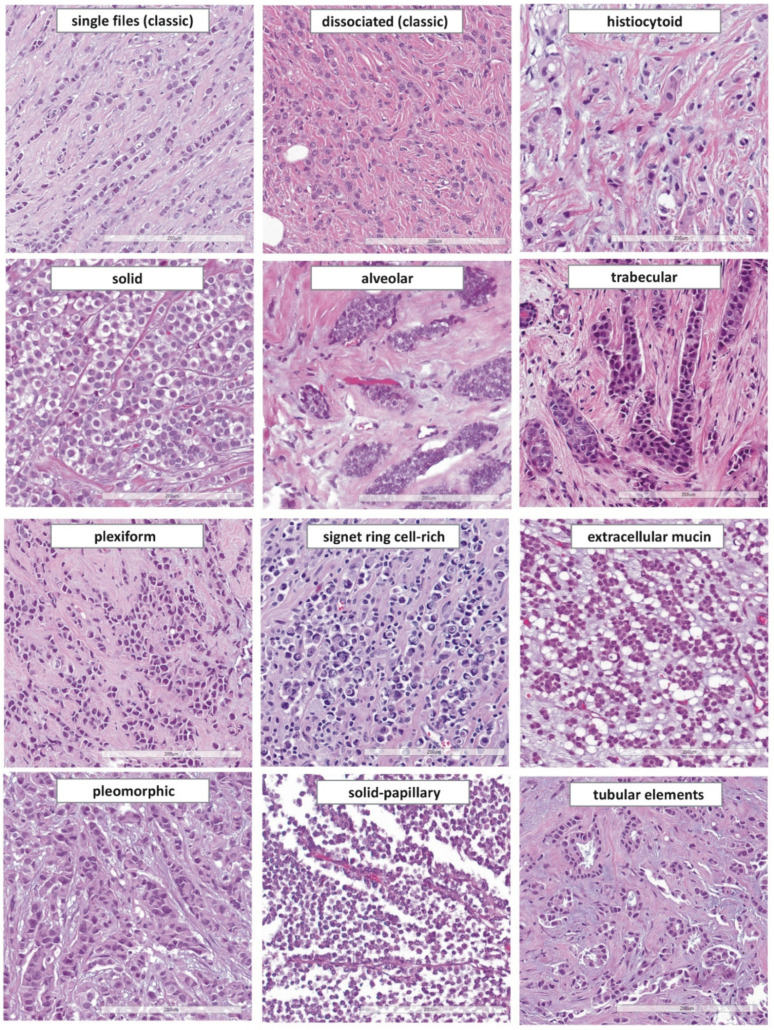
Invasive lobular breast cancer (ILC) is the most common special histological type of breast cancer (BC). This review recapitulates developments in the histomorphologic assessment of ILC from its beginnings with the seminal work of Foote and Stewart, which was published in 1941, until today. We discuss different concepts of ILC and their implications. These concepts include (i) BC arising from mammary lobules, (ii) BC growing in dissociated cells and single files, and (iii) BC defined as a morpho-molecular spectrum of tumors with distinct histological and molecular characteristics related to impaired cell adhesion. This review also provides a comprehensive overview of ILC variants, their histomorphology, and differential diagnosis. Furthermore, this review highlights recent advances which have contributed to a better understanding of the histomorphology of ILC, such as the role of the basal lamina component laminin, the molecular specificities of triple-negative ILC, and E-cadherin to P-cadherin expression switching as the molecular determinant of tubular elements in -deficient ILC. Last but not least, we provide a detailed account of the tumor microenvironment in ILC, including tumor infiltrating lymphocyte (TIL) levels, which are comparatively low in ILC compared to other BCs, but correlate with clinical outcome. The distinct histomorphology of ILC clearly reflects a special tumor biology. In the clinic, special treatment strategies have been established for triple-negative, HER2-positive, and ER-positive BC. Treatment specialization for patients diagnosed with ILC is just in its beginnings. Accordingly, ILC deserves greater attention as a special tumor entity in BC diagnostics, patient care, and cancer research.
浸润性小叶癌(ILC)是乳腺癌(BC)最常见的特殊组织学类型。本综述概括了自1941年Foote和Stewart发表开创性著作以来,ILC组织形态学评估的发展历程,直至今日。我们讨论了ILC的不同概念及其影响。这些概念包括:(i)起源于乳腺小叶的乳腺癌;(ii)以离散细胞和单行排列方式生长的乳腺癌;(iii)被定义为具有与细胞黏附受损相关的独特组织学和分子特征的肿瘤形态分子谱的乳腺癌。本综述还全面概述了ILC的变体、其组织形态学及鉴别诊断。此外,本综述强调了有助于更好理解ILC组织形态学的最新进展,如基底膜成分层粘连蛋白的作用、三阴性ILC的分子特异性,以及E-钙黏蛋白向P-钙黏蛋白表达转换作为E-钙黏蛋白缺陷型ILC中管状成分的分子决定因素。最后但同样重要的是,我们详细阐述了ILC中的肿瘤微环境,包括肿瘤浸润淋巴细胞(TIL)水平,与其他乳腺癌相比,ILC中的TIL水平相对较低,但与临床结果相关。ILC独特的组织形态学清楚地反映了一种特殊的肿瘤生物学特性。在临床上,针对三阴性、HER2阳性和ER阳性乳腺癌已制定了特殊的治疗策略。针对诊断为ILC的患者的治疗专业化尚处于起步阶段。因此,在乳腺癌诊断、患者护理和癌症研究中,ILC作为一种特殊的肿瘤实体值得更多关注。