Saldana Carolina, Majidipur Amene, Beaumont Emma, Huet Eric, de la Taille Alexandre, Vacherot Francis, Firlej Virginie, Destouches Damien
Univ Paris Est Creteil, TRePCa, F-94010 Creteil, France.
AP-HP, Hopital Henri-Mondor, Service Oncologie, F-94010 Creteil, France.
Cancers (Basel). 2021 Jul 28;13(15):3791. doi: 10.3390/cancers13153791.
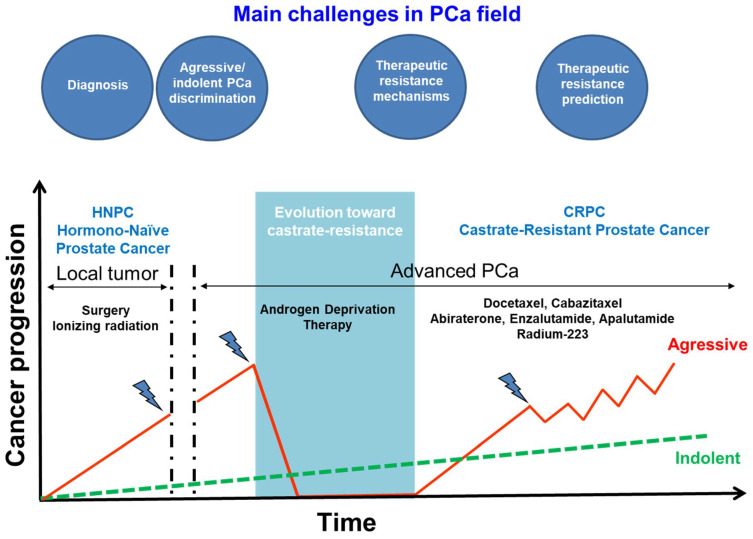
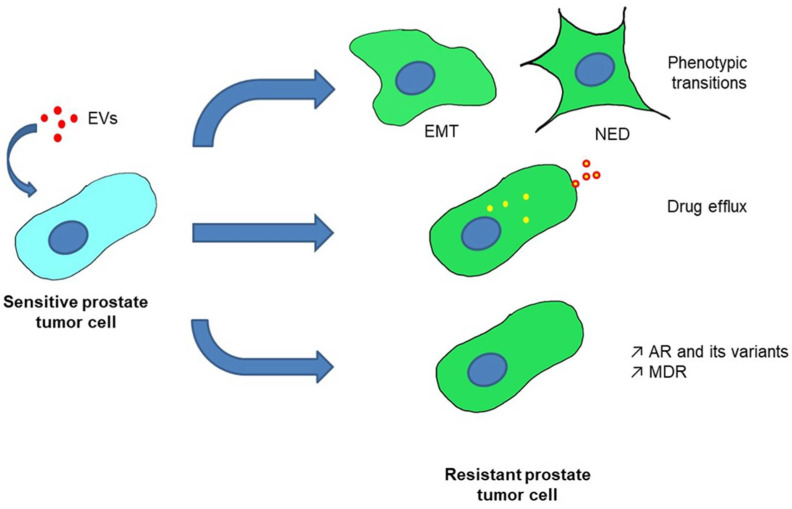
Prostate cancer (PCa) is the second most frequent cancer and the fifth leading cause of cancer death among men worldwide. At first, advanced PCa is treated by androgen deprivation therapy with a good initial response. Nevertheless, recurrences occur, leading to Castrate-Resistance Prostate Cancer (CRPC). During the last decade, new therapies based on inhibition of the androgen receptor pathway or taxane chemotherapies have been used to treat CRPC patients leading to an increase in overall survival, but the occurrence of resistances limits their benefits. Numerous studies have demonstrated the implication of extracellular vesicles (EVs) in different cancer cellular mechanisms. Thus, the possibility to isolate and explore EVs produced by tumor cells in plasma/sera represents an important opportunity for the deciphering of those mechanisms and the discovery of biomarkers. Herein, we summarized the role of EVs in therapeutic resistance of advanced prostate cancer and their use to find biomarkers able to predict these resistances.
前列腺癌(PCa)是全球男性中第二常见的癌症,也是癌症死亡的第五大主要原因。起初,晚期PCa通过雄激素剥夺疗法进行治疗,初始反应良好。然而,复发会发生,导致去势抵抗性前列腺癌(CRPC)。在过去十年中,基于抑制雄激素受体途径的新疗法或紫杉烷化疗已被用于治疗CRPC患者,从而提高了总生存率,但耐药性的出现限制了它们的益处。大量研究表明细胞外囊泡(EVs)参与了不同的癌症细胞机制。因此,在血浆/血清中分离和探索肿瘤细胞产生的EVs的可能性为破译这些机制和发现生物标志物提供了一个重要机会。在此,我们总结了EVs在晚期前列腺癌治疗耐药性中的作用及其用于寻找能够预测这些耐药性的生物标志物的用途。