Erdmann Kati, Distler Florian, Gräfe Sebastian, Kwe Jeremy, Erb Holger H H, Fuessel Susanne, Pahernik Sascha, Thomas Christian, Borkowetz Angelika
Department of Urology, Faculty of Medicine, University Hospital Carl Gustav Carus, Technische Universität Dresden, 01307 Dresden, Germany.
National Center for Tumor Diseases (NCT), German Cancer Research Center (DKFZ), Faculty of Medicine and University Hospital Carl Gustav Carus, Technische Universität Dresden, Helmholtz-Zentrum Dresden-Rossendorf (HZDR), 01307 Dresden, Germany.
Cancers (Basel). 2024 Jul 4;16(13):2453. doi: 10.3390/cancers16132453.
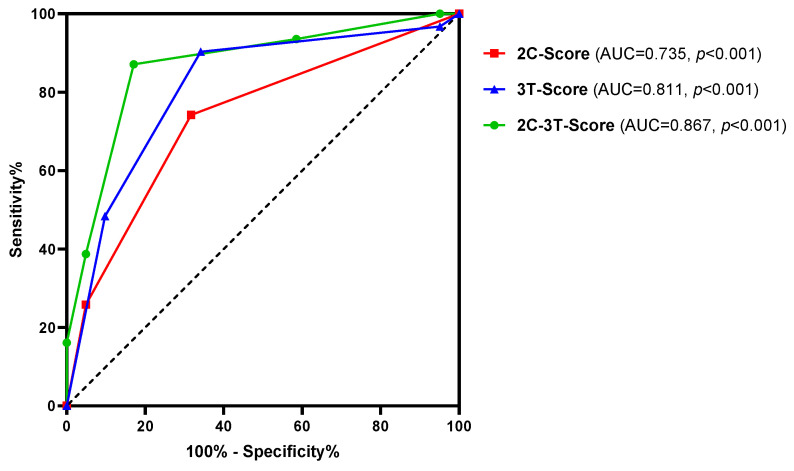
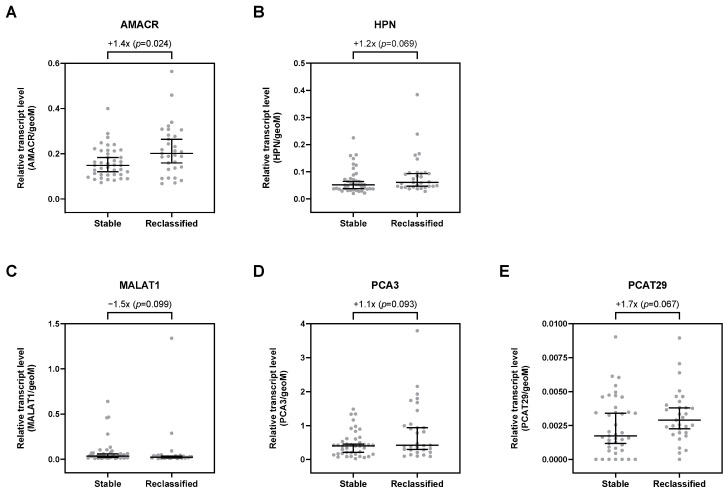
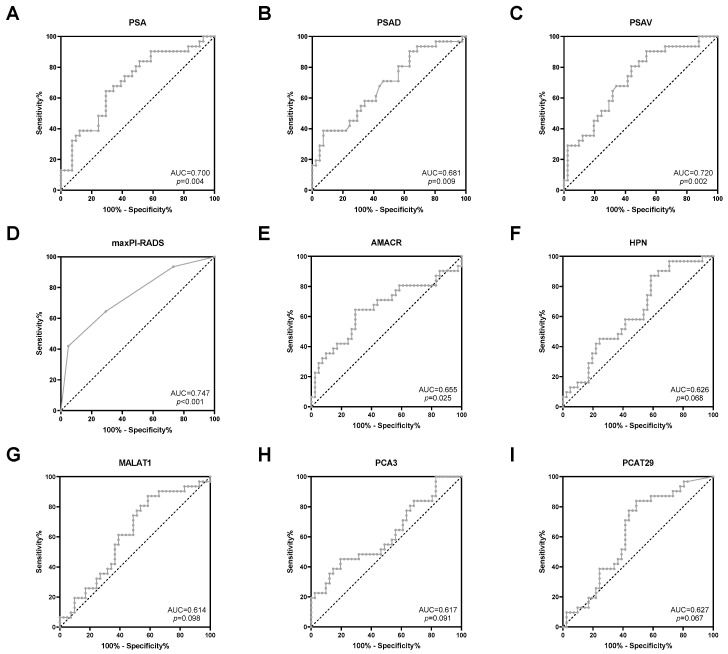
Serum prostate-specific antigen (PSA), its derivatives, and magnetic resonance tomography (MRI) lack sufficient specificity and sensitivity for the prediction of risk reclassification of prostate cancer (PCa) patients on active surveillance (AS). We investigated selected transcripts in urinary extracellular vesicles (uEV) from PCa patients on AS to predict PCa risk reclassification (defined by ISUP 1 with PSA > 10 ng/mL or ISUP 2-5 with any PSA level) in control biopsy. Before the control biopsy, urine samples were prospectively collected from 72 patients, of whom 43% were reclassified during AS. Following RNA isolation from uEV, multiplexed reverse transcription, and pre-amplification, 29 PCa-associated transcripts were quantified by quantitative PCR. The predictive ability of the transcripts to indicate PCa risk reclassification was assessed by receiver operating characteristic (ROC) curve analyses via calculation of the area under the curve (AUC) and was then compared to clinical parameters followed by multivariate regression analysis. ROC curve analyses revealed a predictive potential for AMACR, HPN, MALAT1, PCA3, and PCAT29 (AUC = 0.614-0.655, < 0.1). PSA, PSA density, PSA velocity, and MRI maxPI-RADS showed AUC values of 0.681-0.747 ( < 0.05), with accuracies for indicating a PCa risk reclassification of 64-68%. A model including AMACR, MALAT1, PCAT29, PSA density, and MRI maxPI-RADS resulted in an AUC of 0.867 ( < 0.001) with a sensitivity, specificity, and accuracy of 87%, 83%, and 85%, respectively, thus surpassing the predictive power of the individual markers. These findings highlight the potential of uEV transcripts in combination with clinical parameters as monitoring markers during the AS of PCa.
血清前列腺特异性抗原(PSA)及其衍生物以及磁共振断层扫描(MRI)在预测接受主动监测(AS)的前列腺癌(PCa)患者的风险重新分类方面缺乏足够的特异性和敏感性。我们研究了接受AS的PCa患者尿细胞外囊泡(uEV)中的特定转录本,以预测对照活检中PCa的风险重新分类(根据国际泌尿病理学会[ISUP]定义,PSA>10 ng/mL为1级,或任何PSA水平下为2 - 5级)。在对照活检前,前瞻性收集了72例患者的尿液样本,其中43%在AS期间被重新分类。从uEV中分离RNA、进行多重逆转录和预扩增后,通过定量PCR对29种与PCa相关的转录本进行定量。通过计算曲线下面积(AUC),采用受试者工作特征(ROC)曲线分析评估转录本指示PCa风险重新分类的预测能力,然后与临床参数进行比较,随后进行多变量回归分析。ROC曲线分析显示,甲酰基辅酶A消旋酶(AMACR)、嗜铬粒蛋白(HPN)、转移相关肺腺癌转录本1(MALAT1)、前列腺癌基因3(PCA3)和前列腺癌相关转录本29(PCAT29)具有预测潜力(AUC = 0.614 - 0.655,P<0.1)。PSA、PSA密度、PSA速率和MRI最大前列腺影像报告和数据系统(maxPI-RADS)的AUC值为0.681 - 0.747(P<0.05),指示PCa风险重新分类的准确率为64% - 68%。一个包含AMACR、MALAT1、PCAT29、PSA密度和MRI maxPI-RADS的模型的AUC为0.867(P<0.001),敏感性、特异性和准确率分别为87%、83%和85%,从而超过了单个标志物的预测能力。这些发现突出了uEV转录本与临床参数相结合作为PCa主动监测期间监测标志物的潜力。