Institut du Cerveau-Paris Brain Institute-ICM, INSERM, CNRS, APHP, Sorbonne Université, Pitié-Salpêtrière Hospital, 75013 Paris, France.
Neurogenetics Team, EPHE, Paris Sciences Lettres Research University, 75000 Paris, France.
Cells. 2021 Jul 2;10(7):1678. doi: 10.3390/cells10071678.
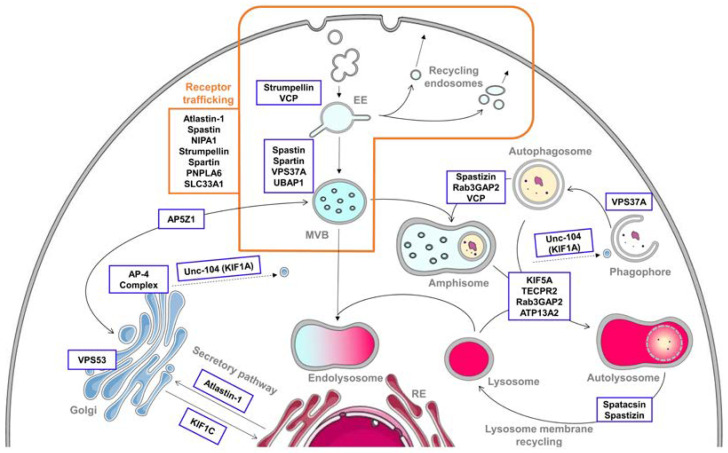
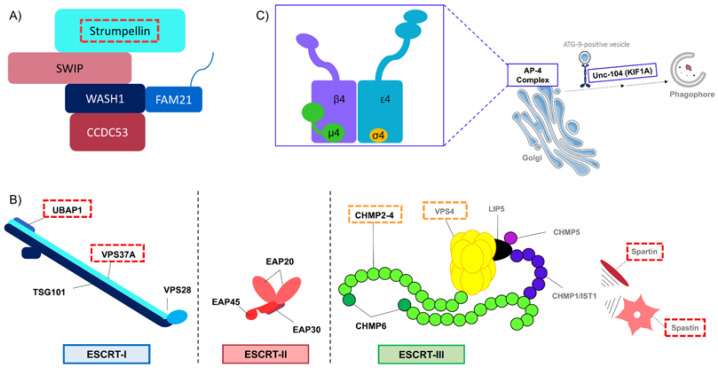
Hereditary spastic paraplegia (HSP) refers to a group of neurological disorders involving the degeneration of motor neurons. Due to their clinical and genetic heterogeneity, finding common effective therapeutics is difficult. Therefore, a better understanding of the common pathological mechanisms is necessary. The role of several HSP genes/proteins is linked to the endolysosomal and autophagic pathways, suggesting a functional convergence. Furthermore, impairment of these pathways is particularly interesting since it has been linked to other neurodegenerative diseases, which would suggest that the nervous system is particularly sensitive to the disruption of the endolysosomal and autophagic systems. In this review, we will summarize the involvement of HSP proteins in the endolysosomal and autophagic pathways in order to clarify their functioning and decipher some of the pathological mechanisms leading to HSP.
遗传性痉挛性截瘫(HSP)是一组涉及运动神经元退化的神经疾病。由于其临床和遗传异质性,很难找到共同有效的治疗方法。因此,更好地了解常见的病理机制是必要的。一些 HSP 基因/蛋白的作用与内溶酶体和自噬途径有关,这表明它们具有功能上的收敛性。此外,这些途径的损伤特别有趣,因为它与其他神经退行性疾病有关,这表明神经系统对内溶酶体和自噬系统的破坏特别敏感。在这篇综述中,我们将总结 HSP 蛋白在内溶酶体和自噬途径中的作用,以阐明它们的功能,并解析导致 HSP 的一些病理机制。