Department of Child and Adolescent Mental Health, University Hospital Erlangen, Friedrich-Alexander University Erlangen-Nürnberg, 91054 Erlangen, Germany.
Department of Psychology, Friedrich-Alexander University Erlangen-Nürnberg, 91052 Erlangen, Germany.
Int J Environ Res Public Health. 2021 Jul 27;18(15):7920. doi: 10.3390/ijerph18157920.
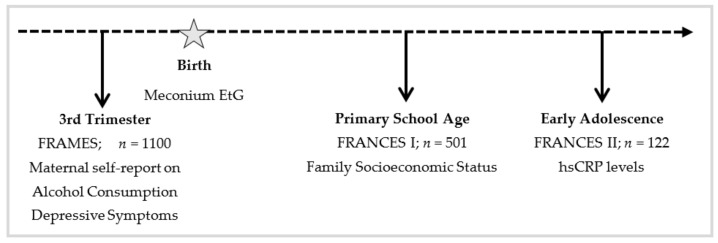
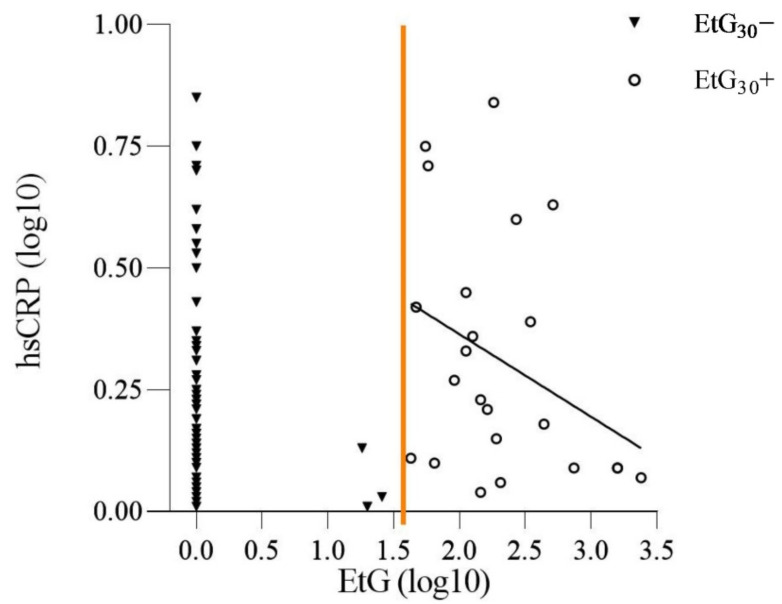
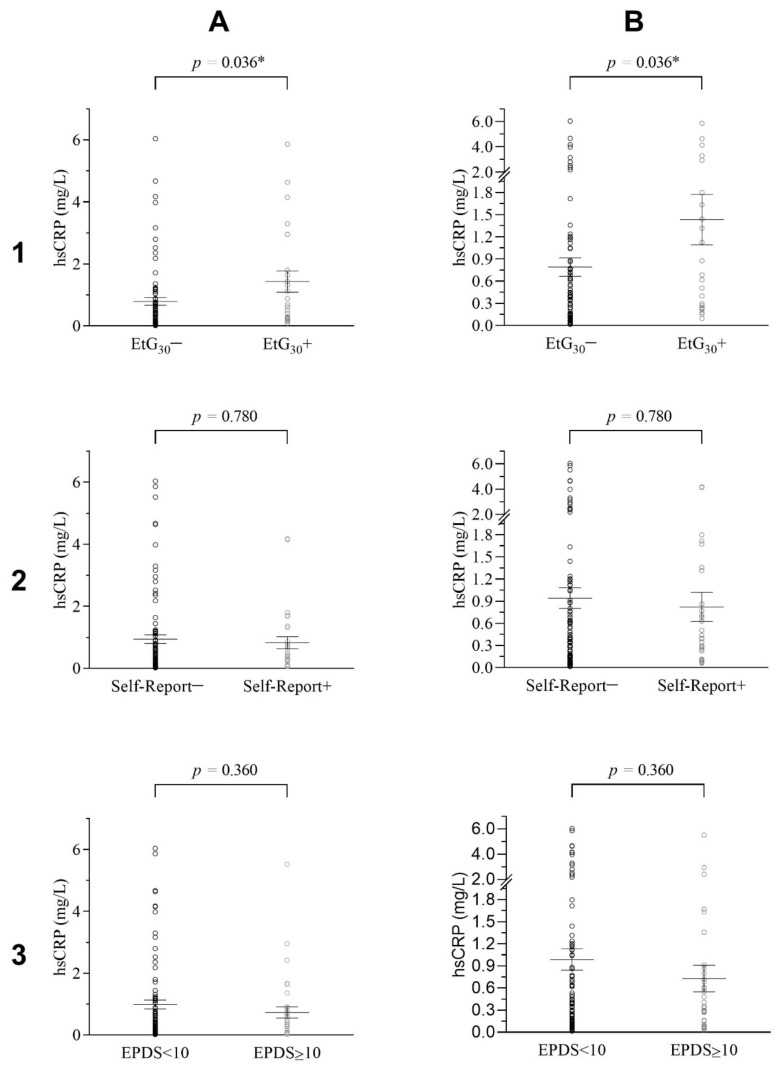
(1) This longitudinal study aimed to investigate the link between prenatal alcohol exposure and prenatal maternal depression with the offspring's low-grade inflammatory status. (2) Prenatal alcohol exposure was determined via maternal self-report during the 3rd trimester of pregnancy (self-report+: = 29) and the meconium alcohol metabolite Ethyl Glucuronide (EtG), collected at birth (≥30 ng/g: = 23). The Edinburgh Postnatal Depression Scale (EPDS) was used to screen for prenatal maternal depressive symptoms during the 3rd trimester (≥10: = 35). Fifteen years later, 122 adolescents ( = 13.32 years; 48.4% female) provided blood samples for the analysis of high sensitivity C-reactive protein (hsCRP; = 0.91; = 1.28). (3) Higher hsCRP levels were found in EtG positive adolescents ( = 0.036, ηp = 0.04) and an inverse non-significant dose-response relation with hsCRP ( = -0.35, = 0.113). For maternal self-reported prenatal alcohol consumption ( = 0.780, ηp = 0.00) and prenatal depressive symptoms ( = 0.360, ηp = 0.01) no differences for hsCRP levels between the affected and unaffected groups were found. (4) Adolescents with prenatal alcohol exposure are at risk for low-grade systemic inflammation. The EtG biomarker may be more accurate compared to self-reports. The findings suggest that prenatal maternal depression does not evoke low-grade systemic inflammation.
(1) 本纵向研究旨在探讨产前酒精暴露与产前母体抑郁与后代低度炎症状态之间的联系。(2) 产前酒精暴露通过母亲在妊娠第 3 期的自我报告确定(自我报告+:n = 29)和在出生时收集的胎粪酒精代谢物乙基葡萄糖醛酸(EtG),≥30ng/g:n = 23)。爱丁堡产后抑郁量表(EPDS)用于在第 3 期筛查产前母体抑郁症状(≥10:n = 35)。15 年后,122 名青少年(n = 13.32 岁;48.4%为女性)提供血液样本,用于分析高敏 C 反应蛋白(hsCRP;n = 0.91;n = 1.28)。(3) 在 EtG 阳性青少年中发现更高的 hsCRP 水平(n = 0.036,ηp = 0.04),与 hsCRP 呈负相关但无统计学意义(n = -0.35,ηp = 0.113)。对于母亲自我报告的产前酒精消费(n = 0.780,ηp = 0.00)和产前抑郁症状(n = 0.360,ηp = 0.01),在受影响和未受影响的组之间,hsCRP 水平没有差异。(4) 有产前酒精暴露的青少年患低度系统性炎症的风险增加。与自我报告相比,EtG 生物标志物可能更准确。研究结果表明,产前母体抑郁不会引起低度系统性炎症。