Dietetics Programme and Centre for Healthy Ageing and Wellness (H-Care), Faculty of Health Sciences, Universiti Kebangsaan Malaysia, Jalan Raja Muda Abdul Aziz, Kuala Lumpur 50300, Malaysia.
Disease Control Division, Ministry of Health Malaysia, Putrajaya 62590, Malaysia.
Int J Environ Res Public Health. 2021 Jul 30;18(15):8099. doi: 10.3390/ijerph18158099.
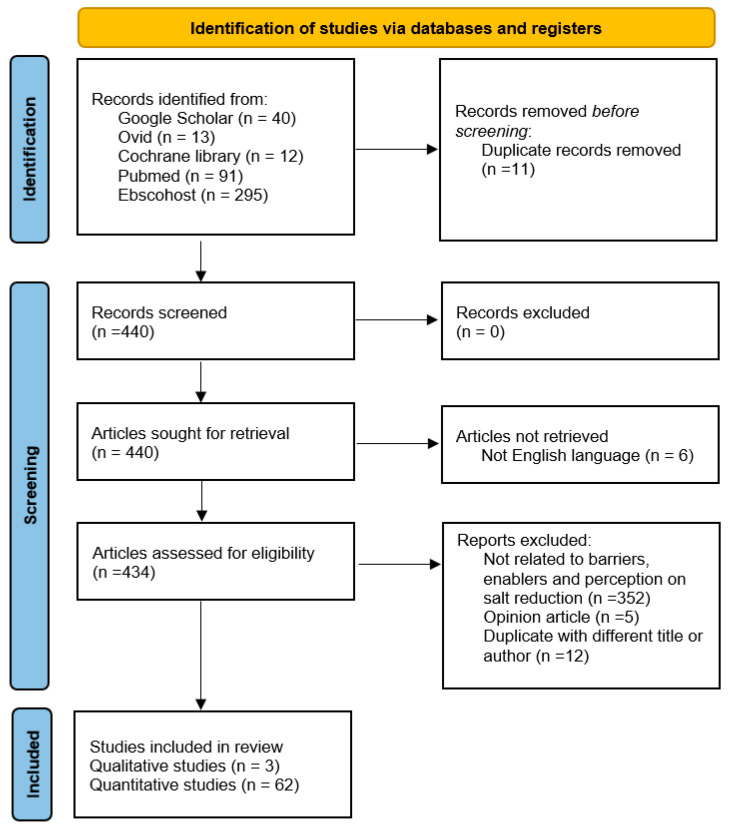
In this review, we have investigated the perceptions, barriers, and enabling factors that were responsible for a dietary salt reduction in the out-of-home sectors. For this purpose, we examined different knowledge databases such as Google Scholar, Ebscohost, MEDLINE (PubMed), Ovid, and Cochrane Library for research articles from September to December 2020. The inclusion criteria for the research articles were that they had to be published in English and had to be a qualitative or quantitative study that was conducted after 2010. These studies also had to report the various enablers, barriers, and perceptions regarding salt reduction in the out-of-home sectors. After implementing the inclusion criteria, we successfully screened a total of 440 studies, out of which 65 articles fulfilled all the criteria. The perceived barriers that hindered salt reduction among the out-of-home sectors included lack of menu and food variabilities, loss of sales due to salt reduction, lack of technical skills for implementing the salt reduction processes for cooking or reformulation, and an absence of environmental and systemic support for reducing the salt concentration. Furthermore, the enablers for salt reduction included the intervention programs, easy accessibility to salt substitutes, salt intake measurement, educational availability, and a gradual reduction in the salt levels. With regards to the behavior or perceptions, the effect of organizational and individual characteristics on their salt intake were reported. The majority of the people were not aware of their salt intake or the effect of salt on their health. These people also believed that low salt food was recognized as tasteless. In conclusion, the enablers, barriers, and perceptions regarding salt reduction in the out-of-home sectors were multifaceted. Therefore, for the implementation of the strategies, policies, and initiatives for addressing the barriers, the policymakers need to encourage a multisectoral collaboration for reducing the salt intake in the population.
在本次综述中,我们研究了导致外食部门减少用盐的看法、障碍和促成因素。为此,我们在 2020 年 9 月至 12 月期间,使用 Google Scholar、Ebscohost、MEDLINE(PubMed)、Ovid 和 Cochrane Library 等不同的知识数据库,对研究文章进行了检索。纳入研究文章的标准为:必须以英文发表,必须是 2010 年后进行的定性或定量研究,并且必须报告外食部门减少用盐的各种促成因素、障碍和看法。在实施纳入标准后,我们共成功筛选出 440 篇研究文章,其中 65 篇文章符合所有标准。外食部门减少用盐的感知障碍包括菜单和食物多样性不足、减盐导致销售额下降、缺乏用于烹饪或配方改良的减盐流程的技术技能,以及缺乏减少盐浓度的环境和系统支持。此外,减少用盐的促成因素包括干预计划、易于获得盐替代品、盐摄入量测量、教育资源的可及性以及逐步降低盐水平。关于行为或看法,有研究报告了组织和个人特征对其盐摄入量的影响。大多数人不知道自己的盐摄入量或盐对健康的影响,他们还认为低盐食品被认为是无味的。总之,外食部门减少用盐的促成因素、障碍和看法是多方面的。因此,为了实施解决障碍的策略、政策和举措,政策制定者需要鼓励多部门合作,以减少人群的盐摄入量。