• 文献检索
  • 文档翻译
  • 深度研究
  • 学术资讯
  • Suppr Zotero 插件Zotero 插件
  • 邀请有礼
  • 套餐&价格
  • 历史记录
应用&插件
Suppr Zotero 插件Zotero 插件浏览器插件Mac 客户端Windows 客户端微信小程序
定价
高级版会员购买积分包购买API积分包
服务
文献检索文档翻译深度研究API 文档MCP 服务
关于我们
关于 Suppr公司介绍联系我们用户协议隐私条款
关注我们

Suppr 超能文献

核心技术专利:CN118964589B侵权必究
粤ICP备2023148730 号-1Suppr @ 2026

文献检索

告别复杂PubMed语法,用中文像聊天一样搜索,搜遍4000万医学文献。AI智能推荐,让科研检索更轻松。

立即免费搜索

文件翻译

保留排版,准确专业,支持PDF/Word/PPT等文件格式,支持 12+语言互译。

免费翻译文档

深度研究

AI帮你快速写综述,25分钟生成高质量综述,智能提取关键信息,辅助科研写作。

立即免费体验

韩国的减盐进展。

Progress on sodium reduction in South Korea.

机构信息

Director, Center for Children's Foodservice Management, Osong, Republic of Korea.

Department of Food & Nutrition, Shingu College, Seongnam, Republic of Korea.

出版信息

BMJ Glob Health. 2020 May;5(5). doi: 10.1136/bmjgh-2019-002028.

DOI:10.1136/bmjgh-2019-002028
PMID:32404470
原文链接:https://pmc.ncbi.nlm.nih.gov/articles/PMC7228482/
Abstract

INTRODUCTION

High dietary sodium is a leading contributor to hypertension, and hypertension is the leading underlying cause of death globally. There is a robust body of evidence supporting the health benefits of sodium reduction. Sodium intake in South Korea is high, with about half the population consuming 4000 mg/day, twice the recommended upper limit.

METHODS

In 2012, South Korea implemented its National Plan to Reduce Sodium Intake, with a goal of reducing population sodium consumption by 20%, to 3900 mg/day, by 2020. The plan included five key components: (1) a consumer awareness campaign designed to change food consumption behaviours; (2) increased availability of low-sodium foods at schools and worksites; (3) increased availability of low-sodium meals in restaurants; (4) voluntary reformulation of processed foods to lower sodium content; and (5) development of low-sodium recipes for food prepared at home. Monitoring and evaluation included tracking sodium intake and sources of dietary sodium using the Korea National Health and Nutrition Examination Survey.

RESULTS

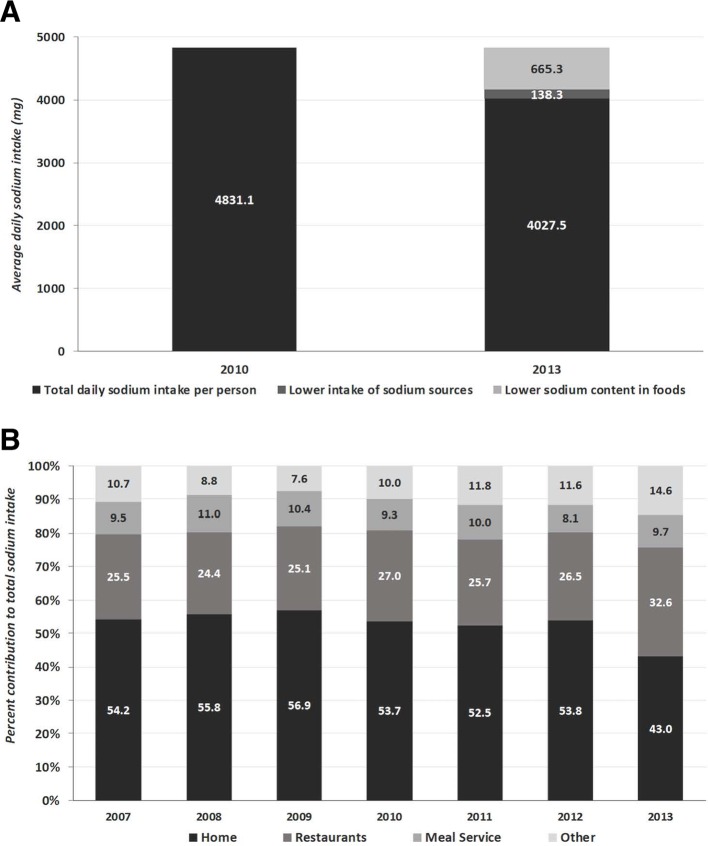
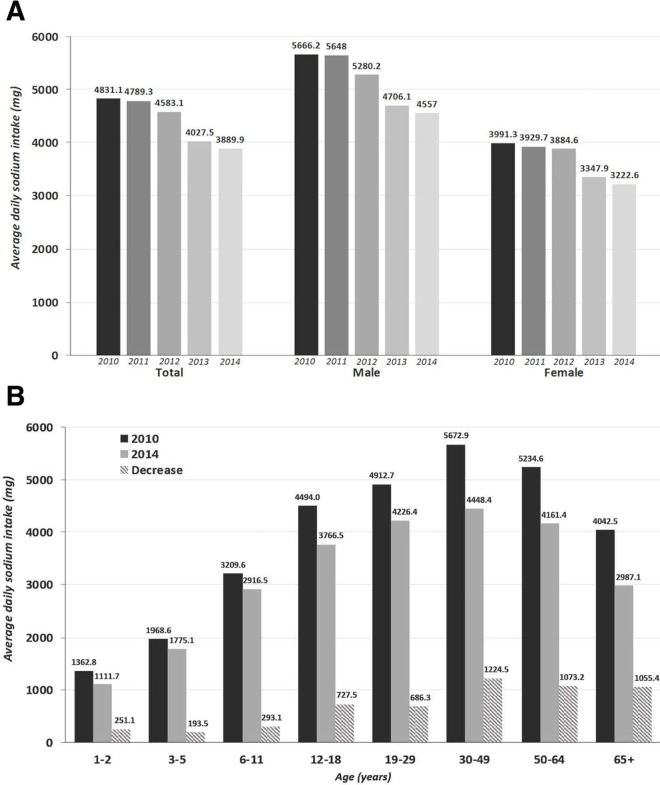
By 2014, South Korea had reduced dietary sodium consumption among adults by 23.7% compared to a survey conducted in 2010 prior to implementation of a nationwide salt reduction campaign that used this comprehensive, multipronged approach. The reductions in sodium intake were accompanied by reductions in population blood pressure and hypertension prevalence. Although causal associations between the sodium reduction programme and reduced sodium intake cannot be made, the declines occurred with the introduction of the programme.

CONCLUSION

Multicomponent interventions have great potential to reduce population sodium intake. Lessons learnt from South Korea could be applied to other countries and are likely very relevant to other Asian countries with similar food sources and consumption profiles.

摘要

简介

高钠饮食是导致高血压的主要因素之一,而高血压是全球主要的死亡原因。有大量证据表明减少钠摄入量对健康有益。韩国的钠摄入量很高,约有一半人口每天摄入 4000 毫克,是建议上限的两倍。

方法

2012 年,韩国实施了国家减钠计划,目标是到 2020 年将人口的钠摄入量减少 20%,降至 3900 毫克/天。该计划包括五个关键组成部分:(1)开展消费者意识运动,改变食品消费行为;(2)在学校和工作场所增加低钠食品的供应;(3)增加餐馆低钠餐的供应;(4)自愿对加工食品进行配方调整,降低钠含量;(5)为在家准备的食物开发低钠食谱。监测和评估包括通过韩国国家健康和营养检查调查跟踪钠摄入量和膳食钠的来源。

结果

到 2014 年,与 2010 年在全国范围内开展减盐运动之前进行的调查相比,韩国成年人的膳食钠摄入量减少了 23.7%。钠摄入量的减少伴随着人群血压和高血压患病率的降低。虽然不能确定减盐计划与减少钠摄入量之间存在因果关系,但这些下降是在该计划推出的情况下发生的。

结论

多组分干预措施具有很大潜力可减少人群的钠摄入量。韩国的经验教训可应用于其他国家,与其他亚洲国家具有相似的食物来源和消费模式,这些经验教训可能非常相关。
https://cdn.ncbi.nlm.nih.gov/pmc/blobs/4074/7228482/a3609fb3fc51/bmjgh-2019-002028f03.jpg
https://cdn.ncbi.nlm.nih.gov/pmc/blobs/4074/7228482/5e5dae8ed94b/bmjgh-2019-002028f01.jpg
https://cdn.ncbi.nlm.nih.gov/pmc/blobs/4074/7228482/28853de9499d/bmjgh-2019-002028f02.jpg
https://cdn.ncbi.nlm.nih.gov/pmc/blobs/4074/7228482/a3609fb3fc51/bmjgh-2019-002028f03.jpg
https://cdn.ncbi.nlm.nih.gov/pmc/blobs/4074/7228482/5e5dae8ed94b/bmjgh-2019-002028f01.jpg
https://cdn.ncbi.nlm.nih.gov/pmc/blobs/4074/7228482/28853de9499d/bmjgh-2019-002028f02.jpg
https://cdn.ncbi.nlm.nih.gov/pmc/blobs/4074/7228482/a3609fb3fc51/bmjgh-2019-002028f03.jpg

相似文献

1
Progress on sodium reduction in South Korea.韩国的减盐进展。
BMJ Glob Health. 2020 May;5(5). doi: 10.1136/bmjgh-2019-002028.
2
Impact of Salt Intake on the Pathogenesis and Treatment of Hypertension.盐摄入对高血压发病机制及治疗的影响
Adv Exp Med Biol. 2017;956:61-84. doi: 10.1007/5584_2016_147.
3
Salt reduction in the United Kingdom: a successful experiment in public health.英国的减盐行动:一次成功的公共卫生实验。
J Hum Hypertens. 2014 Jun;28(6):345-52. doi: 10.1038/jhh.2013.105. Epub 2013 Oct 31.
4
Lifestyle modifications to prevent and control hypertension. 5. Recommendations on dietary salt. Canadian Hypertension Society, Canadian Coalition for High Blood Pressure Prevention and Control, Laboratory Centre for Disease Control at Health Canada, Heart and Stroke Foundation of Canada.预防和控制高血压的生活方式改变。5. 关于膳食盐的建议。加拿大高血压协会、加拿大高血压预防与控制联盟、加拿大卫生部疾病控制实验室中心、加拿大心脏与中风基金会。
CMAJ. 1999 May 4;160(9 Suppl):S29-34.
5
Sodium reduction in communities Shawnee County survey 2011: methods and baseline key findings.2011年肖尼县社区钠摄入量减少情况调查:方法与基线主要发现
J Public Health Manag Pract. 2014 Jan-Feb;20(1 Suppl 1):S9-15. doi: 10.1097/PHH.0b013e31829d48df.
6
CDC grand rounds: dietary sodium reduction - time for choice.疾病预防控制中心例会:减少饮食中的钠——是时候做出选择了。
MMWR Morb Mortal Wkly Rep. 2012 Feb 10;61(5):89-91.
7
Expansion of the National Salt Reduction Initiative: A Mathematical Model of Benefits and Risks of Population-Level Sodium Reduction.国家减盐倡议的扩展:一项关于人群层面钠减少的益处和风险的数学模型
Med Decis Making. 2016 Jan;36(1):72-85. doi: 10.1177/0272989X15583846. Epub 2015 Apr 29.
8
Estimating Canadian sodium intakes and the health impact of meeting national and WHO recommended sodium intake levels: A macrosimulation modelling study.估算加拿大的钠摄入量以及达到国家和世界卫生组织推荐的钠摄入量水平对健康的影响:一项宏观模拟建模研究。
PLoS One. 2023 May 10;18(5):e0284733. doi: 10.1371/journal.pone.0284733. eCollection 2023.
9
Process evaluation of Samoa's national salt reduction strategy (MASIMA): what interventions can be successfully replicated in lower-income countries?萨摩亚国家减盐战略(MASIMA)的过程评估:哪些干预措施可以在低收入国家成功复制?
Implement Sci. 2018 Aug 6;13(1):107. doi: 10.1186/s13012-018-0802-1.
10
Review of behaviour change interventions to reduce population salt intake.减少人群盐摄入量的行为改变干预措施综述。
Int J Behav Nutr Phys Act. 2017 Feb 8;14(1):17. doi: 10.1186/s12966-017-0467-1.

引用本文的文献

1
Trends in Urinary Sodium-to-Potassium Ratios in Koreans: Analysis of KNHANES 2016-2023 Data.韩国人尿钠钾比值趋势:基于2016 - 2023年韩国国家健康与营养检查调查(KNHANES)数据的分析
Nutrients. 2025 Jul 24;17(15):2411. doi: 10.3390/nu17152411.
2
The Burden and Risk Factors of Gastric Cancer in Eastern Asia From 1990 to 2021: Longitudinal Observational Study of the Global Burden of Disease Study 2021.1990年至2021年东亚地区胃癌的负担及危险因素:全球疾病负担研究2021的纵向观察性研究
JMIR Cancer. 2025 Aug 8;11:e75728. doi: 10.2196/75728.
3
The potential health impact and healthcare cost savings of different sodium reduction strategies in Canada.

本文引用的文献

1
Comparison of 24-hour urine and 24-hour diet recall for estimating dietary sodium intake in populations: A systematic review and meta-analysis.比较 24 小时尿液和 24 小时饮食回忆在估计人群膳食钠摄入量中的应用:系统评价和荟萃分析。
J Clin Hypertens (Greenwich). 2019 Dec;21(12):1753-1762. doi: 10.1111/jch.13729. Epub 2019 Nov 25.
2
The International Consortium for Quality Research on Dietary Sodium/Salt (TRUE) position statement on the use of 24-hour, spot, and short duration (<24 hours) timed urine collections to assess dietary sodium intake.国际膳食钠/盐质量研究联合会(TRUE)关于使用 24 小时、单次和短时间(<24 小时)定时尿液收集来评估膳食钠摄入量的立场声明。
J Clin Hypertens (Greenwich). 2019 Jun;21(6):700-709. doi: 10.1111/jch.13551. Epub 2019 May 14.
3
加拿大不同钠减排策略对健康的潜在影响及医疗成本节约情况。
BMC Public Health. 2025 Jul 3;25(1):2379. doi: 10.1186/s12889-025-22941-8.
4
Dietary modulation for the hypertension risk group in Koreans: a cross-sectional study.韩国高血压风险人群的饮食调节:一项横断面研究。
Nutr Metab (Lond). 2025 Apr 10;22(1):30. doi: 10.1186/s12986-025-00921-4.
5
The Impact of Non-Fiscal Mandatory and Voluntary Policies and Interventions on the Reformulation of Food and Beverage Products: A Systematic Review.非财政强制性和自愿性政策及干预措施对食品和饮料产品配方改革的影响:系统评价。
Nutrients. 2024 Oct 14;16(20):3484. doi: 10.3390/nu16203484.
6
Temporal trends in adherence to lifestyle recommendations of patients with hypertension in Korea, 2007-2021.2007 - 2021年韩国高血压患者对生活方式建议的依从性的时间趋势
Hypertens Res. 2025 Jan;48(1):157-167. doi: 10.1038/s41440-024-01838-w. Epub 2024 Aug 16.
7
Dietary and other lifestyle factors and their influence on non-communicable diseases in the Western Pacific region.饮食及其他生活方式因素及其对西太平洋地区非传染性疾病的影响。
Lancet Reg Health West Pac. 2023 Dec 1;43:100842. doi: 10.1016/j.lanwpc.2023.100842. eCollection 2024 Feb.
8
Association between dietary nutrient intake and prevalence of myopia in Korean adolescents: evidence from the 7th Korea National Health and Nutrition Examination Survey.韩国青少年饮食营养摄入与近视患病率之间的关联:来自第七次韩国国民健康与营养检查调查的证据。
Front Pediatr. 2024 Jan 11;11:1285465. doi: 10.3389/fped.2023.1285465. eCollection 2023.
9
Sodium intake trend and current intake level by meal provision place among the citizens of Seoul.首尔市民按膳食供应地点划分的钠摄入量趋势及当前摄入量水平
Nutr Res Pract. 2023 Jun;17(3):516-528. doi: 10.4162/nrp.2023.17.3.516. Epub 2023 Jan 5.
10
Comparison of participant and non-participant perceptions on healthy restaurant for sodium reduction: a qualitative study.参与者与非参与者对减钠健康餐厅认知的比较:一项定性研究
Nutr Res Pract. 2023 Jun;17(3):503-515. doi: 10.4162/nrp.2023.17.3.503. Epub 2023 Feb 20.
Health effects of dietary risks in 195 countries, 1990-2017: a systematic analysis for the Global Burden of Disease Study 2017.195 个国家 1990 年至 2017 年饮食风险对健康的影响:2017 年全球疾病负担研究的系统分析。
Lancet. 2019 May 11;393(10184):1958-1972. doi: 10.1016/S0140-6736(19)30041-8. Epub 2019 Apr 4.
4
Global, regional, and national comparative risk assessment of 84 behavioural, environmental and occupational, and metabolic risks or clusters of risks for 195 countries and territories, 1990-2017: a systematic analysis for the Global Burden of Disease Study 2017.全球、区域和国家 84 种行为、环境、职业和代谢风险以及 195 个国家和地区 1990 至 2017 年风险簇的比较风险评估:全球疾病负担研究 2017 系统分析。
Lancet. 2018 Nov 10;392(10159):1923-1994. doi: 10.1016/S0140-6736(18)32225-6. Epub 2018 Nov 8.
5
Twenty-Four-Hour Diet recall and Diet records compared with 24-hour urinary excretion to predict an individual's sodium consumption: A Systematic Review.24 小时膳食回顾法和膳食记录与 24 小时尿排泄量相比,预测个体的钠摄入量:系统评价。
J Clin Hypertens (Greenwich). 2018 Oct;20(10):1360-1376. doi: 10.1111/jch.13391. Epub 2018 Oct 9.
6
Percentage of ingested sodium excreted in 24-hour urine collections: A systematic review and meta-analysis.24小时尿液收集样本中排出的摄入钠百分比:一项系统评价与荟萃分析。
J Clin Hypertens (Greenwich). 2018 Sep;20(9):1220-1229. doi: 10.1111/jch.13353. Epub 2018 Aug 12.
7
Estimation model for habitual 24-hour urinary-sodium excretion using simple questionnaires from normotensive Koreans.使用来自血压正常的韩国人的简单问卷对习惯性24小时尿钠排泄量进行估计的模型。
PLoS One. 2018 Feb 15;13(2):e0192588. doi: 10.1371/journal.pone.0192588. eCollection 2018.
8
Association between 24-h urinary sodium excretion and obesity in Korean adults: A multicenter study.韩国成年人24小时尿钠排泄与肥胖之间的关联:一项多中心研究。
Nutrition. 2017 Sep;41:113-119. doi: 10.1016/j.nut.2017.04.006. Epub 2017 Apr 26.
9
Population-level interventions in government jurisdictions for dietary sodium reduction: a Cochrane Review.人群层面的政府管辖区饮食钠减少干预措施:一项 Cochrane 综述。
Int J Epidemiol. 2017 Oct 1;46(5):1551-1405. doi: 10.1093/ije/dyw361.
10
Sodium Reduction--Saving Lives by Putting Choice Into Consumers' Hands.减少钠摄入——将选择权交给消费者以拯救生命。
JAMA. 2016 Aug 9;316(6):579-80. doi: 10.1001/jama.2016.7992.