Jamilloux Yvan, Romain-Scelle Nicolas, Rabilloud Muriel, Morel Coralie, Kodjikian Laurent, Maucort-Boulch Delphine, Bielefeld Philip, Sève Pascal
Department of Internal Medicine, Hôpital de la Croix-Rousse, Hospices Civils de Lyon, Université Claude Bernard-Lyon 1, F-69004 Lyon, France.
Service de Biostatistique et Bioinformatique, Pôle Santé Publique, Hospices Civils de Lyon, Université de Lyon, F-69000 Lyon, France.
J Clin Med. 2021 Jul 30;10(15):3398. doi: 10.3390/jcm10153398.
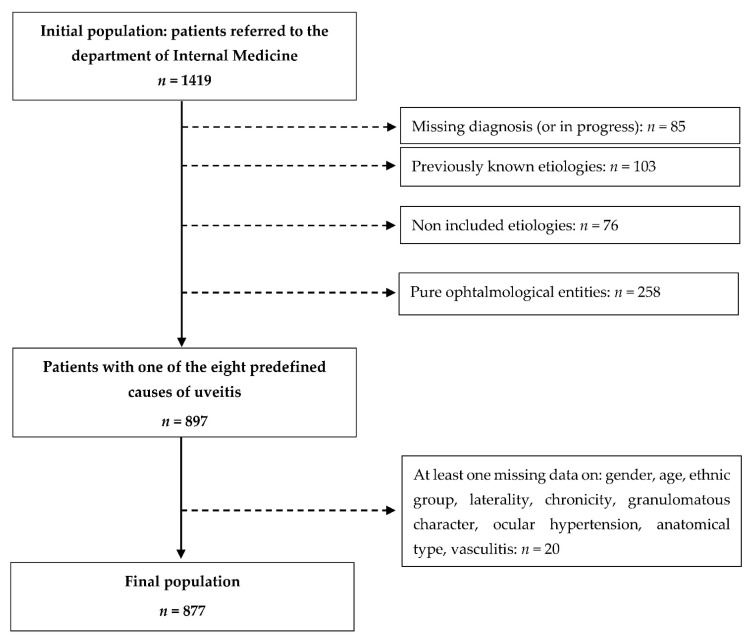
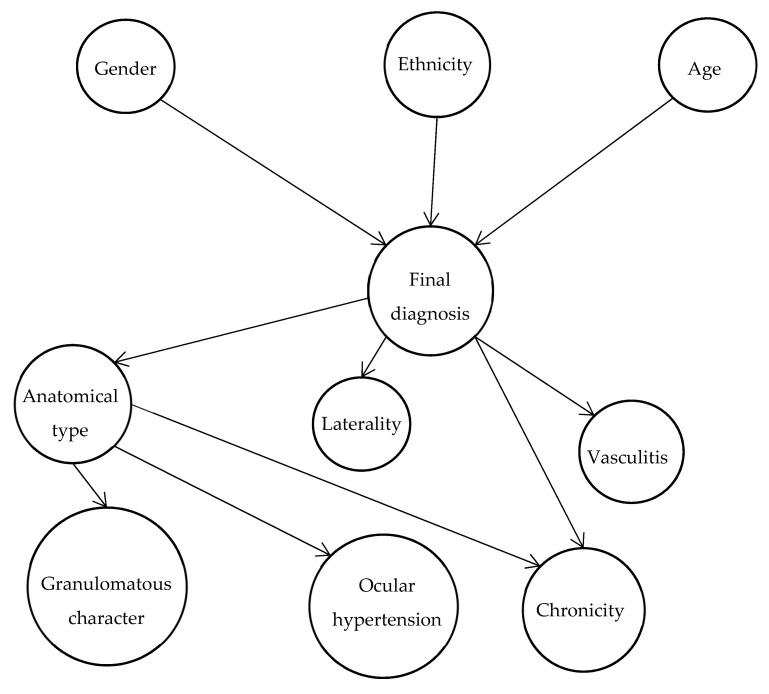
The etiological diagnosis of uveitis is complex. We aimed to implement and validate a Bayesian belief network algorithm for the differential diagnosis of the most relevant causes of uveitis. The training dataset ( = 897) and the test dataset ( = 154) were composed of all incident cases of uveitis admitted to two internal medicine departments, in two independent French centers (Lyon, 2003-2016 and Dijon, 2015-2017). The etiologies of uveitis were classified into eight groups. The algorithm was based on simple epidemiological characteristics (age, gender, and ethnicity) and anatomoclinical features of uveitis. The cross-validated estimate obtained in the training dataset concluded that the etiology of uveitis determined by the experts corresponded to one of the two most probable diagnoses in at least 77% of the cases. In the test dataset, this probability reached at least 83%. For the training and test datasets, when the most likely diagnosis was considered, the highest sensitivity was obtained for spondyloarthritis and HLA-B27-related uveitis (76% and 63%, respectively). The respective specificities were 93% and 54%. This algorithm could help junior and general ophthalmologists in the differential diagnosis of uveitis. It could guide the diagnostic work-up and help in the selection of further diagnostic investigations.
葡萄膜炎的病因诊断复杂。我们旨在实施并验证一种贝叶斯信念网络算法,用于对葡萄膜炎最相关病因进行鉴别诊断。训练数据集(n = 897)和测试数据集(n = 154)由法国两个独立中心(里昂,2003 - 2016年;第戎,2015 - 2017年)两个内科收治的所有葡萄膜炎新发病例组成。葡萄膜炎的病因分为八组。该算法基于简单的流行病学特征(年龄、性别和种族)以及葡萄膜炎的解剖临床特征。在训练数据集中获得的交叉验证估计结果显示,专家确定的葡萄膜炎病因在至少77%的病例中与两个最可能的诊断之一相符。在测试数据集中,这一概率至少达到83%。对于训练和测试数据集,当考虑最可能的诊断时,脊柱关节炎和HLA - B27相关葡萄膜炎的敏感性最高(分别为76%和63%)。各自的特异性分别为93%和54%。该算法可帮助初级眼科医生和普通眼科医生进行葡萄膜炎的鉴别诊断。它可指导诊断检查工作,并有助于选择进一步的诊断性检查。