Microsoft Research, One Microsoft Way, Redmond, WA, USA.
Department of Computer Science, University College London, London, UK.
Nat Commun. 2021 Aug 6;12(1):4758. doi: 10.1038/s41467-021-24974-0.
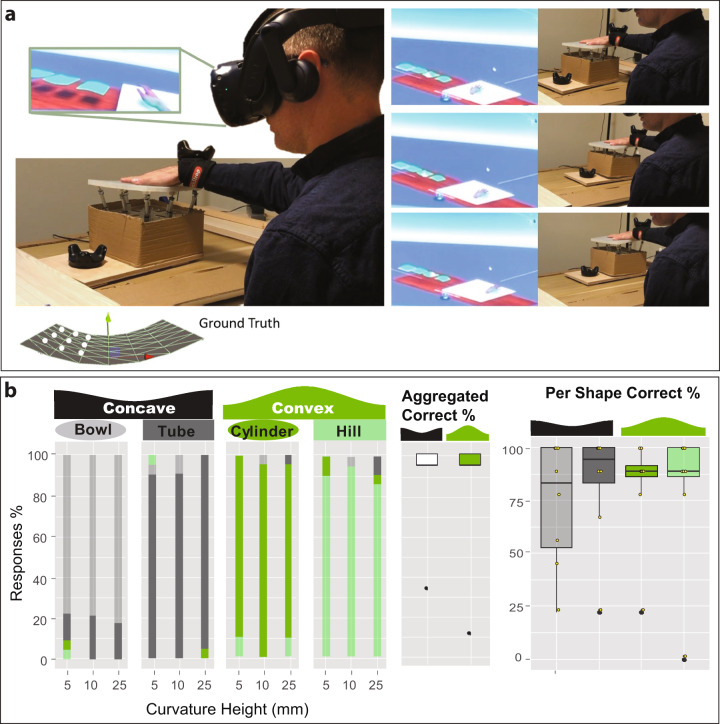
Shape displays enable people to touch simulated surfaces. A common architecture of such devices uses a mechatronic pin-matrix. Besides their complexity and high cost, these matrix displays suffer from sharp edges due to the discreet representation which reduces their ability to render a large continuous surface when sliding the hand. We propose using an engineered auxetic material actuated by a smaller number of motors. The material bends in multiple directions, feeling smooth and rigid to touch. A prototype implementation uses nine actuators on a 220 mm square section of material. It can display a range of surface curvatures under the palm of a user without aliased edges. In this work we use an auxetic skeleton to provide rigidity on a soft material and demonstrate the potential of this class of surface through user experiments.
形状显示器使人们能够触摸模拟表面。这种设备的一种常见架构使用机电式销矩阵。除了它们的复杂性和高成本之外,由于离散表示,这些矩阵显示器在滑动手时会产生锐利的边缘,从而降低了它们呈现大连续表面的能力。我们建议使用数量较少的电机驱动的工程弹性材料。该材料可以向多个方向弯曲,触摸起来感觉光滑而坚硬。原型实现使用 9 个致动器在 220mm 见方的材料上。它可以在用户手掌下显示一系列表面曲率,而不会出现边缘混淆。在这项工作中,我们使用弹性骨架在柔软的材料上提供刚性,并通过用户实验展示了这类表面的潜力。