Department of Molecular Biology, Princeton University, Princeton, NJ 08544, USA.
Department of Molecular Biology, Princeton University, Princeton, NJ 08544, USA; LSI Genomics, Princeton University, Princeton, NJ 08544, USA.
Cell. 2021 Sep 2;184(18):4697-4712.e18. doi: 10.1016/j.cell.2021.07.022. Epub 2021 Aug 6.
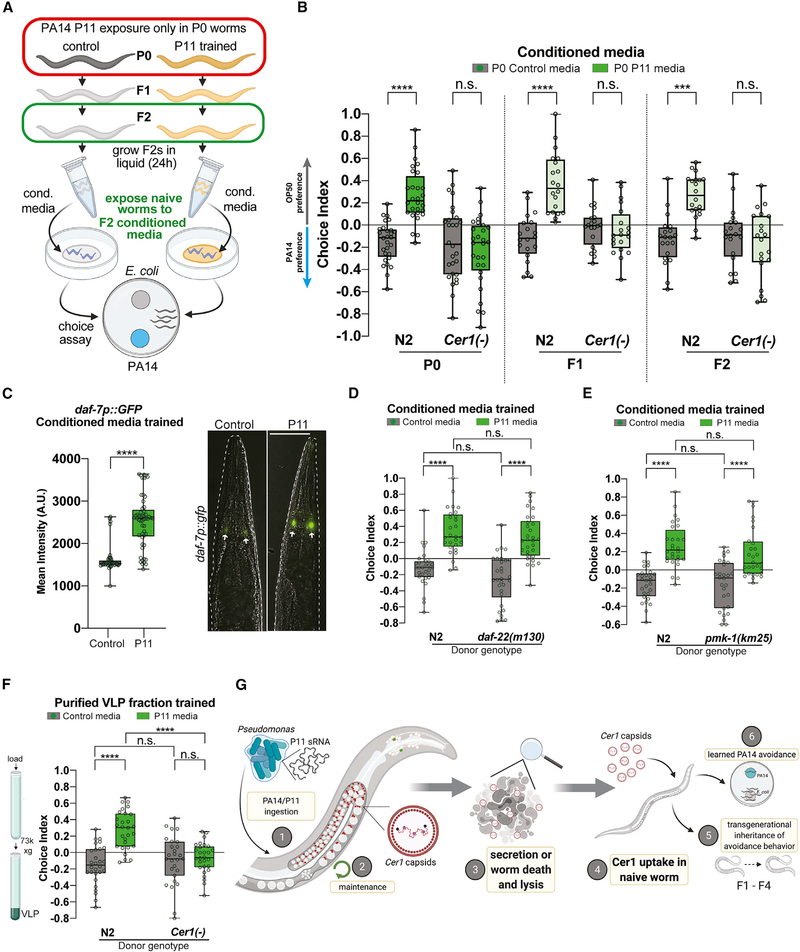
Animals face both external and internal dangers: pathogens threaten from the environment, and unstable genomic elements threaten from within. C. elegans protects itself from pathogens by "reading" bacterial small RNAs, using this information to both induce avoidance and transmit memories for four generations. Here, we found that memories can be transferred from either lysed animals or from conditioned media to naive animals via Cer1 retrotransposon-encoded virus-like particles. Moreover, Cer1 functions internally at the step of transmission of information from the germline to neurons and is required for learned avoidance. The presence of the Cer1 retrotransposon in wild C. elegans strains correlates with the ability to learn and inherit small-RNA-induced pathogen avoidance. Together, these results suggest that C. elegans has co-opted a potentially dangerous retrotransposon to instead protect itself and its progeny from a common pathogen through its inter-tissue signaling ability, hijacking this genomic element for its own adaptive immunity benefit.
病原体从环境中威胁,不稳定的基因组元件从内部威胁。C. elegans 通过“读取”细菌小 RNA 来保护自己免受病原体的侵害,利用这些信息来诱导回避并将记忆传递四代。在这里,我们发现,通过 Cer1 逆转座子编码的病毒样颗粒,可以从裂解的动物或条件培养基中传递记忆到幼稚的动物。此外,Cer1 在从生殖系到神经元传递信息的步骤中起内部作用,并且对于学习回避是必需的。Cer1 逆转座子在野生 C. elegans 品系中的存在与学习和遗传小 RNA 诱导的病原体回避的能力相关。总之,这些结果表明,C. elegans 已经利用一种潜在危险的逆转座子来保护自己和后代免受常见病原体的侵害,通过其组织间信号传递能力,劫持这个基因组元件来获得自身适应性免疫的好处。