Tønning Morten Lindbjerg, Faurholt-Jepsen Maria, Frost Mads, Bardram Jakob Eyvind, Kessing Lars Vedel
Copenhagen Affective Disorder Research Center (CADIC), Psychiatric Center Copenhagen, Copenhagen, Denmark.
Department of Clinical Medicine, Faculty of Health and Medical Sciences, University of Copenhagen, Copenhagen, Denmark.
Front Psychiatry. 2021 Jul 9;12:701360. doi: 10.3389/fpsyt.2021.701360. eCollection 2021.
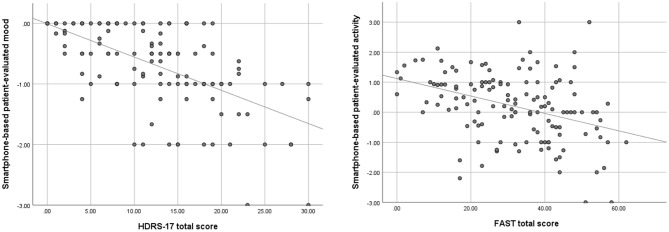
Smartphones comprise a promising tool for symptom monitoring in patients with unipolar depressive disorder (UD) collected as either patient-reportings or possibly as automatically generated smartphone data. However, only limited research has been conducted in clinical populations. We investigated the association between smartphone-collected monitoring data and validated psychiatric ratings and questionnaires in a well-characterized clinical sample of patients diagnosed with UD. Smartphone data, clinical ratings, and questionnaires from patients with UD were collected 6 months following discharge from psychiatric hospitalization as part of a randomized controlled study. Smartphone data were collected daily, and clinical ratings (i.e., ) were conducted three times during the study. We investigated associations between (1) smartphone-based patient-reported mood and activity and clinical ratings and questionnaires; (2) automatically generated smartphone data resembling physical activity, social activity, and phone usage and clinical ratings; and (3) automatically generated smartphone data and same-day smartphone-based patient-reported mood and activity. A total of 74 patients provided 11,368 days of smartphone data, 196 ratings, and 147 questionnaires. We found that: (1) patient-reported mood and activity were associated with clinical ratings and questionnaires ( < 0.001), so that higher symptom scores were associated with lower patient-reported mood and activity, (2) Out of 30 investigated associations on automatically generated data and clinical ratings of depression, only four showed statistical significance. Further, lower psychosocial functioning was associated with fewer daily steps ( = 0.036) and increased number of incoming ( = 0.032), outgoing ( = 0.015) and missed calls ( = 0.007), and longer phone calls ( = 0.012); (3) Out of 20 investigated associations between automatically generated data and daily patient-reported mood and activity, 12 showed statistical significance. For example, lower patient-reported activity was associated with fewer daily steps, shorter distance traveled, increased incoming and missed calls, and increased screen-time. Smartphone-based self-monitoring is feasible and associated with clinical ratings in UD. Some automatically generated data on behavior may reflect clinical features and psychosocial functioning, but these should be more clearly identified in future studies, potentially combining patient-reported and smartphone-generated data.
智能手机是监测单相抑郁症(UD)患者症状的一种很有前景的工具,可通过患者报告或可能通过自动生成的智能手机数据来收集相关信息。然而,针对临床人群的研究还很有限。我们在一个特征明确的被诊断为UD的临床样本中,研究了智能手机收集的监测数据与经过验证的精神科评分及问卷之间的关联。作为一项随机对照研究的一部分,在精神科住院出院6个月后收集了UD患者的智能手机数据、临床评分和问卷。智能手机数据每天收集一次,临床评分(即……)在研究期间进行了三次。我们研究了以下几方面的关联:(1)基于智能手机的患者报告的情绪和活动与临床评分及问卷之间的关联;(2)自动生成的类似身体活动、社交活动和电话使用情况的智能手机数据与临床评分之间的关联;(3)自动生成的智能手机数据与同一天基于智能手机的患者报告的情绪和活动之间的关联。共有74名患者提供了11368天的智能手机数据、196次评分和147份问卷。我们发现:(1)患者报告的情绪和活动与临床评分及问卷相关(<0.001),因此症状评分越高,患者报告的情绪和活动越低;(2)在对自动生成的数据与抑郁症临床评分进行的30项调查关联中,只有4项具有统计学意义。此外,社会心理功能较低与每日步数较少(=0.036)、来电(=0.032)、去电(=0.015)和未接来电数量增加(=0.007)以及通话时间延长(=0.012)相关;(3)在对自动生成的数据与患者每日报告的情绪和活动之间进行的20项调查关联中,有12项具有统计学意义。例如,患者报告的活动较低与每日步数较少、行进距离较短、来电和未接来电增加以及屏幕使用时间增加相关。基于智能手机进行自我监测在UD中是可行的,并且与临床评分相关。一些自动生成的行为数据可能反映临床特征和社会心理功能,但这些在未来的研究中应更明确地加以识别,可能需要将患者报告的数据和智能手机生成的数据结合起来。