Zeballos-Gross Danae, Rojas-Sereno Zulma, Salgado-Caxito Marília, Poeta Patricia, Torres Carmen, Benavides Julio A
Departamento de Ecología y Biodiversidad, Facultad de Ciencias de la Vida, Universidad Andrés Bello, Santiago, Chile.
Facultad de Ciencias de la Vida, Centro de Investigación para la Sustentabilidad, Universidad Andrés Bello, Santiago, Chile.
Front Microbiol. 2021 Jul 23;12:703886. doi: 10.3389/fmicb.2021.703886. eCollection 2021.
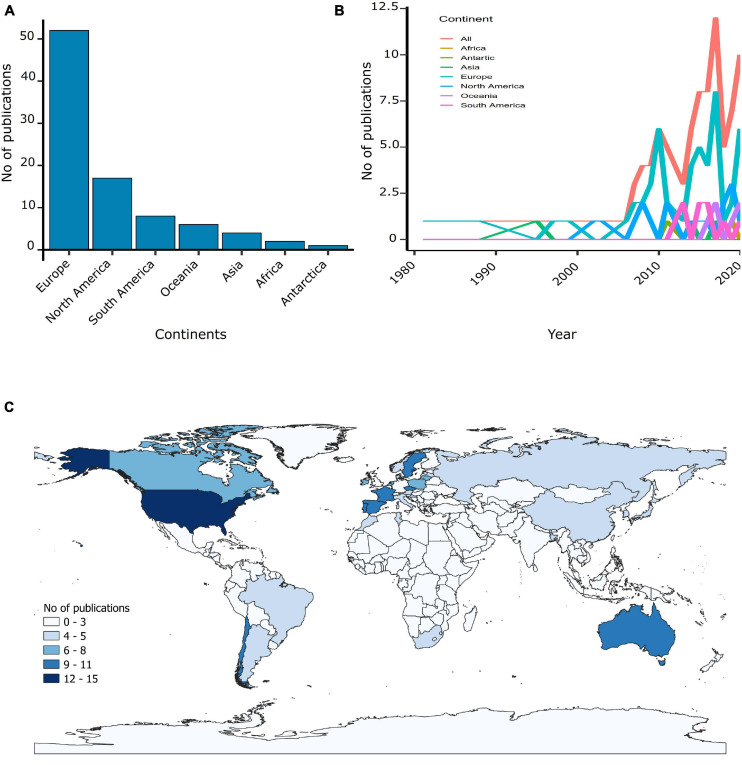
The role of wildlife with long-range dispersal such as gulls in the global dissemination of antimicrobial resistance (AMR) across natural and anthropogenic aquatic environments remains poorly understood. Antibiotic-resistant bacteria have been detected in resident and migratory gulls worldwide for more than a decade, suggesting gulls as either sentinels of AMR pollution from anthropogenic sources or independent reservoirs that could maintain and disperse AMR across aquatic environments. However, confirming either of these roles remains challenging and incomplete. In this review, we present current knowledge on the geographic regions where AMR has been detected in gulls, the molecular characterization of resistance genes, and the evidence supporting the capacity of gulls to disperse AMR across regions or countries. We identify several limitations of current research to assess the role of gulls in the spread of AMR including most studies not identifying the source of AMR, few studies comparing bacteria isolated in gulls with other wild or domestic species, and almost no study performing longitudinal sampling over a large period of time to assess the maintenance and dispersion of AMR by gulls within and across regions. We suggest future research required to confirm the role of gulls in the global dispersion of AMR including the standardization of sampling protocols, longitudinal sampling using advanced satellite tracking, and whole-genome sequencing typing. Finally, we discuss the public health implications of the spread of AMR by gulls and potential solutions to limit its spread in aquatic environments.
诸如海鸥这类具有远距离扩散能力的野生动物在抗微生物药物耐药性(AMR)于自然和人为水生环境中的全球传播里所起的作用,仍鲜为人知。十多年来,在全球各地的留鸟和候鸟海鸥体内都检测到了抗生素耐药菌,这表明海鸥要么是人为来源AMR污染的哨兵,要么是能够在水生环境中维持和传播AMR的独立储存库。然而,要证实这两种作用中的任何一种都仍然具有挑战性且并不完整。在本综述中,我们介绍了目前关于在海鸥体内检测到AMR的地理区域、耐药基因的分子特征,以及支持海鸥在各区域或国家间传播AMR能力的证据。我们确定了当前评估海鸥在AMR传播中作用的研究存在的几个局限性,包括大多数研究未确定AMR的来源,很少有研究将海鸥体内分离出的细菌与其他野生或家养物种的细菌进行比较,而且几乎没有研究在很长一段时间内进行纵向采样以评估海鸥在区域内和区域间对AMR的维持和传播情况。我们建议开展未来研究以证实海鸥在AMR全球传播中的作用,包括采样方案的标准化、使用先进卫星追踪技术进行纵向采样,以及全基因组测序分型。最后,我们讨论了海鸥传播AMR对公共卫生的影响以及限制其在水生环境中传播的潜在解决方案。