Santosaningsih Dewi, Erikawati Dewi, Hakim Iffa A, Santoso Sanarto, Hidayat M, Suwenda Ayu H, Puspitasari Vicky, Irhamni Irhamni, Kuntaman Kuntaman, van Arkel Andreas L E, Terlouw Luke G, Oudenes Neline, Willemse-Erix Diana, Snijders Susan V, Erler Nicole S, Verbrugh Henri A, Severin Juliëtte A
Department of Microbiology, Faculty of Medicine, Brawijaya University/Dr. Saiful Anwar Hospital, Malang, Indonesia.
Department of Medical Microbiology and Infectious Diseases, Erasmus MC University Medical Center, Rotterdam, the Netherlands.
Infect Prev Pract. 2019 Dec 3;1(3-4):100028. doi: 10.1016/j.infpip.2019.100028. eCollection 2019 Dec.
Methicillin-resistant (MRSA) is endemic in healthcare settings in Indonesia.
To evaluate the effect of a bundle of preventive measures on the transmission and acquisition of MRSA in a surgical ward of a resource-limited hospital in Indonesia.
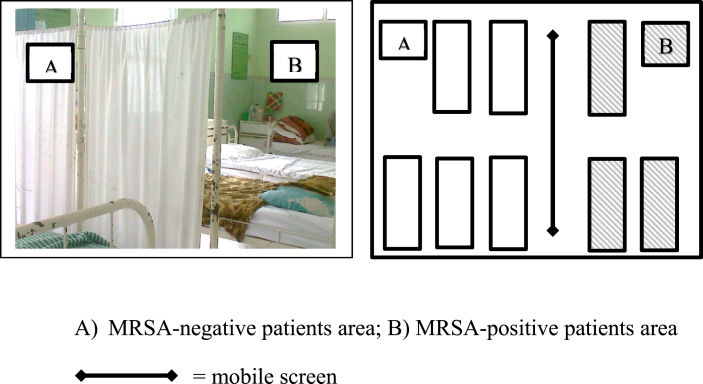
The study consisted of a pre-intervention (7 months), intervention (2 months), and post-intervention phase (5 months) and included screening for MRSA among eligible patients, healthcare workers (HCWs), and the hospital environment. In the intervention phase, a bundle of preventive actions was introduced, comprising: a hand hygiene educational program, cohorting of MRSA-positive patients, decolonization therapy for all MRSA-positive patients and HCWs, and cleaning and disinfection of the ward's innate environment. Hand hygiene compliance was assessed throughout the study period. The primary outcome was the acquisition rate of MRSA among patients per 1,000 patient-days at risk. Clonality of MRSA isolates was determined by Raman spectroscopy and multilocus sequence typing.
In total, 1,120 patients were included. Hand hygiene compliance rate rose from 15% pre-intervention to 65% post-intervention (<0.001). The MRSA acquisition decreased from 9/1,000 patient-days at risk pre-intervention to 3/1,000 patient-days at risk post-intervention, but this difference did not reach statistical significance (=0.08). Raman type 9 which belonged to ST239 was the single dominant MRSA clone.
The introduction of a bundle of preventive measures may reduce MRSA transmission and acquisition among surgery patients in a resource-limited hospital in Indonesia, but additional efforts are needed.
耐甲氧西林金黄色葡萄球菌(MRSA)在印度尼西亚的医疗机构中呈地方性流行。
评估一系列预防措施对印度尼西亚一家资源有限医院外科病房中MRSA传播和感染的影响。
该研究包括干预前阶段(7个月)、干预阶段(2个月)和干预后阶段(5个月),对符合条件的患者、医护人员(HCW)和医院环境进行MRSA筛查。在干预阶段,引入了一系列预防措施,包括:手卫生教育计划、对MRSA阳性患者进行分组、对所有MRSA阳性患者和医护人员进行去定植治疗,以及对病房固有环境进行清洁和消毒。在整个研究期间评估手卫生依从性。主要结局是每1000个患者危险日中患者的MRSA感染率。通过拉曼光谱和多位点序列分型确定MRSA分离株的克隆性。
总共纳入了1120名患者。手卫生依从率从干预前的15%上升到干预后的65%(<0.001)。MRSA感染率从干预前每1000个患者危险日中的9例降至干预后每1000个患者危险日中的3例,但这种差异未达到统计学显著性(P = 0.08)。属于ST239的拉曼9型是单一优势MRSA克隆。
在印度尼西亚一家资源有限的医院中,引入一系列预防措施可能会减少外科手术患者中MRSA的传播和感染,但仍需进一步努力。