German Cancer Research Center (DKFZ), Heidelberg, Germany.
Mannheim Medical Faculty, University of Heidelberg, Heidelberg, Germany.
Pharmacoeconomics. 2021 Nov;39(11):1243-1269. doi: 10.1007/s40273-021-01065-y. Epub 2021 Aug 9.
Debate over the viability of the current commercial research and development (R&D) model is ongoing. A controversial theme is the cost of bringing a new molecular entity (NME) to market.
Our aim was to evaluate the range and suitability of published R&D cost estimates as to the degree to which they represent the actual costs of industry.
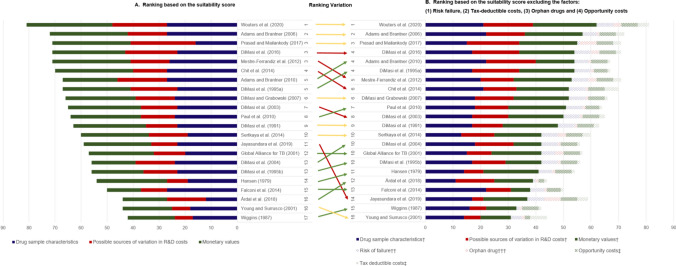
We provided a systematic literature review based on articles found in the Pubmed, Embase and EconLit electronic databases, and in a previously published review. Articles published before March 2020 that estimated the total R&D costs were included (22 articles with 45 unique cost estimates). We included only literature in which the methods used to collect the information and to estimate the R&D costs were clearly described; therefore, three reports were excluded. We extracted average pre-launch R&D costs per NME and converted the values to 2019 US dollars (US$) using the gross domestic product (GDP) price deflator. We appraised the suitability of the R&D estimated costs by using a scoring system that captures three domains: (1) how success rates and development time used for cost estimation were obtained; (2) whether the study considered potential sources contributing to the variation in R&D costs; and (3) what the components of the cost estimation were.
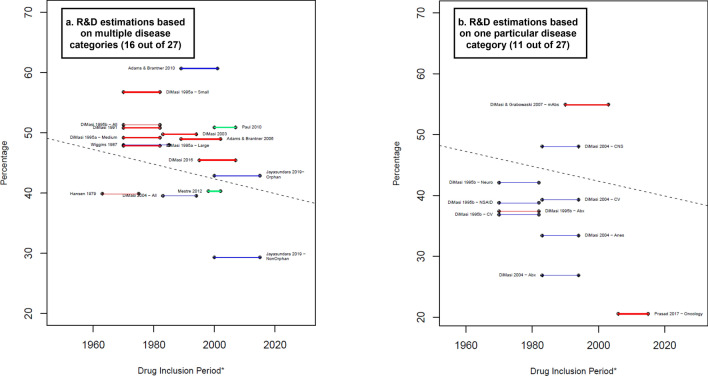
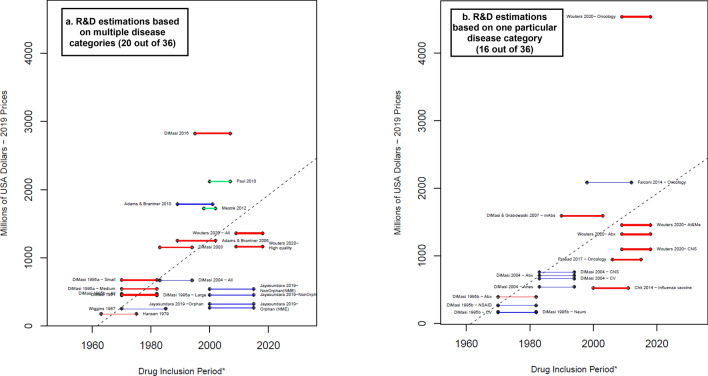
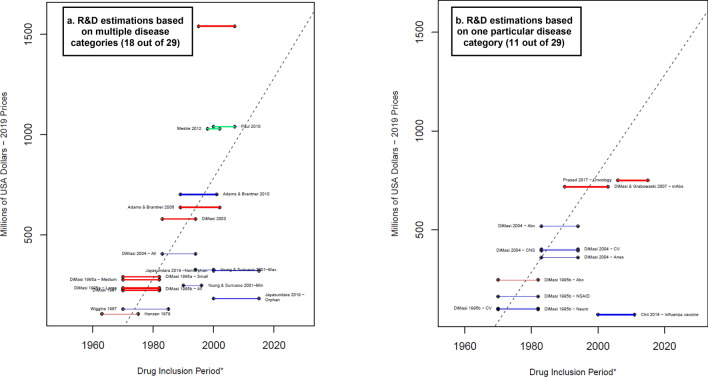
Estimates of total average capitalized pre-launch R&D costs varied widely, ranging from $161 million to $4.54 billion (2019 US$). Therapeutic area-specific estimates were highest for anticancer drugs (between $944 million and $4.54 billion). Our analysis identified a trend of increasing R&D costs per NME over time but did not reveal a relation between cost estimates and study ranking when the suitability scores were assessed. We found no evidence of an increase in suitability scores over time.
There is no universally correct answer regarding how much it costs, on average, to research and develop an NME. Future studies should explicitly address previously neglected variables, which likely explain some variability in estimates, and consider the trade-off between the transparency and public accessibility of data and their specificity. Use of our proposed suitability scoring system may assist in addressing such issues.
目前商业研发(R&D)模式的可行性仍存在争议。一个有争议的主题是将新的分子实体(NME)推向市场的成本。
我们旨在评估已发表的 R&D 成本估算的范围和适宜性,以了解它们在多大程度上代表了行业的实际成本。
我们提供了一项基于 Pubmed、Embase 和 EconLit 电子数据库以及先前发表的综述中发现的文章的系统文献综述。纳入了估计总 R&D 成本的文章(22 篇文章,45 个独特的成本估算)。我们仅纳入了明确描述了用于收集信息和估算 R&D 成本的方法的文献;因此,排除了三份报告。我们提取了每个 NME 的平均上市前 R&D 成本,并使用国内生产总值(GDP)价格平减指数将其转换为 2019 年美元(US$)。我们使用一个评分系统评估 R&D 估算成本的适宜性,该系统捕捉了三个方面:(1)用于成本估算的成功率和开发时间的获取方式;(2)研究是否考虑了导致 R&D 成本变化的潜在来源;(3)成本估算的组成部分。
总资本化为上市前 R&D 成本的平均估算值差异很大,范围从 1.61 亿美元到 45.4 亿美元(2019 年 US$)。特定治疗领域的估算值最高的是抗癌药物(9.44 亿美元至 45.4 亿美元)。我们的分析发现,随着时间的推移,每个 NME 的 R&D 成本呈上升趋势,但在评估适宜性评分时,并未发现成本估算与研究排名之间存在关系。我们没有发现随着时间的推移适宜性评分增加的证据。
关于研究和开发 NME 的平均成本,没有一个普遍正确的答案。未来的研究应明确解决以前被忽视的变量,这些变量可能解释了估算中的一些差异,并考虑数据透明度和可及性与其特异性之间的权衡。使用我们提出的适宜性评分系统可能有助于解决这些问题。