Department of Biology, University of North Dakota, Starcher Hall, 10 Cornell Street Stop 9019, Grand Forks, ND 58202, USA.
Institute of Biodiversity and Ecosystem Research, Bulgarian Academy of Sciences, 2 Gagarin Street, 1113 Sofia, Bulgaria.
Int J Parasitol. 2022 Jan;52(1):47-63. doi: 10.1016/j.ijpara.2021.06.002. Epub 2021 Aug 6.
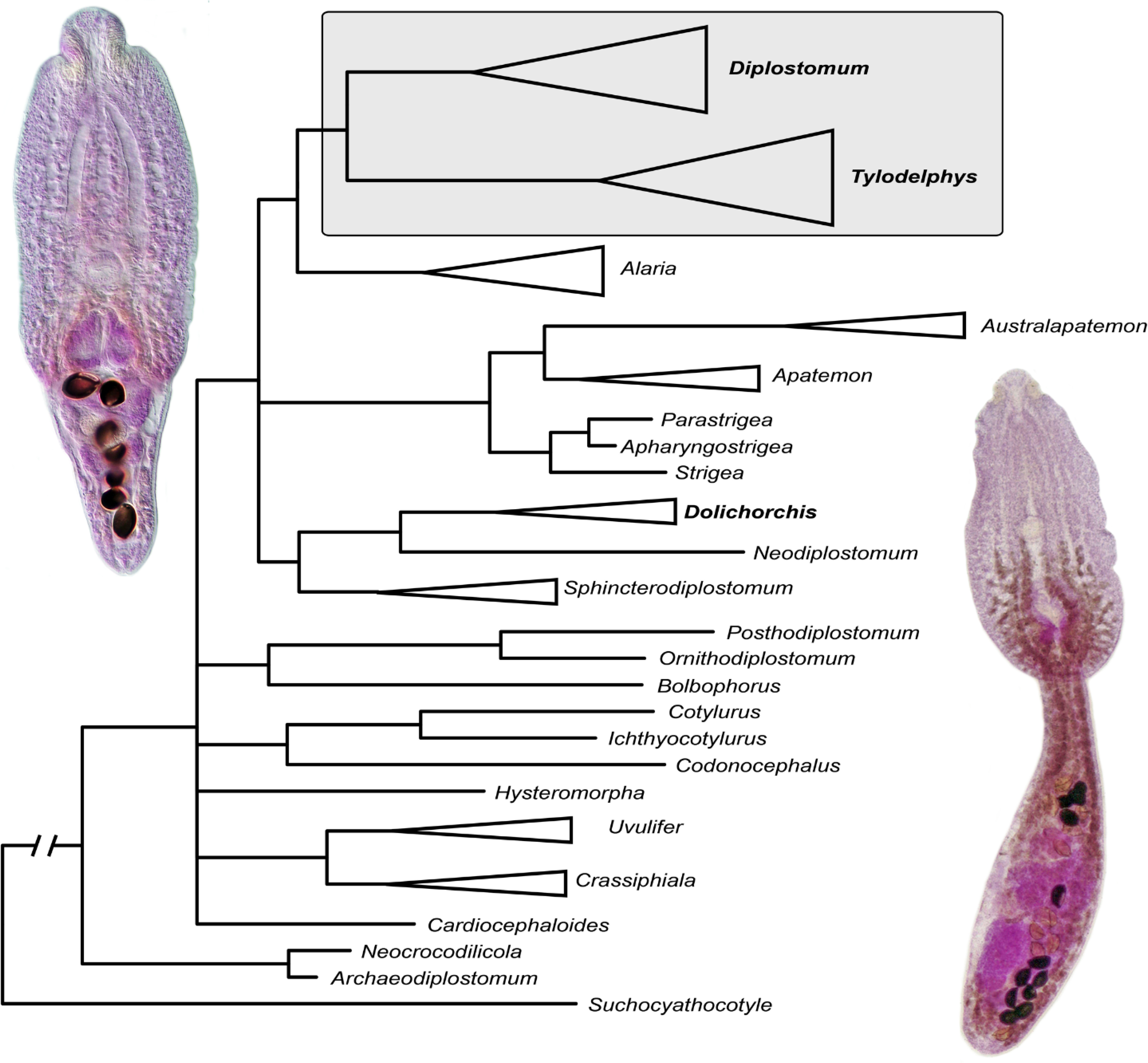
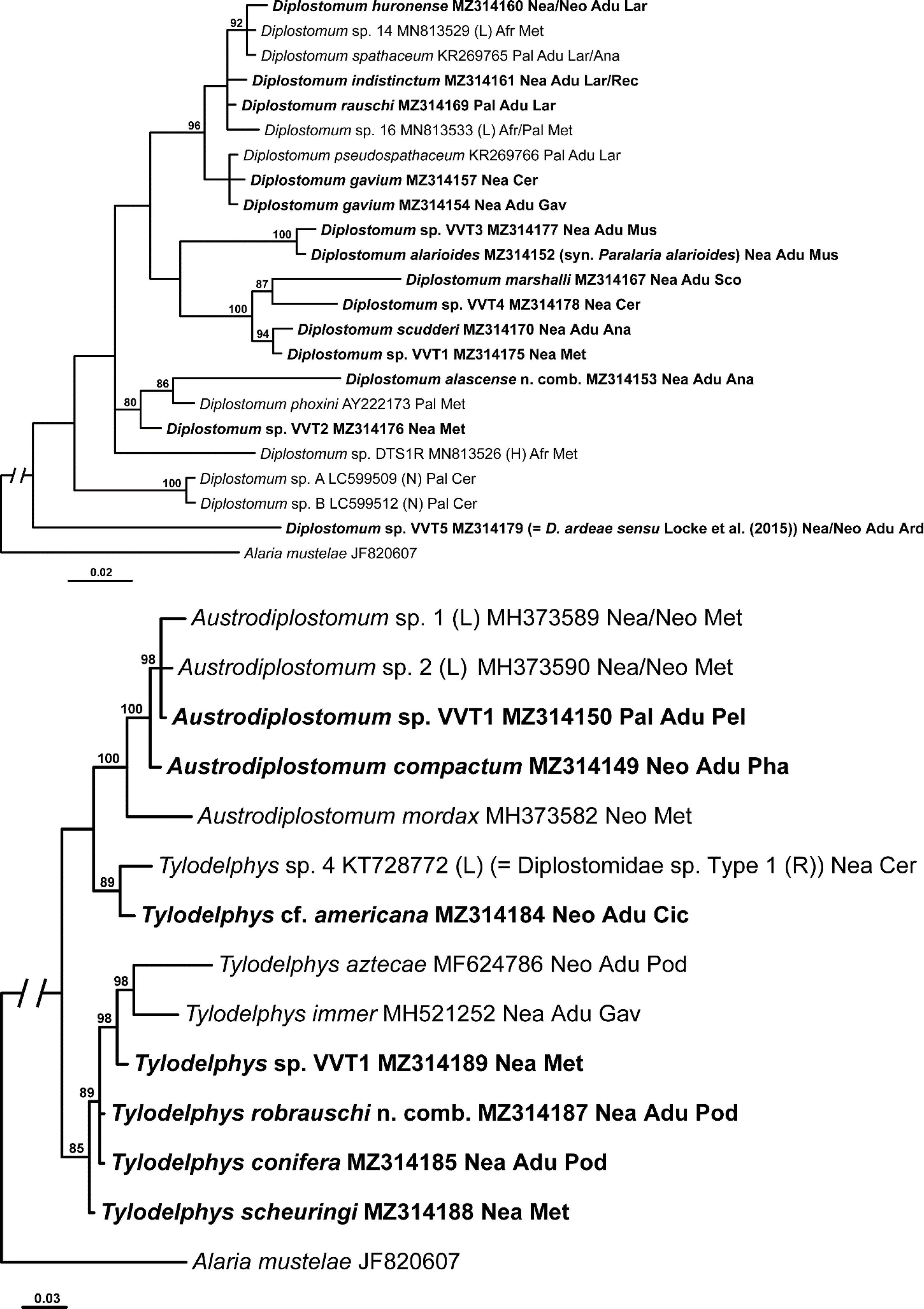
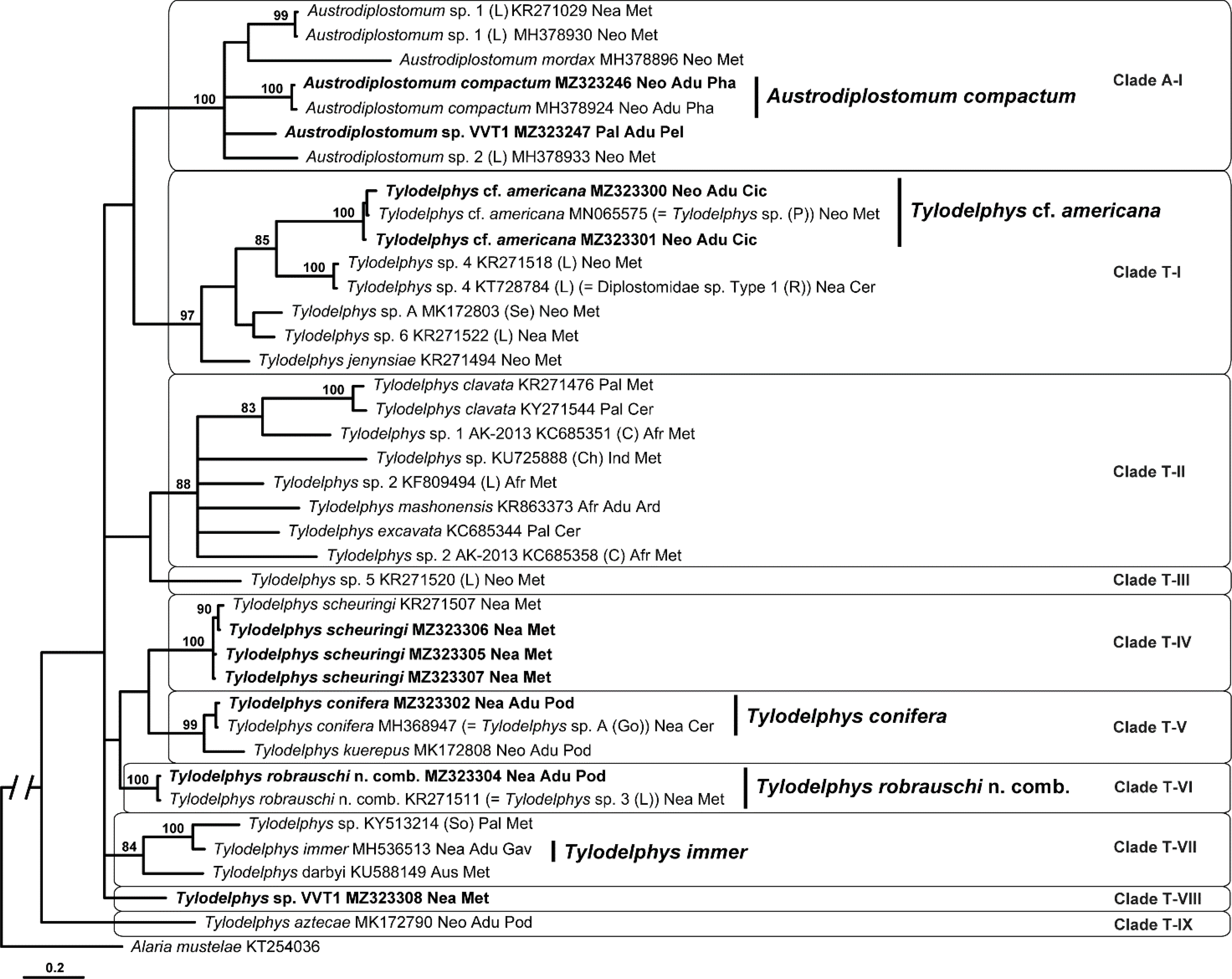
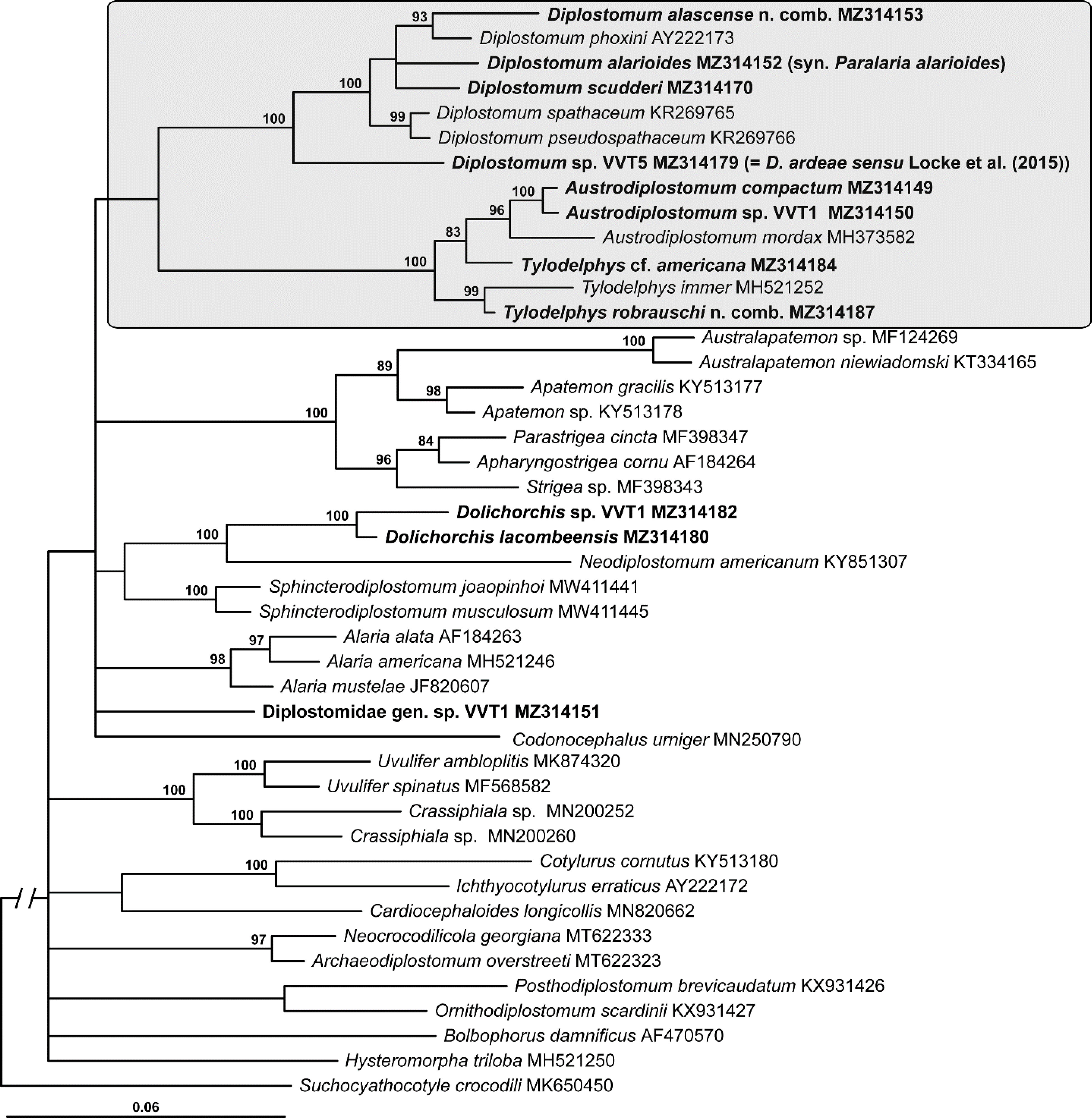
The Diplostomidae Poirier, 1886 is a large, globally distributed family of digeneans parasitic in intestines of their definitive hosts. Diplostomum and Tylodelphys spp. are broadly distributed, commonly reported, and the most often sequenced diplostomid genera. The majority of published DNA sequences from these genera originated from larval stages only, which typically cannot be identified to the species level based on morphology alone. We generated partial large ribosomal subunit (28S) rRNA and cytochrome c oxidase subunit 1 (cox1) mtDNA gene sequences from 14 species/species-level lineages of Diplostomum, six species/species-level lineages of Tylodelphys, two species/species-level lineages of Austrodiplostomum, one species previously assigned to Paralaria, two species/species-level lineages of Dolichorchis and one unknown diplostomid. Our DNA sequences of 11 species/species-level lineages of Diplostomum (all identified to species), four species/species-level lineages of Tylodelphys (all identified to species), Austrodiplostomum compactum, Paralaria alarioides and Dolichorchis lacombeensis originated from adult specimens. 28S sequences were used for phylogenetic inference to demonstrate the position of Paralaria alarioides and Dolichorchis spp. within the Diplostomoidea and study the interrelationships of Diplostomum, Tylodelphys and Austrodiplostomum. Our results demonstrate that two diplostomids from the North American river otter (P. alarioides and a likely undescribed taxon) belong within Diplostomum. Further, our results demonstrate the non-monophyly of Tylodelphys due to the position of Austrodiplostomum spp., based on our phylogenetic analyses and morphology. Furthermore, the results of phylogenetic analysis of 28S confirmed the status of Dolichorchis as a separate genus. The phylogenies suggest multiple definitive host-switching events (birds to otters and among major avian groups) and a New World origin of Diplostomum and Tylodelphys spp. Our DNA sequences from adult digeneans revealed identities of 10 previously published lineages of Diplostomum and Tylodelphys, which were previously identified to genus only. The novel DNA data from this work provide opportunities for future comparisons of larval diplostomines collected in ecological studies.
片形科(Diplostomidae)Poirier,1886 是一个大型的、全球分布的复殖目吸虫科,其寄生在终末宿主的肠道中。 Diplostomum 和 Tylodelphys spp. 分布广泛,常被报道,是最常被测序的片形科属。这些属的大多数已发表的 DNA 序列仅来源于幼虫阶段,仅基于形态学通常无法将其鉴定到种的水平。我们从 14 种 Diplostomum 种/种级谱系、6 种 Tylodelphys 种/种级谱系、2 种 Austrodiplostomum 种/种级谱系、1 种先前分配给 Paralaria 的种、2 种 Dolichorchis 种/种级谱系和 1 种未知的片形科中生成了部分大亚基核糖体(28S)rRNA 和细胞色素 c 氧化酶亚基 1(cox1)mtDNA 基因序列。我们的 DNA 序列来自 11 种 Diplostomum 种/种级谱系(均鉴定到种)、4 种 Tylodelphys 种/种级谱系(均鉴定到种)、Austrodiplostomum compactum、Paralaria alarioides 和 Dolichorchis lacombeensis 均来自成虫标本。28S 序列用于系统发育推断,以证明 Paralaria alarioides 和 Dolichorchis spp. 在 Diplostomoidea 中的位置,并研究 Diplostomum、Tylodelphys 和 Austrodiplostomum 之间的相互关系。我们的结果表明,来自北美的河獭(Paralaria alarioides 和一种可能未描述的分类群)的两种片形科吸虫属于 Diplostomum。此外,我们的系统发育分析和形态学结果表明,由于 Austrodiplostomum spp. 的位置,Tylodelphys 的非单系性。此外,28S 系统发育分析的结果证实了 Dolichorchis 作为一个独立属的地位。系统发育表明,鸟类到水獭的多次终末宿主转换事件(以及主要鸟类群之间的转换)以及 Diplostomum 和 Tylodelphys spp. 的新大陆起源。我们从成虫双殖吸虫中获得的 DNA 序列揭示了以前仅鉴定到属的 10 个先前发表的 Diplostomum 和 Tylodelphys 谱系的身份。这项工作的新 DNA 数据为未来比较生态研究中收集的幼虫片形科吸虫提供了机会。