Allami Tyser, Alamiery Ahmed, Nassir Mohamed H, Kadhum Amir H
Department of Chemical and Process Engineering, Faculty of Engineering and Built Environment, Universiti Kebangsaan Malaysia, Bangi 43600, Selangor Darul Ehsan, Malaysia.
Polymers (Basel). 2021 Jul 27;13(15):2467. doi: 10.3390/polym13152467.
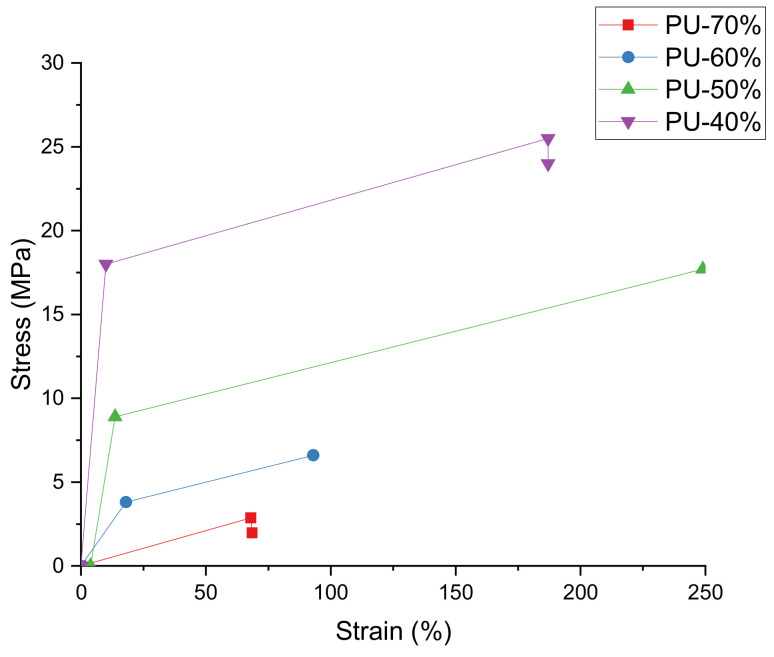
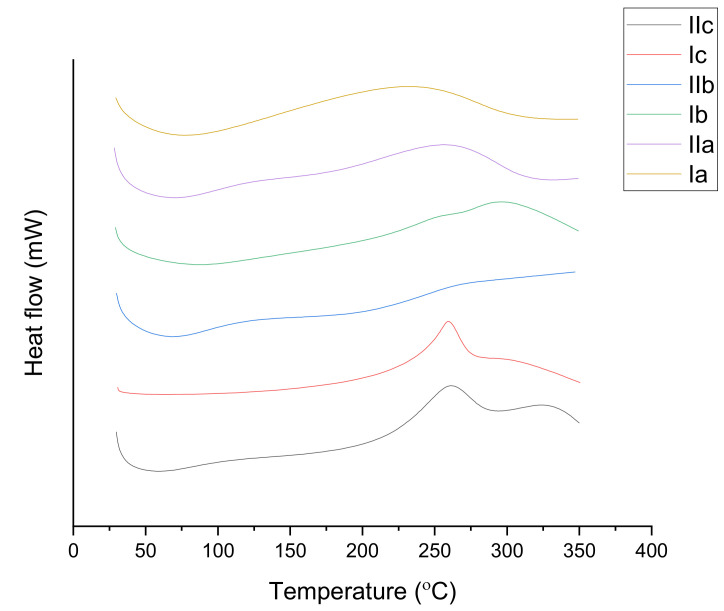
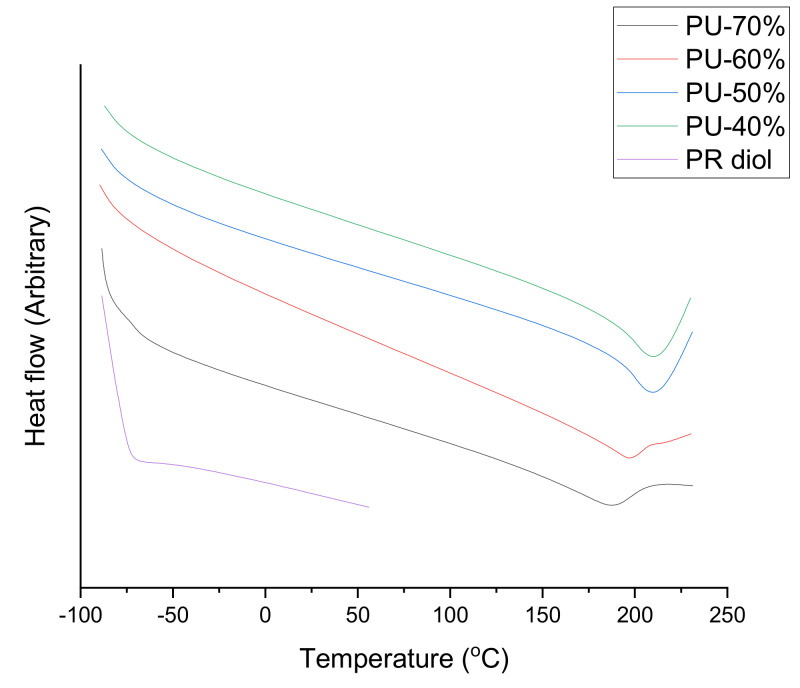
The effect of the soft and hard polyurethane (PU) segments caused by the hydrogen link in phase-separation kinetics was studied to investigate the morphological annealing of PU and thermoplastic polyurethane (TPU). The significance of the segmented PUs is to achieve enough stability for further applications in biomedical and environmental fields. In addition, other research focuses on widening the plastic features and adjusting the PU-polyimide ratio to create elastomer of the poly(urethane-imide). Regarding TPU- and PU-nanocomposite, numerous studies investigated the incorporation of inorganic nanofillers such as carbon or clay to incorporating TPU-nanocomposite in several applications. Additionally, the complete exfoliation was observed up to 5% and 3% of TPU-clay modified with 12 amino lauric acid and benzidine, respectively. PU-nanocomposite of 5 wt.% Cloisite30B showed an increase in modulus and tensile strength by 110% and 160%, respectively. However, the nanocomposite PU-0.5 wt.% Carbone Nanotubes (CNTs) show an increase in the tensile modulus by 30% to 90% for blown and flat films, respectively. Coating PU influences stress-strain behavior because of the interaction between the soft segment and physical crosslinkers. The thermophysical properties of the TPU matrix have shown two glass transition temperatures ('s) corresponding to the soft and the hard segment. Adding a small amount of tethered clay shifts for both segments by 44 °C and 13 °C, respectively, while adding clay from 1 to 5 wt.% results in increasing the thermal stability of TPU composite from 12 to 34 °C, respectively. The differential scanning calorimetry (DSC) was used to investigate the phase structure of PU dispersion, showing an increase in thermal stability, solubility, and flexibility. Regarding the electrical properties, the maximum piezoresistivity (10 S/m) of 7.4 wt.% MWCNT was enhanced by 92.92%. The chemical structure of the PU-CNT composite has shown a degree of agglomeration under disruption of the sp2 carbon structure. However, with extended graphene loading to 5.7 wt.%, piezoresistivity could hit 10 S/m, less than 100 times that of PU. In addition to electrical properties, the acoustic behavior of MWCNT (0.35 wt.%)/SiO (0.2 wt.%)/PU has shown sound absorption of 80 dB compared to the PU foam sample. Other nanofillers, such as SiO, TiO, ZnO, AlO, were studied showing an improvement in the thermal stability of the polymer and enhancing scratch and abrasion resistance.
研究了氢键在相分离动力学中对软硬聚氨酯(PU)链段的影响,以探究PU和热塑性聚氨酯(TPU)的形态退火。分段PU的重要意义在于在生物医学和环境领域的进一步应用中实现足够的稳定性。此外,其他研究重点在于拓宽塑料特性并调整PU-聚酰亚胺比例以制备聚(氨酯-酰亚胺)弹性体。关于TPU和PU纳米复合材料,众多研究调查了诸如碳或粘土等无机纳米填料的掺入情况,以便在多种应用中掺入TPU纳米复合材料。此外,分别观察到用12-氨基月桂酸和联苯胺改性的TPU-粘土中,高达5%和3%时能实现完全剥离。5 wt.%的Cloisite30B的PU纳米复合材料的模量和拉伸强度分别提高了110%和160%。然而,0.5 wt.%的碳纳米管(CNT)的纳米复合材料的吹塑膜和平膜的拉伸模量分别提高了30%至90%。涂层PU会影响应力-应变行为,这是由于软链段与物理交联剂之间的相互作用。TPU基体的热物理性质显示出对应于软链段和硬链段的两个玻璃化转变温度。添加少量键合粘土时,两个链段的玻璃化转变温度分别偏移44℃和13℃,而添加1至5 wt.%的粘土会使TPU复合材料的热稳定性分别从12℃提高到34℃。差示扫描量热法(DSC)用于研究PU分散体的相结构,结果表明其热稳定性、溶解性和柔韧性有所提高。关于电学性能,7.4 wt.%的多壁碳纳米管(MWCNT)的最大压阻率(10 S/m)提高了92.92%。PU-CNT复合材料的化学结构在sp2碳结构破坏下显示出一定程度的团聚。然而,当石墨烯负载量增加到5.7 wt.%时,压阻率可达10 S/m,不到PU的100倍。除电学性能外,0.35 wt.%的MWCNT/二氧化硅(SiO)(0.2 wt.%)/PU的声学行为与PU泡沫样品相比显示出80 dB的吸声效果。还研究了其他纳米填料,如SiO、TiO、ZnO、Al2O3,结果表明聚合物的热稳定性得到改善,耐刮擦和耐磨性增强。