Slavin Moriya, Zamel Joanna, Zohar Keren, Eliyahu Tsiona, Braitbard Merav, Brielle Esther, Baraz Leah, Stolovich-Rain Miri, Friedman Ahuva, Wolf Dana G, Rouvinski Alexander, Linial Michal, Schneidman-Duhovny Dina, Kalisman Nir
Department of Biological Chemistry, Institute of Life Sciences, The Hebrew University of Jerusalem, Jerusalem 9190401, Israel.
Hadassah Academic College Jerusalem, Jerusalem 9101001, Israel.
Proc Natl Acad Sci U S A. 2021 Aug 24;118(34). doi: 10.1073/pnas.2103554118.
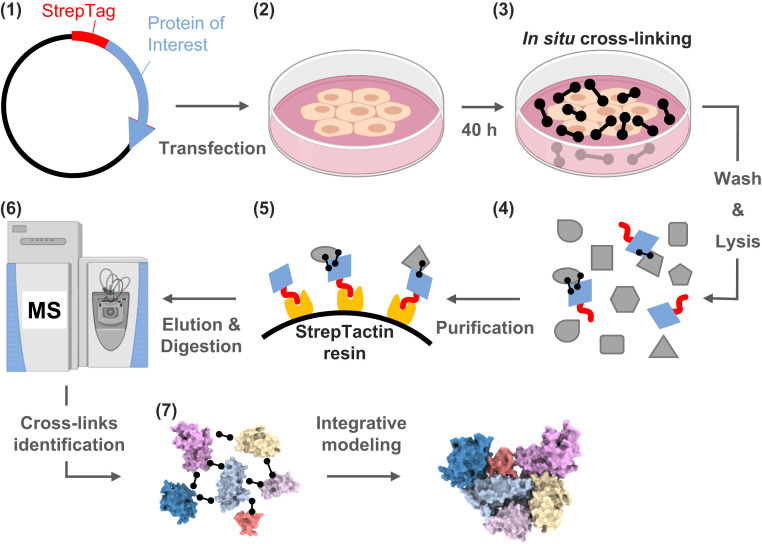
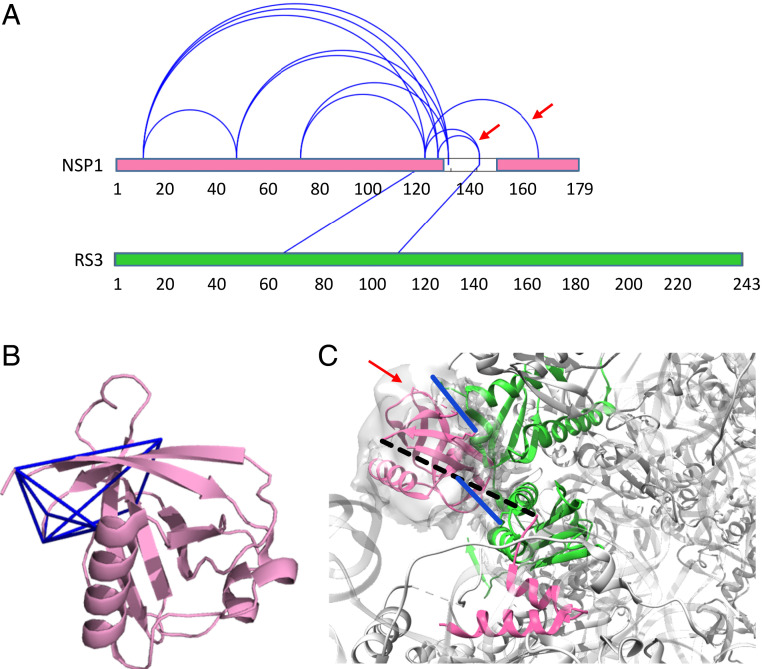
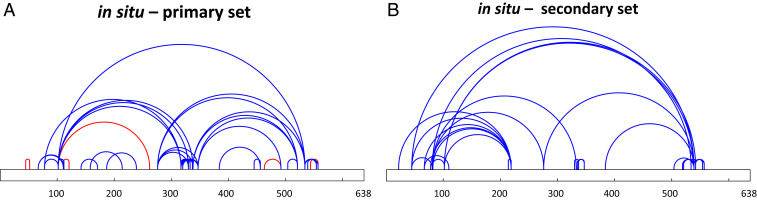
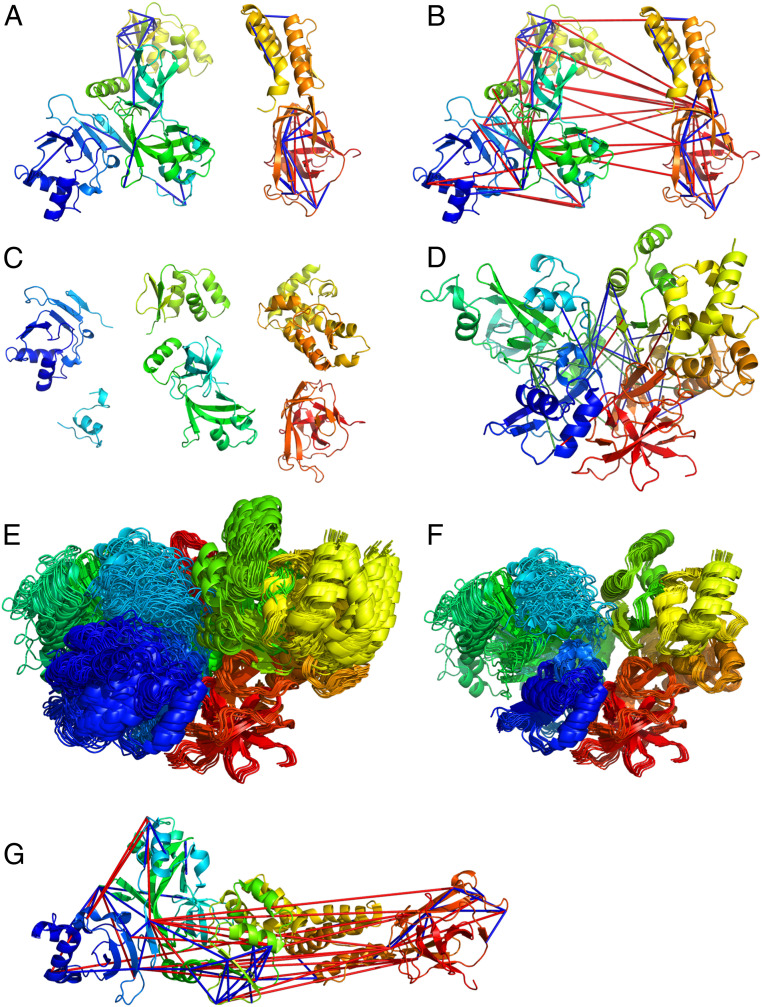
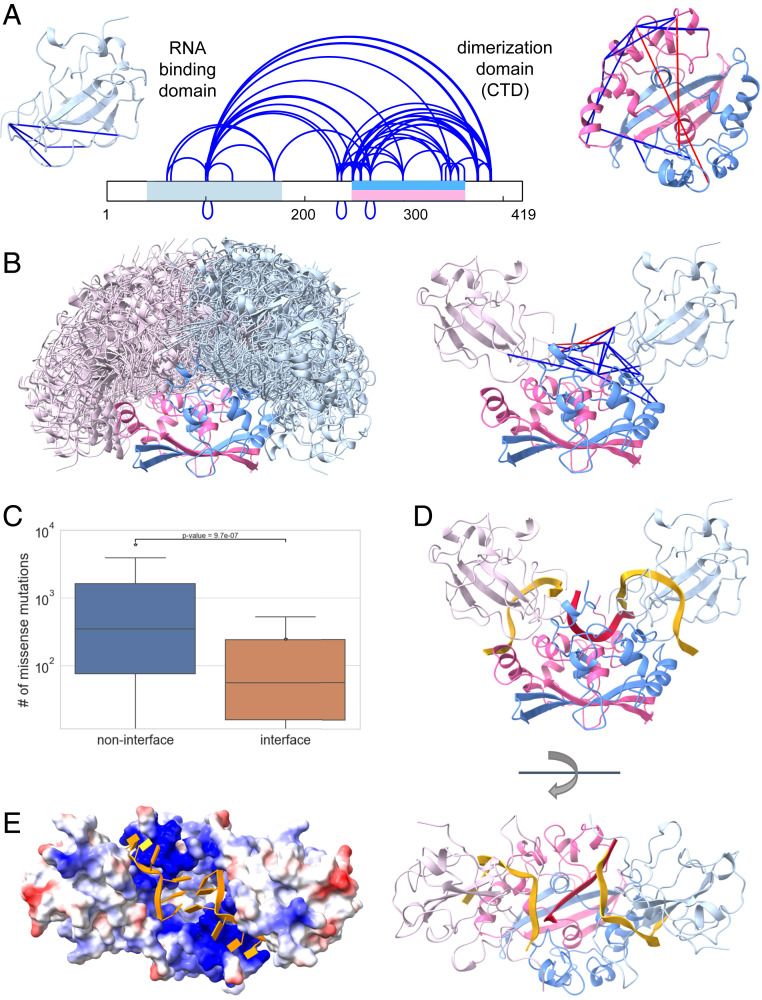
Atomic structures of several proteins from the coronavirus family are still partial or unavailable. A possible reason for this gap is the instability of these proteins outside of the cellular context, thereby prompting the use of in-cell approaches. In situ cross-linking and mass spectrometry (in situ CLMS) can provide information on the structures of such proteins as they occur in the intact cell. Here, we applied targeted in situ CLMS to structurally probe Nsp1, Nsp2, and nucleocapsid (N) proteins from severe acute respiratory syndrome coronavirus 2 (SARS-CoV-2) and obtained cross-link sets with an average density of one cross-link per 20 residues. We then employed integrative modeling that computationally combined the cross-linking data with domain structures to determine full-length atomic models. For the Nsp2, the cross-links report on a complex topology with long-range interactions. Integrative modeling with structural prediction of individual domains by the AlphaFold2 system allowed us to generate a single consistent all-atom model of the full-length Nsp2. The model reveals three putative metal binding sites and suggests a role for Nsp2 in zinc regulation within the replication-transcription complex. For the N protein, we identified multiple intra- and interdomain cross-links. Our integrative model of the N dimer demonstrates that it can accommodate three single RNA strands simultaneously, both stereochemically and electrostatically. For the Nsp1, cross-links with the 40S ribosome were highly consistent with recent cryogenic electron microscopy structures. These results highlight the importance of cellular context for the structural probing of recalcitrant proteins and demonstrate the effectiveness of targeted in situ CLMS and integrative modeling.
冠状病毒家族中几种蛋白质的原子结构仍然不完整或无法获得。造成这一差距的一个可能原因是这些蛋白质在细胞外环境中不稳定,因此促使人们采用细胞内方法。原位交联质谱法(in situ CLMS)可以提供此类蛋白质在完整细胞中结构的相关信息。在这里,我们应用靶向原位CLMS对严重急性呼吸综合征冠状病毒2(SARS-CoV-2)的Nsp1、Nsp2和核衣壳(N)蛋白进行结构探测,获得了平均每20个残基有一个交联的交联集。然后,我们采用整合建模,将交联数据与结构域结构进行计算结合,以确定全长原子模型。对于Nsp2,交联显示出具有长程相互作用的复杂拓扑结构。通过AlphaFold2系统对各个结构域进行结构预测的整合建模,使我们能够生成全长Nsp2的单一一致全原子模型。该模型揭示了三个假定的金属结合位点,并暗示了Nsp2在复制转录复合物中锌调节中的作用。对于N蛋白,我们鉴定出多个结构域内和结构域间的交联。我们的N二聚体整合模型表明,它在立体化学和静电方面都能同时容纳三条单链RNA。对于Nsp1,与40S核糖体的交联与最近的低温电子显微镜结构高度一致。这些结果突出了细胞环境对难处理蛋白质结构探测的重要性,并证明了靶向原位CLMS和整合建模的有效性。