Taub Institute for Research on Alzheimer's Disease and the Aging Brain, Department of Neurology, Columbia University College of Physicians and Surgeons, New York City, NY, USA.
Julius Center for Health Sciences and Primary Care, Department of Epidemiology, University Medical Center Utrecht and Utrecht University, Utrecht, The Netherlands.
J Int Neuropsychol Soc. 2022 Apr;28(4):351-361. doi: 10.1017/S1355617721000539. Epub 2021 Aug 11.
To estimate the prevalence of mild cognitive impairment (MCI) and its subtypes and investigate the impact of midlife cardiovascular risk factors on late-life MCI among the aging Mexican population.
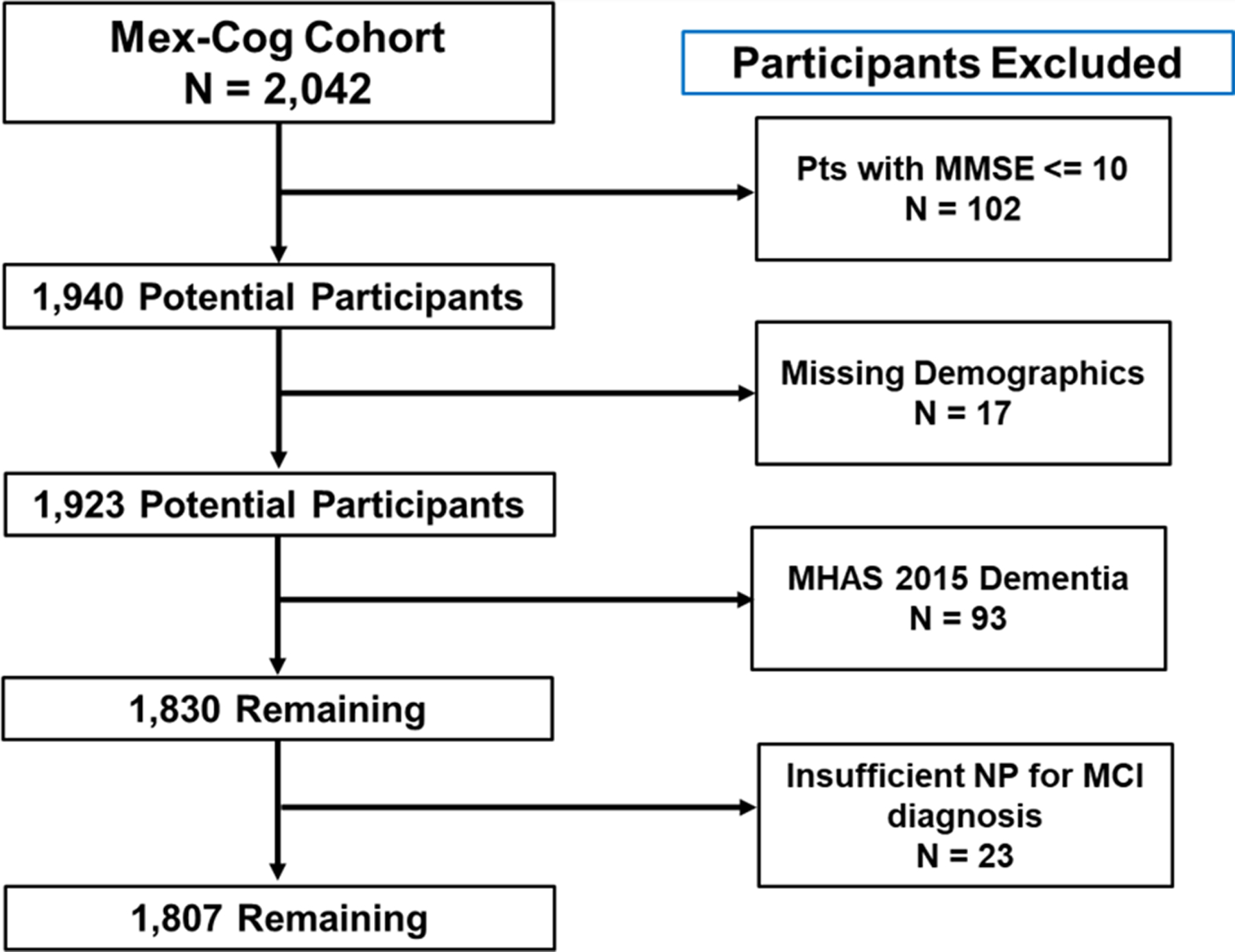
Analyses included a sample of non-demented adults over the age of 55 living in both urban and rural areas of Mexico (N = 1807). MCI diagnosis was assigned based on a comprehensive cognitive assessment assessing the domains of memory, executive functioning, language, and visuospatial ability. The normative sample was selected by means of the robust norms approach. Cognitive impairment was defined by a 1.5-SD cut-off per cognitive domain using normative corrections for age, years of education, and sex. Risk factors included age, education, sex, rurality, depression, insurance status, workforce status, hypertension, diabetes, stroke, and heart disease.
The prevalence of amnestic MCI was 5.9%. Other MCI subtypes ranged from 4.2% to 7.7%. MCI with and without memory impairment was associated with older age (OR = 1.01 [1.01, 1.05]; OR = 1.03 [1.01, 1.04], respectively) and residing in rural areas (OR = 1.49 [1.08, 2.06]; OR = 1.35 [1.03, 1.77], respectively). Depression (OR = 1.07 [1.02, 1.12]), diabetes (OR = 1.37 [1.03, 1.82]), and years of education (OR = 0.94 [0.91, 0.97]) were associated with MCI without memory impairment. Midlife CVD increased the odds of MCI in late-life (OR = 1.76 [1.19, 2.59], which was driven by both midlife hypertension and diabetes (OR = 1.70 [1.18, 2.44]; OR = 1.88 [1.19, 2.97], respectively).
Older age, depression, low education, rurality, and midlife hypertension and diabetes were associated with higher risk of late-life MCI among older adults in Mexico. Our findings suggest that the causes of cognitive impairment are multifactorial and vary by MCI subtype.
估计轻度认知障碍(MCI)的患病率及其亚型,并探讨中年心血管危险因素对墨西哥老龄化人群晚年 MCI 的影响。
分析包括居住在墨西哥城乡地区的年龄在 55 岁以上的非痴呆成年人样本(N=1807)。根据全面认知评估,根据记忆、执行功能、语言和视空间能力领域对 MCI 进行诊断。通过稳健规范方法选择规范样本。使用年龄、教育年限和性别对认知域的规范进行校正,认知障碍的定义为每个认知域的 1.5-SD 截断值。危险因素包括年龄、教育程度、性别、农村、抑郁、保险状况、劳动力状况、高血压、糖尿病、中风和心脏病。
遗忘型 MCI 的患病率为 5.9%。其他 MCI 亚型的患病率在 4.2%至 7.7%之间。伴有和不伴有记忆障碍的 MCI 与年龄较大(OR=1.01[1.01,1.05];OR=1.03[1.01,1.04])和居住在农村地区(OR=1.49[1.08,2.06];OR=1.35[1.03,1.77])有关。抑郁(OR=1.07[1.02,1.12])、糖尿病(OR=1.37[1.03,1.82])和受教育年限(OR=0.94[0.91,0.97])与无记忆障碍的 MCI 相关。中年心血管疾病(CVD)增加了晚年 MCI 的发病风险(OR=1.76[1.19,2.59],这主要是由中年高血压和糖尿病引起的(OR=1.70[1.18,2.44];OR=1.88[1.19,2.97])。
在墨西哥的老年人中,年龄较大、抑郁、教育程度低、农村地区以及中年高血压和糖尿病与晚年 MCI 的风险较高相关。我们的研究结果表明,认知障碍的原因是多因素的,并且因 MCI 亚型而异。