Department of Psychology and Centre for Cognitive Neuroscience, University of Salzburg, Salzburg, Austria.
The Wellcome Centre for Human Neuroimaging, University College London, London, UK.
Commun Biol. 2021 Aug 10;4(1):954. doi: 10.1038/s42003-021-02447-w.
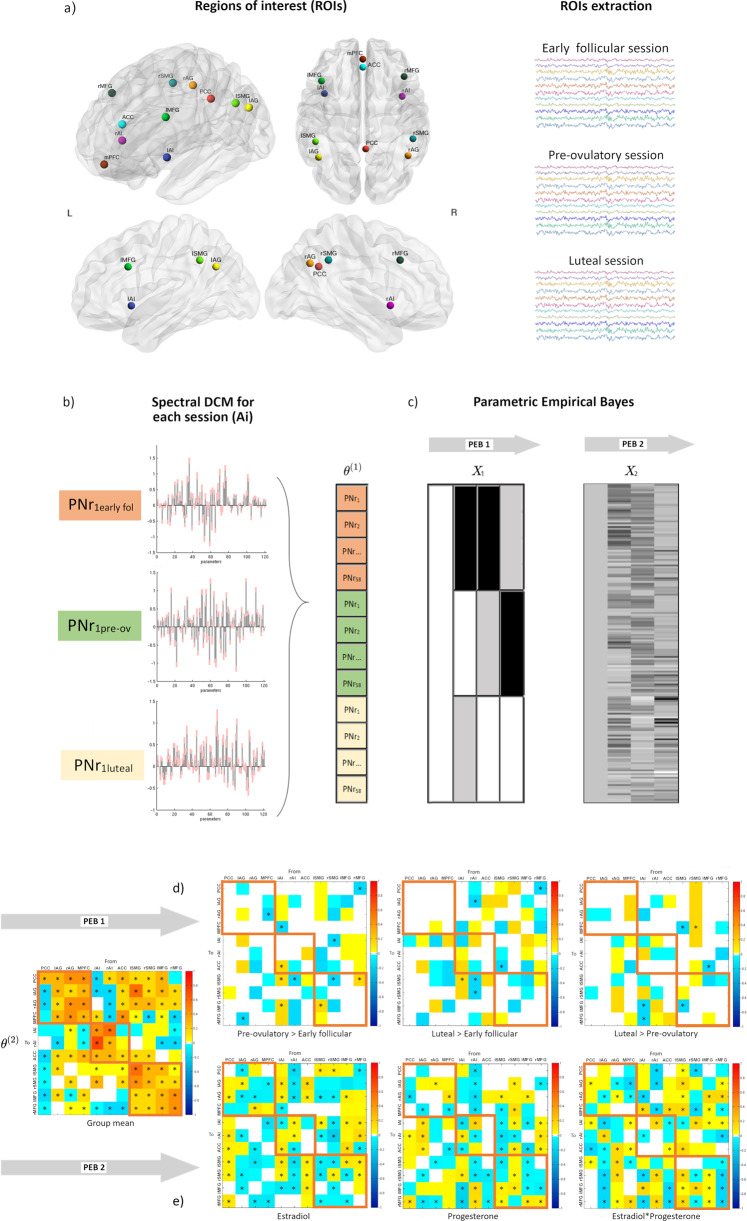
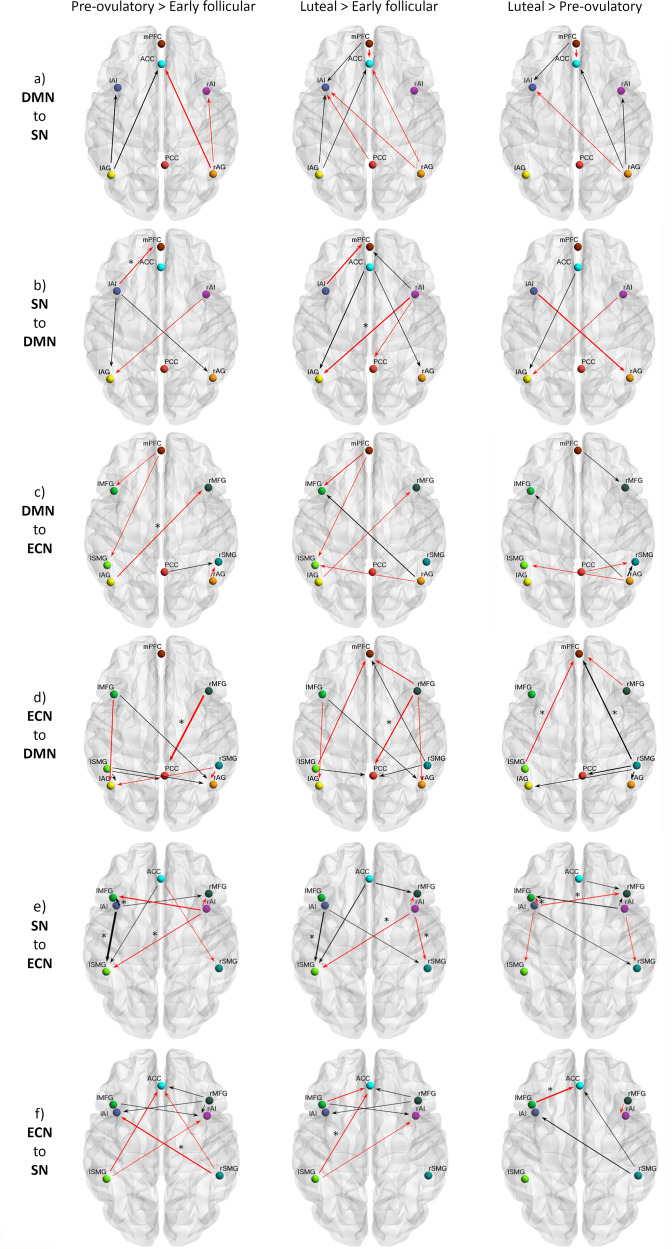
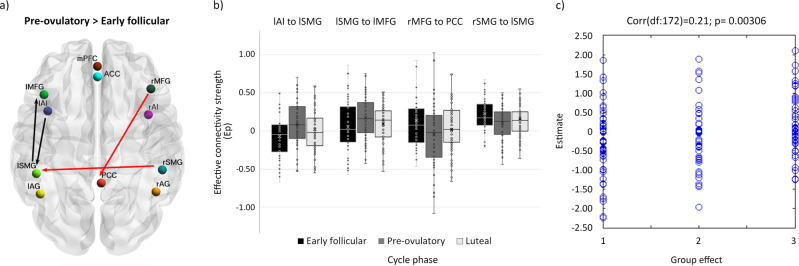
Longitudinal menstrual cycle studies allow to investigate the effects of ovarian hormones on brain organization. Here, we use spectral dynamic causal modelling (spDCM) in a triple network model to assess effective connectivity changes along the menstrual cycle within and between the default mode, salience and executive control networks (DMN, SN, and ECN). Sixty healthy young women were scanned three times along their menstrual cycle, during early follicular, pre-ovulatory and mid-luteal phase. Related to estradiol, right before ovulation the left insula recruits the ECN, while the right middle frontal gyrus decreases its connectivity to the precuneus and the DMN decouples into anterior/posterior parts. Related to progesterone during the mid-luteal phase, the insulae (SN) engage to each other, while decreasing their connectivity to parietal ECN, which in turn engages the posterior DMN. When including the most confident connections in a leave-one out cross-validation, we find an above-chance prediction of the left-out subjects' cycle phase. These findings corroborate the plasticity of the female brain in response to acute hormone fluctuations and may help to further understand the neuroendocrine interactions underlying cognitive changes along the menstrual cycle.
纵向月经周期研究可以调查卵巢激素对大脑组织的影响。在这里,我们使用谱动态因果建模 (spDCM) 在三重网络模型中评估默认模式、显着性和执行控制网络 (DMN、SN 和 ECN) 内和之间沿着月经周期的有效连接变化。60 名健康年轻女性在月经周期的三个阶段进行了扫描,即早期卵泡期、排卵前和中期黄体期。与雌二醇相关,在排卵前,左岛叶招募 ECN,而右额中回降低与楔前叶和 DMN 的连接,并分离为前/后部分。与中期黄体期的孕激素相关,脑岛(SN)相互作用,同时降低与顶叶 ECN 的连接,而 ECN 反过来又与后 DMN 相互作用。当在留一交叉验证中包含最可信的连接时,我们发现可以以上限概率预测被排除在外的受试者的周期阶段。这些发现证实了女性大脑对急性激素波动的可塑性,并可能有助于进一步理解月经周期中认知变化的神经内分泌相互作用。