Mueller Joshua M, Pritschet Laura, Santander Tyler, Taylor Caitlin M, Grafton Scott T, Jacobs Emily Goard, Carlson Jean M
Interdepartmental Graduate Program in Dynamical Neuroscience, University of California, Santa Barbara, Santa Barbara, CA, USA.
Department of Psychological and Brain Sciences, University of California, Santa Barbara, Santa Barbara, CA, USA.
Netw Neurosci. 2021 Feb 1;5(1):125-144. doi: 10.1162/netn_a_00169. eCollection 2021.
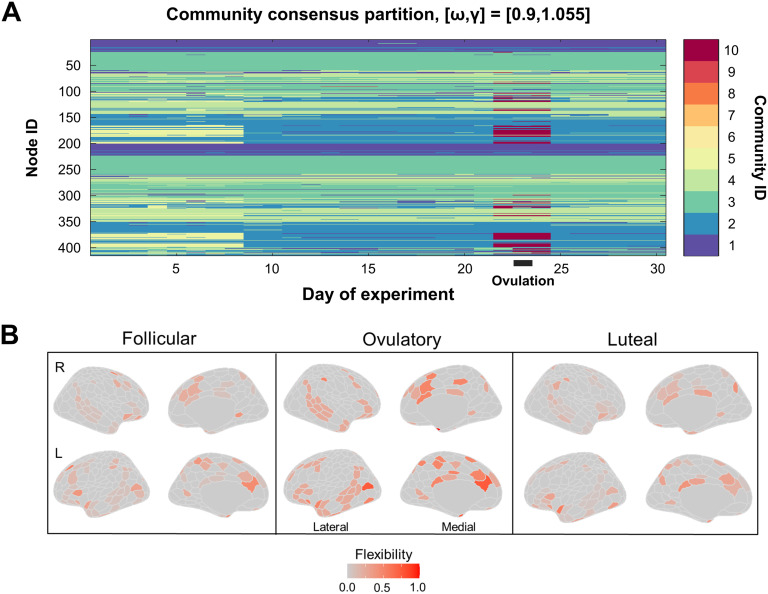
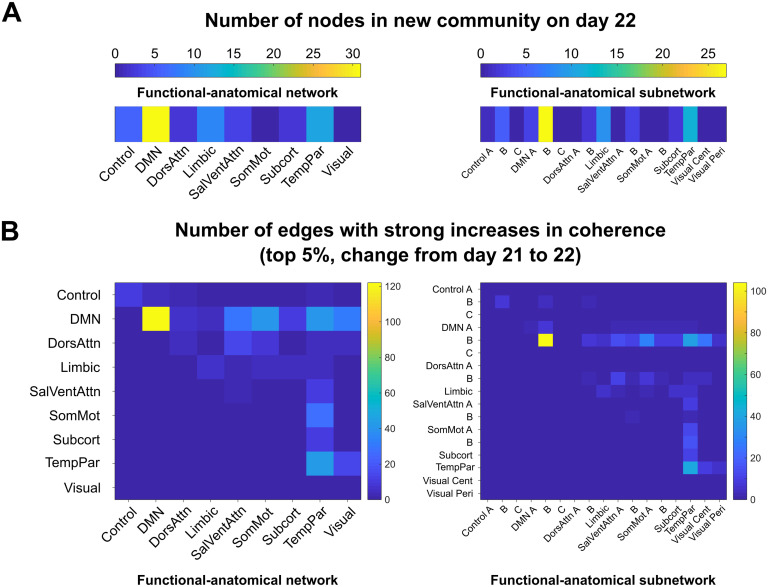
Sex steroid hormones have been shown to alter regional brain activity, but the extent to which they modulate connectivity within and between large-scale functional brain networks over time has yet to be characterized. Here, we applied dynamic community detection techniques to data from a highly sampled female with 30 consecutive days of brain imaging and venipuncture measurements to characterize changes in resting-state community structure across the menstrual cycle. Four stable functional communities were identified, consisting of nodes from visual, default mode, frontal control, and somatomotor networks. Limbic, subcortical, and attention networks exhibited higher than expected levels of nodal flexibility, a hallmark of between-network integration and transient functional reorganization. The most striking reorganization occurred in a default mode subnetwork localized to regions of the prefrontal cortex, coincident with peaks in serum levels of estradiol, luteinizing hormone, and follicle stimulating hormone. Nodes from these regions exhibited strong intranetwork increases in functional connectivity, leading to a split in the stable default mode core community and the transient formation of a new functional community. Probing the spatiotemporal basis of human brain-hormone interactions with dynamic community detection suggests that hormonal changes during the menstrual cycle result in temporary, localized patterns of brain network reorganization.
性类固醇激素已被证明会改变大脑局部活动,但它们随时间调节大规模功能性脑网络内部及之间连接性的程度尚未得到描述。在此,我们将动态群落检测技术应用于一名女性连续30天的脑成像和静脉穿刺测量数据,以表征月经周期中静息态群落结构的变化。我们识别出四个稳定的功能群落,由视觉、默认模式、额叶控制和躯体运动网络的节点组成。边缘系统、皮层下和注意力网络表现出高于预期水平的节点灵活性,这是网络间整合和瞬态功能重组的一个标志。最显著的重组发生在位于前额叶皮质区域的一个默认模式子网络中,与雌二醇、促黄体生成素和促卵泡激素的血清水平峰值一致。这些区域的节点在网络内功能连接性上有强烈增加,导致稳定的默认模式核心群落分裂,并暂时形成一个新的功能群落。用动态群落检测探究人脑 - 激素相互作用的时空基础表明,月经周期中的激素变化会导致脑网络重组的临时、局部模式。