Raru Temam Beshir, Geremew Bisrat Misganaw, Tamirat Koku Sisay
Department of Epidemiology and Biostatistics, School of Public Health, Haramaya University, Harar, Ethiopia.
Department of Epidemiology and Biostatistics, Institute of Public Health, College of Medicine and Health Sciences, University of Gondar, Gondar, Ethiopia.
Neuropsychiatr Dis Treat. 2021 Aug 4;17:2529-2538. doi: 10.2147/NDT.S316769. eCollection 2021.
While getting anti-epileptic drugs (AEDs) treatment around two-thirds of the patients with epilepsy enter a seizure-free state, but some of them continue to experience seizures which increase the risk of accident, disability, death, and treatment side effects. Therefore, this study aimed to identifychanges in the frequency of seizure attacks overtime and associated factors among adult patients with epilepsy.
A retrospective two year follow-up study was conducted among adult patients with epilepsy who initiated AEDs between July 2017 and June 2019. A simple random sampling technique was applied to select 394 patient charts. The data were entered into Epi-data and then exported to R software for further analysis. A generalized linear mixed model under a negative binomial family was applied to identify determinants of the frequency of seizure attacks.
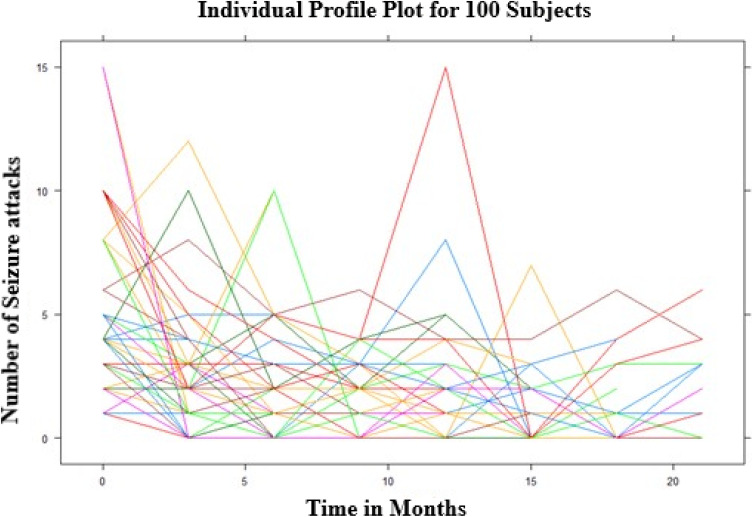
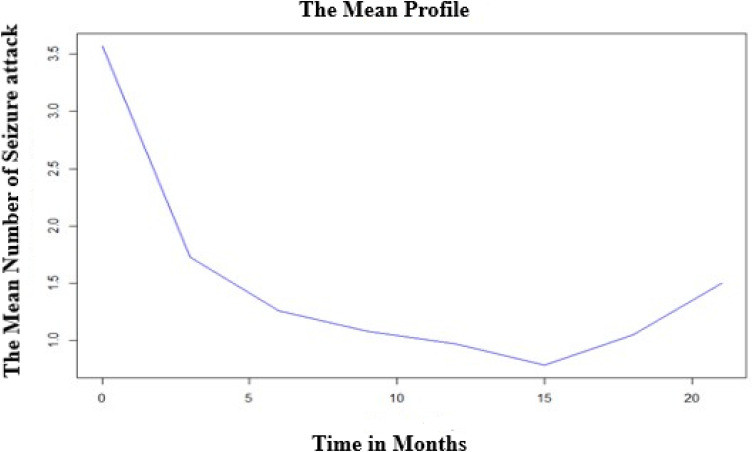
The median number of seizure attacks at baseline were 3 with the IQR of 2 and on average the frequency of seizure attacks decrease in a linear pattern over time. Age group 25-34 years (AIRR = 0.81 and 95% CI: 0.69-0.94), smoking (AIRR = 1.28 and 95% CI: 1.11-1.48), khat use (AIRR = 1.39 and 95% CI: 1.19-1.62), sleep deprivation (AIRR = 1.49 and 95% CI: 1.32-1.69), head injury (AIRR = 1.30 and 95% CI: 1.11-1.53), depression (AIRR = 1.39 and 95% CI: 1.17-1.65), treatment mode (AIRR= 1.22 and 95% CI: 1.07-1.39), and clumsiness (AIRR= 1.85 and 95% CI: 1.24-2.75) were statistically significant seizure predicting factors.
The number of seizure attack changes over time was decreased by a linear function that might reflect treatment effects of AEDs. Smokers, khat chewers, suffering a head injury, depression, experienced sleep deprivation, and clumsiness increases the number of seizure attacks. Conversely, the age group 25-34 years saw a decrease in the number of seizure attacks. This underscores that special attention should be given to substance users and those with related mental health disorders.
约三分之二的癫痫患者在接受抗癫痫药物(AEDs)治疗后进入无癫痫发作状态,但其中一些患者仍会继续发作,这增加了事故、残疾、死亡及治疗副作用的风险。因此,本研究旨在确定成年癫痫患者癫痫发作频率随时间的变化以及相关因素。
对2017年7月至2019年6月开始使用AEDs的成年癫痫患者进行了一项为期两年的回顾性随访研究。采用简单随机抽样技术选取394份患者病历。数据录入Epi - data,然后导出到R软件进行进一步分析。应用负二项分布族下的广义线性混合模型来确定癫痫发作频率的决定因素。
基线时癫痫发作的中位数为3次,四分位间距为2次,癫痫发作频率平均随时间呈线性下降。25 - 34岁年龄组(发病率比=0.81,95%置信区间:0.69 - 0.94)、吸烟(发病率比=1.28,95%置信区间:1.11 - 1.48)、咀嚼巧茶(发病率比=1.39,95%置信区间:1.19 - 1.62)、睡眠剥夺(发病率比=1.49,95%置信区间:1.32 - 1.69)、头部受伤(发病率比=1.30,95%置信区间:1.11 - 1.53)、抑郁(发病率比=1.39,95%置信区间:1.17 - 1.65)、治疗方式(发病率比=1.22,95%置信区间:1.07 - 1.39)以及笨拙(发病率比=1.85,95%置信区间:1.24 - 2.75)是具有统计学意义的癫痫发作预测因素。
癫痫发作次数随时间的变化呈线性下降,这可能反映了AEDs的治疗效果。吸烟者、咀嚼巧茶者、头部受伤者、抑郁者、经历睡眠剥夺者以及笨拙者的癫痫发作次数增加。相反,25 - 34岁年龄组的癫痫发作次数减少。这强调了应特别关注物质使用者和患有相关精神健康障碍的人群。