Dai Tianxing, Li Jing, Lu Xu, Ye Linsen, Yu Haoyuan, Zhang Lele, Deng Mingbin, Zhu Shuguang, Liu Wei, Wang Guoying, Yang Yang
Department of Hepatic Surgery and Liver Transplant Program, The Third Affiliated Hospital of Sun Yat-Sen University, Guangzhou, People's Republic of China.
Department of Infectious Diseases and Hepatology Unit, Nanfang Hospital, Southern Medical University, Guangzhou, People's Republic of China.
Pharmgenomics Pers Med. 2021 Aug 3;14:927-945. doi: 10.2147/PGPM.S319524. eCollection 2021.
Ferroptosis, as a novel regulated cell death form, has a close interaction with metabolism, which is largely unknown in cancer. In the present study, we conducted a comprehensive analysis of ferroptosis-related metabolic genes to delineate the metabolic signatures induced by ferroptosis and evaluate its prognostic significance in hepatocellular carcinoma (HCC).
The ferroptosis-related metabolic genes (Fer-MRGs) were identified by correlation analyses with transcriptome data from The Cancer Genome Atlas and Gene Expression Omnibus. Then, univariate and the least absolute shrinkage and selection operator Cox regression analysis was used to establish a novel risk score model. Univariate and multivariate COX analyses were used to identify independent prognostic factors for overall survival (OS) of HCC, and a nomogram was developed. The Fer-MRGs' expression was further evaluated by quantitative real-time polymerase chain reaction in HCC.
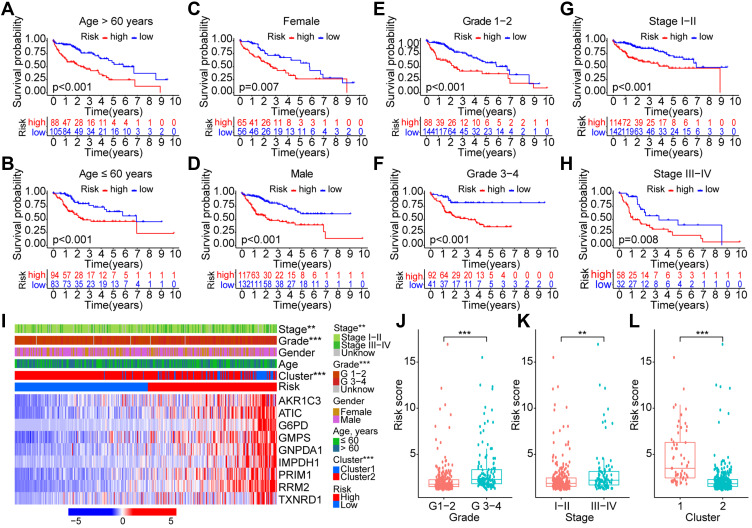
A total of 77 metabolic genes were identified as Fer-MRGs, and 26 were found with prognostic values for OS of HCC. Then, a novel nine-gene (AKR1C3, ATIC, G6PD, GMPS, GNPDA1, IMPDH1, PRIM1, RRM2, and TXNRD1) risk score model was constructed. Survival analyses showed worse OS in high-risk patients both in the training and validation groups. The model was also identified as an independent prognostic factor for HCC, and a prognostic nomogram for OS was further established with superior discriminative capacity and prediction accuracy. Notably, close correlations were also identified between the risk score and the expression of immune checkpoint genes, immune subtypes of tumor, and susceptibility of HCC to chemotherapeutic agents. Finally, elevated expression of eight Fer-MRGs (except for IMPDH1) was further verified in 16 pairs of HCC tumor and adjacent tissues.
These results indicated the intense interaction between ferroptosis and metabolism, the significant role of ferroptosis-related MRGs, and the great potential of the novel risk score model for prognosis prediction in HCC.
铁死亡作为一种新型的调控性细胞死亡形式,与代谢密切相关,而在癌症中这方面大多未知。在本研究中,我们对铁死亡相关代谢基因进行了全面分析,以描绘铁死亡诱导的代谢特征,并评估其在肝细胞癌(HCC)中的预后意义。
通过与来自癌症基因组图谱和基因表达综合数据库的转录组数据进行相关性分析,鉴定出铁死亡相关代谢基因(Fer-MRGs)。然后,使用单变量和最小绝对收缩和选择算子Cox回归分析建立一个新的风险评分模型。采用单变量和多变量COX分析来确定HCC总生存期(OS)的独立预后因素,并绘制列线图。通过定量实时聚合酶链反应进一步评估HCC中Fer-MRGs的表达。
共鉴定出77个代谢基因作为Fer-MRGs,其中26个对HCC的OS具有预后价值。随后,构建了一个新的九基因(AKR1C3、ATIC、G6PD、GMPS、GNPDA1、IMPDH1、PRIM1、RRM2和TXNRD1)风险评分模型。生存分析显示,训练组和验证组中的高危患者OS较差。该模型也被确定为HCC的独立预后因素,并进一步建立了具有卓越判别能力和预测准确性的OS预后列线图。值得注意的是,还发现风险评分与免疫检查点基因的表达、肿瘤的免疫亚型以及HCC对化疗药物的敏感性之间存在密切相关性。最后,在16对HCC肿瘤组织和癌旁组织中进一步验证了8个Fer-MRGs(IMPDH1除外)的表达升高。
这些结果表明铁死亡与代谢之间存在紧密相互作用,铁死亡相关MRGs具有重要作用,以及新的风险评分模型在HCC预后预测方面具有巨大潜力。