Lyu Ruiqing, Singh Sanjay K, Liu Yongliang, Patra Barunava, Zhou Yan, Wang Bingwu, Pattanaik Sitakanta, Yuan Ling
Department of Plant and Soil Sciences and the Kentucky Tobacco Research and Development Center, University of Kentucky, 1401 University Drive, Lexington, KY 40546 USA.
South China Botanical Garden, Chinese Academy of Sciences, Guangzhou, 510650 China.
aBIOTECH. 2021;2(3):226-239. doi: 10.1007/s42994-021-00053-2. Epub 2021 Jun 17.
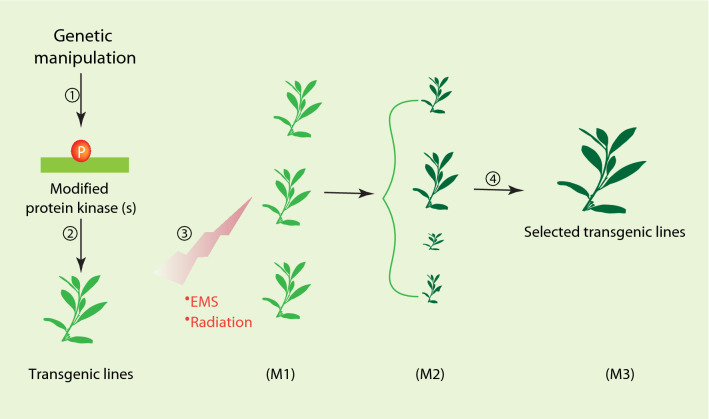
Being sessile, plants have evolved sophisticated mechanisms to balance between growth and defense to survive in the harsh environment. The transition from growth to defense is commonly achieved by factors, such as protein kinases (PKs) and transcription factors, that initiate signal transduction and regulate specialized metabolism. Plants produce an array of lineage-specific specialized metabolites for chemical defense and stress tolerance. Some of these molecules are also used by humans as drugs. However, many of these defense-responsive metabolites are toxic to plant cells and inhibitory to growth and development. Plants have, thus, evolved complex regulatory networks to balance the accumulation of the toxic metabolites. Perception of external stimuli is a vital part of the regulatory network. Protein kinase-mediated signaling activates a series of defense responses by phosphorylating the target proteins and translating the stimulus into downstream cellular signaling. As biosynthesis of specialized metabolites is triggered when plants perceive stimuli, a possible connection between PKs and specialized metabolism is well recognized. However, the roles of PKs in plant specialized metabolism have not received much attention until recently. Here, we summarize the recent advances in understanding PKs in plant specialized metabolism. We aim to highlight how the stimulatory signals are transduced, leading to the biosynthesis of corresponding metabolites. We discuss the post-translational regulation of specialized metabolism and provide insights into the mechanisms by which plants respond to the external signals. In addition, we propose possible strategies to increase the production of plant specialized metabolites in biotechnological applications using PKs.
由于植物固着生长,它们进化出了复杂的机制来平衡生长和防御,以便在恶劣环境中生存。从生长到防御的转变通常由蛋白质激酶(PKs)和转录因子等因子来实现,这些因子启动信号转导并调节特殊代谢。植物产生一系列谱系特异性的特殊代谢产物用于化学防御和胁迫耐受。其中一些分子也被人类用作药物。然而,许多这些防御反应性代谢产物对植物细胞有毒,并抑制生长和发育。因此,植物进化出了复杂的调控网络来平衡有毒代谢产物的积累。对外部刺激的感知是调控网络的重要组成部分。蛋白质激酶介导的信号传导通过磷酸化靶蛋白并将刺激转化为下游细胞信号来激活一系列防御反应。由于植物感知刺激时会触发特殊代谢产物的生物合成,PKs与特殊代谢之间的可能联系已得到广泛认可。然而,直到最近,PKs在植物特殊代谢中的作用才受到较多关注。在这里,我们总结了在理解PKs在植物特殊代谢中的作用方面的最新进展。我们旨在强调刺激信号是如何转导的,从而导致相应代谢产物的生物合成。我们讨论了特殊代谢的翻译后调控,并深入了解植物对外部信号的响应机制。此外,我们提出了在生物技术应用中利用PKs增加植物特殊代谢产物产量的可能策略。