Department of Gastroenterology, Hepatobiliary and Pancreatic Medical Oncology Division, Kanagawa Cancer Center, Kanagawa, Japan.
Molecular Pathology and Genetics Division, Kanagawa Cancer Center Research Institute, Kanagawa, Japan.
Cancer Sci. 2021 Nov;112(11):4679-4691. doi: 10.1111/cas.15106. Epub 2021 Aug 30.
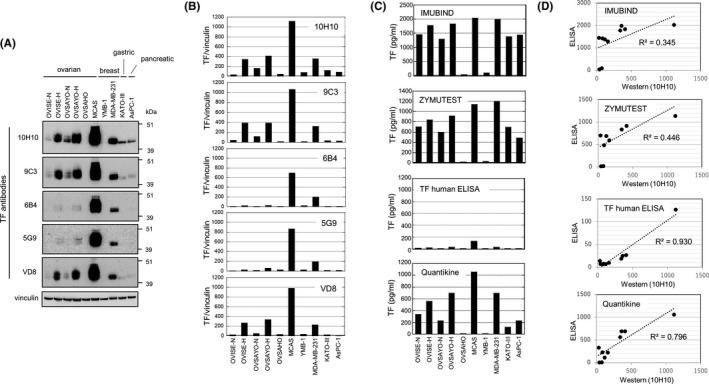
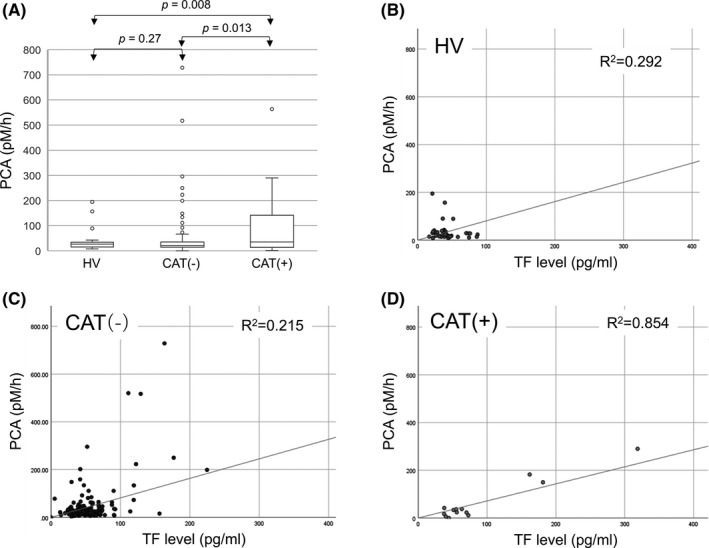
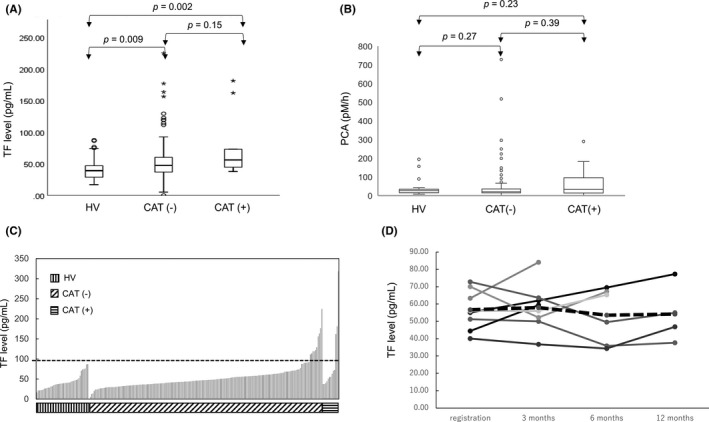
Pancreatic cancer frequently involves cancer-associated thromboembolism, which is strongly associated with poor prognosis. Tissue factor, a blood coagulation factor largely produced in cancer patients as a component of extracellular vesicles, plays a key role in the incidence of cancer-associated thromboembolism in patients with pancreatic cancer. However, no prospective studies have been published on the relationship between tissue factor and cancer-associated thromboembolism or patient clinical characteristics, including recent chemotherapy regimens. Thus, we aimed to address this in a Japanese cohort of 197 patients and 41 healthy volunteers. Plasma tissue factor levels were measured by ELISAs preevaluated by tissue factor specificity. Multivariable analysis was used to identify independent predictors of cancer-associated thromboembolism. We found that the cancer-associated thromboembolism rate in the patient cohort was 6.6% (4.6%, venous thromboembolism; 2.0%, arterial thromboembolism). Tissue factor levels of 100 pg/mL or higher at patient registration were predictive of cancer-associated thromboembolism, with positive and negative predictive values of 23.1% and 94.6%, respectively. Multivariable analysis showed that plasma tissue factor levels were an independent predictive factor for cancer-associated thromboembolism, with a risk ratio of 5.54 (95% confidence interval, 1.02-30.09). Unlike in healthy volunteers and patients without cancer-associated thromboembolism, tissue factor levels were highly correlated with extracellular vesicles' procoagulant activity in patients developing cancer-associated thromboembolism. Taken together, our data show that the tissue factor levels at patient registration were a predictive factor for cancer-associated thromboembolism in this cohort of patients with pancreatic cancer.
胰腺癌常伴有癌相关血栓栓塞,这与预后不良密切相关。组织因子是一种凝血因子,在癌症患者中主要作为细胞外囊泡的组成部分产生,在胰腺癌患者癌相关血栓栓塞的发生中起关键作用。然而,目前尚无关于组织因子与癌相关血栓栓塞或患者临床特征(包括最近的化疗方案)之间关系的前瞻性研究。因此,我们旨在对 197 名患者和 41 名健康志愿者组成的日本队列进行研究。通过对组织因子特异性进行预评估的 ELISA 测量血浆组织因子水平。使用多变量分析来确定癌相关血栓栓塞的独立预测因素。我们发现,患者队列的癌相关血栓栓塞发生率为 6.6%(4.6%为静脉血栓栓塞,2.0%为动脉血栓栓塞)。患者登记时组织因子水平为 100 pg/mL 或更高可预测癌相关血栓栓塞,阳性预测值和阴性预测值分别为 23.1%和 94.6%。多变量分析表明,血浆组织因子水平是癌相关血栓栓塞的独立预测因素,风险比为 5.54(95%置信区间,1.02-30.09)。与健康志愿者和无癌相关血栓栓塞的患者不同,在发生癌相关血栓栓塞的患者中,组织因子水平与细胞外囊泡的促凝活性高度相关。总之,我们的数据表明,患者登记时的组织因子水平是该胰腺癌患者队列中癌相关血栓栓塞的预测因素。