Vanderbilt University Medical Center, Nashville, TN, USA.
Metro Nashville Public Schools, Nashville, TN, USA.
J Prim Care Community Health. 2021 Jan-Dec;12:21501327211037892. doi: 10.1177/21501327211037892.
INTRODUCTION/OBJECTIVES: Despite compelling evidence of clinical and economic benefits, adherence to colorectal cancer (CRC) screening remains low. Increasing public awareness through various outreach methods may improve screening uptake. The objective of this study was to evaluate the uptake of non-invasive multi-target stool DNA (mt-sDNA) by different outreach methods in an average-risk employer population.
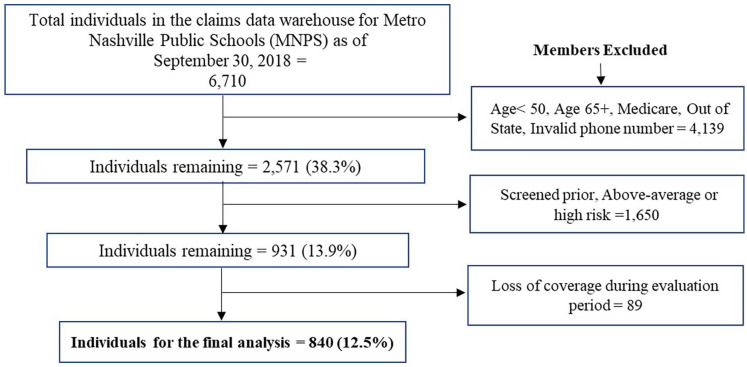
This retrospective observational study included CRC screening-eligible individuals aged ≥50 years insured by the Metropolitan Nashville Public Schools (MNPS) employee healthcare plan. The study intervention arms included population-based outreach and office visit-based interaction. The mt-sDNA completion rate (proportion of individuals who return the mt-sDNA kit after consenting to have it shipped to their home), proportion of patients who performed follow-up colonoscopy after a positive test, and time to follow-up colonoscopy were assessed.
A total of 167 mt-sDNA kits were shipped to eligible participants (aged 50-64 years) in the population-based outreach arm. In the office visit-based interaction arm, a total of 132 mt-sDNA kits were shipped to eligible participants (aged ≥50 years). The mt-sDNA completion rate was significantly higher for office visit-based interaction as compared to population-based outreach (76.8% vs 53.5%; < .001) among those aged 50 to 64 years. While all patients aged 50 to 64 years with a positive mt-sDNA result received a follow-up colonoscopy in both arms, the median time to follow-up colonoscopy was shorter among the population-based outreach (55 vs 136 days; < .05).
Office visit-based interaction was associated with a higher mt-sDNA completion rate as compared to the population-based outreach among average-risk, CRC screening-eligible individuals aged 50 to 64 years old.
简介/目的:尽管有令人信服的临床和经济效益证据,但结直肠癌(CRC)筛查的依从性仍然很低。通过各种外展方法提高公众意识可能会提高筛查率。本研究的目的是评估通过不同外展方法在平均风险雇主人群中对非侵入性多靶点粪便 DNA(mt-sDNA)的接受程度。
本回顾性观察性研究包括年龄在 50 岁及以上且有资格接受 CRC 筛查的大都会纳什维尔公立学校(MNPS)员工医保计划的参保者。研究干预组包括基于人群的外展和基于就诊的互动。评估 mt-sDNA 完成率(在同意将 mt-sDNA 试剂盒寄送到其家中后返回试剂盒的个体比例)、阳性检测后进行后续结肠镜检查的患者比例以及后续结肠镜检查的时间。
在基于人群的外展组中,共向符合条件的参与者(年龄在 50-64 岁之间)寄出了 167 个 mt-sDNA 试剂盒。在基于就诊的互动组中,共向符合条件的参与者(年龄≥50 岁)寄出了 132 个 mt-sDNA 试剂盒。在年龄在 50-64 岁之间的人群中,与基于人群的外展相比,基于就诊的互动的 mt-sDNA 完成率明显更高(76.8%对 53.5%;<0.001)。虽然在两条臂中,所有年龄在 50-64 岁之间 mt-sDNA 阳性结果的患者均接受了后续结肠镜检查,但基于人群的外展组的中位随访结肠镜检查时间更短(55 对 136 天;<0.05)。
与基于人群的外展相比,基于就诊的互动在年龄在 50-64 岁的平均风险、CRC 筛查合格人群中与更高的 mt-sDNA 完成率相关。