Department of Neurology, Ibn Sina Hospital, Gamal Abdel Nasser Street, Sabah Medical Area, Safat, Kuwait.
Department of Neurology and Psychiatry, University of Alexandria, Alexandria, Egypt.
J Neurol. 2022 Feb;269(2):541-576. doi: 10.1007/s00415-021-10752-x. Epub 2021 Aug 12.
Since the declaration of COVID-19 pandemic, several case reports of demyelination of both peripheral and central nervous systems have been published. The association between CNS demyelination and viral infection has long been documented, and this link was recently reported following SARS-CoV-2 infection as well.
In this systematic review, we aim to investigate the existing literature on CNS demyelination associated with SARS-CoV-2, and the proposed pathophysiological mechanisms.
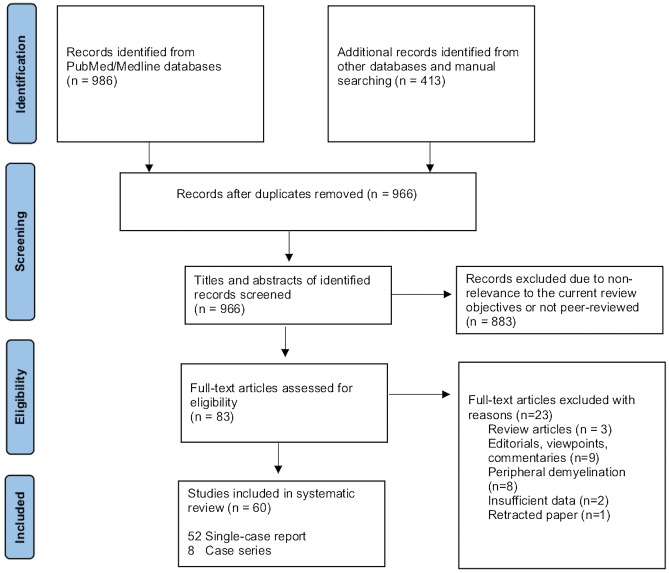
We conducted a systematic review of articles in PubMed, SCOPUS, EMBASE, Cochrane, Google Scholar and Ovid databases, from 1 January 2020 until June 15, 2021. The following keywords were used: "COVID-19", "SARS-CoV-2", "demyelination", "demyelinating disease", "multiple sclerosis", "neuromyelitis optica", and "transverse myelitis".
A total of 60 articles were included in the final analysis of this systematic review and included 102 patients: 52 (51%) men and 50 (49%) women, with a median age of 46.5 years. The demyelination mimicked a variety of conditions with a picture of encephalitis/encephalomyelitis being the most common. At the same time other patterns were less frequently reported such as MS, NMOSD and even MOGAD. Longitudinally extensive transverse myelitis (LETM) was the most frequently reported pattern of spinal cord involvement.
A growing body of literature has shown an association between SARS-CoV-2 infection and the development of different types of CNS demyelination. Although causality cannot readily be inferred, this review may suggest a probable causal relationship, through a para-infectious or post-infectious immune-mediated etiology in COVID-19 patients. This relationship needs to be clarified in future research.
自宣布 COVID-19 大流行以来,已经发表了几例外周和中枢神经系统脱髓鞘的病例报告。中枢神经系统脱髓鞘与病毒感染之间的关联早已得到证实,最近也有报道称 SARS-CoV-2 感染后也存在这种关联。
在本系统综述中,我们旨在调查与 SARS-CoV-2 相关的中枢神经系统脱髓鞘的现有文献,并提出潜在的病理生理学机制。
我们在 PubMed、SCOPUS、EMBASE、Cochrane、Google Scholar 和 Ovid 数据库中进行了系统综述,检索时间从 2020 年 1 月 1 日至 2021 年 6 月 15 日。使用了以下关键词:“COVID-19”、“SARS-CoV-2”、“脱髓鞘”、“脱髓鞘疾病”、“多发性硬化症”、“视神经脊髓炎”和“横贯性脊髓炎”。
本系统综述共纳入 60 篇文章,其中包括 102 例患者:52 例(51%)为男性,50 例(49%)为女性,中位年龄为 46.5 岁。脱髓鞘病变模仿了多种疾病,以脑炎/脑脊髓炎最为常见。同时,其他病变模式也有报道,如 MS、NMOSD,甚至 MOGAD。长节段横贯性脊髓炎(LETM)是最常见的脊髓受累模式。
越来越多的文献表明 SARS-CoV-2 感染与不同类型的中枢神经系统脱髓鞘之间存在关联。虽然不能轻易推断因果关系,但通过 COVID-19 患者的潜在感染或感染后免疫介导机制,本综述可能提示存在一种可能的因果关系。这一关系需要在未来的研究中进一步澄清。