Department of Neurosurgery, Hyogo College of Medicine, Nishinomiya, Japan.
Department of Clinical Epidemiology, Hyogo College of Medicine, 1-1 Mukogawa, Nishinomiya, Hyogo, 663-8501, Japan.
Transl Stroke Res. 2022 Jun;13(3):370-381. doi: 10.1007/s12975-021-00937-x. Epub 2021 Aug 14.
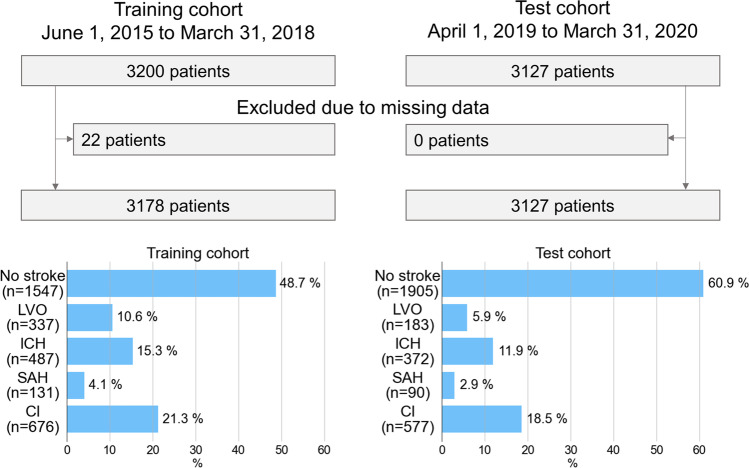
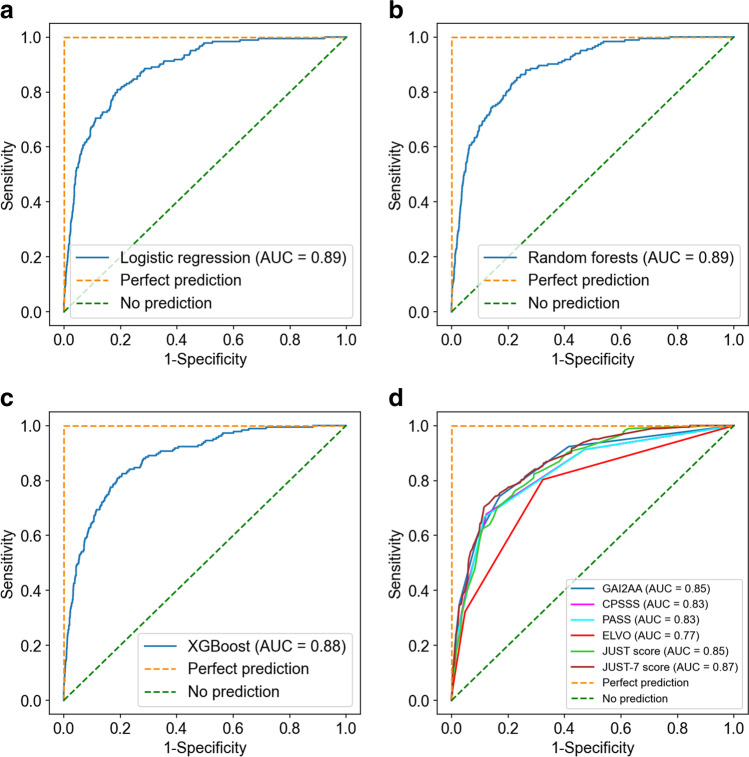
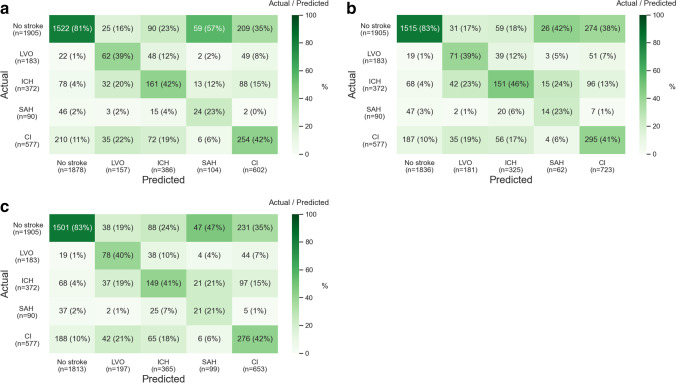
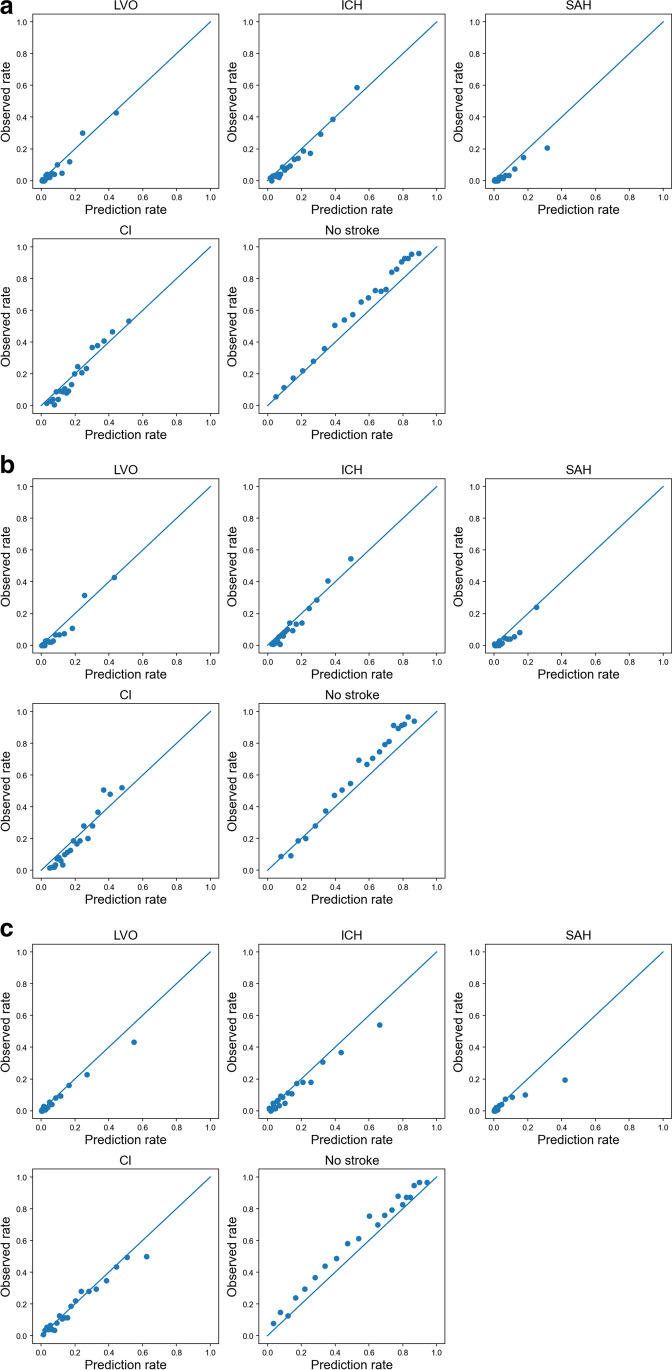
In conjunction with recent advancements in machine learning (ML), such technologies have been applied in various fields owing to their high predictive performance. We tried to develop prehospital stroke scale with ML. We conducted multi-center retrospective and prospective cohort study. The training cohort had eight centers in Japan from June 2015 to March 2018, and the test cohort had 13 centers from April 2019 to March 2020. We use the three different ML algorithms (logistic regression, random forests, XGBoost) to develop models. Main outcomes were large vessel occlusion (LVO), intracranial hemorrhage (ICH), subarachnoid hemorrhage (SAH), and cerebral infarction (CI) other than LVO. The predictive abilities were validated in the test cohort with accuracy, positive predictive value, sensitivity, specificity, area under the receiver operating characteristic curve (AUC), and F score. The training cohort included 3178 patients with 337 LVO, 487 ICH, 131 SAH, and 676 CI cases, and the test cohort included 3127 patients with 183 LVO, 372 ICH, 90 SAH, and 577 CI cases. The overall accuracies were 0.65, and the positive predictive values, sensitivities, specificities, AUCs, and F scores were stable in the test cohort. The classification abilities were also fair for all ML models. The AUCs for LVO of logistic regression, random forests, and XGBoost were 0.89, 0.89, and 0.88, respectively, in the test cohort, and these values were higher than the previously reported prediction models for LVO. The ML models developed to predict the probability and types of stroke at the prehospital stage had superior predictive abilities.
结合机器学习(ML)的最新进展,由于其具有较高的预测性能,这些技术已被应用于各个领域。我们尝试使用 ML 开发院前卒中量表。我们进行了多中心回顾性和前瞻性队列研究。训练队列来自日本的 8 个中心,时间为 2015 年 6 月至 2018 年 3 月,测试队列来自 2019 年 4 月至 2020 年 3 月的 13 个中心。我们使用三种不同的 ML 算法(逻辑回归、随机森林、XGBoost)来开发模型。主要结局是大血管闭塞(LVO)、颅内出血(ICH)、蛛网膜下腔出血(SAH)和除 LVO 以外的脑梗死(CI)。在测试队列中,通过准确性、阳性预测值、敏感性、特异性、接收者操作特征曲线(ROC)下面积(AUC)和 F 分数验证了预测能力。训练队列包括 3178 例患者,其中 337 例 LVO、487 例 ICH、131 例 SAH 和 676 例 CI 病例,测试队列包括 3127 例患者,其中 183 例 LVO、372 例 ICH、90 例 SAH 和 577 例 CI 病例。总体准确率为 0.65,阳性预测值、敏感性、特异性、AUC 和 F 分数在测试队列中保持稳定。所有 ML 模型的分类能力也相当不错。在测试队列中,逻辑回归、随机森林和 XGBoost 的 LVO 的 AUC 分别为 0.89、0.89 和 0.88,这些值高于先前报道的 LVO 预测模型。用于预测院前阶段卒中概率和类型的 ML 模型具有较好的预测能力。