Department of Health Policy, London School of Economics, London, UK.
Department of Health Policy and Management, Harvard T.H. Chan School of Public Health, Boston, Massachusetts, USA.
Health Serv Res. 2021 Dec;56 Suppl 3(Suppl 3):1335-1346. doi: 10.1111/1475-6773.13739. Epub 2021 Aug 14.
This study explores differences in spending and utilization of health care services for an older person with frailty before and after a hip fracture.
We used individual-level patient data from five care settings.
We compared utilization and spending of an older person aged older than 65 years for 365 days before and after a hip fracture across 11 countries and five domains of care as follows: acute hospital care, primary care, outpatient specialty care, post-acute rehabilitative care, and outpatient drugs. Utilization and spending were age and sex standardized..
DATA COLLECTION/EXTRACTION METHODS: The data were compiled by the International Collaborative on Costs, Outcomes, and Needs in Care (ICCONIC) across 11 countries as follows: Australia, Canada, England, France, Germany, the Netherlands, New Zealand, Spain, Sweden, Switzerland, and the United States.
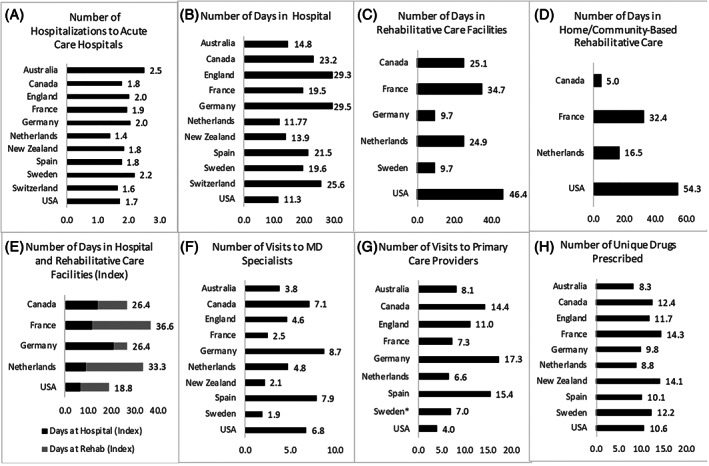
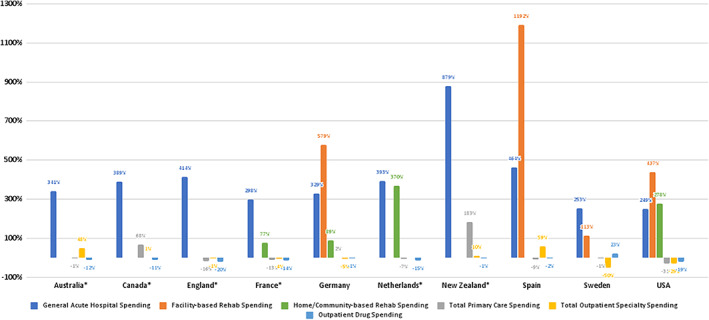
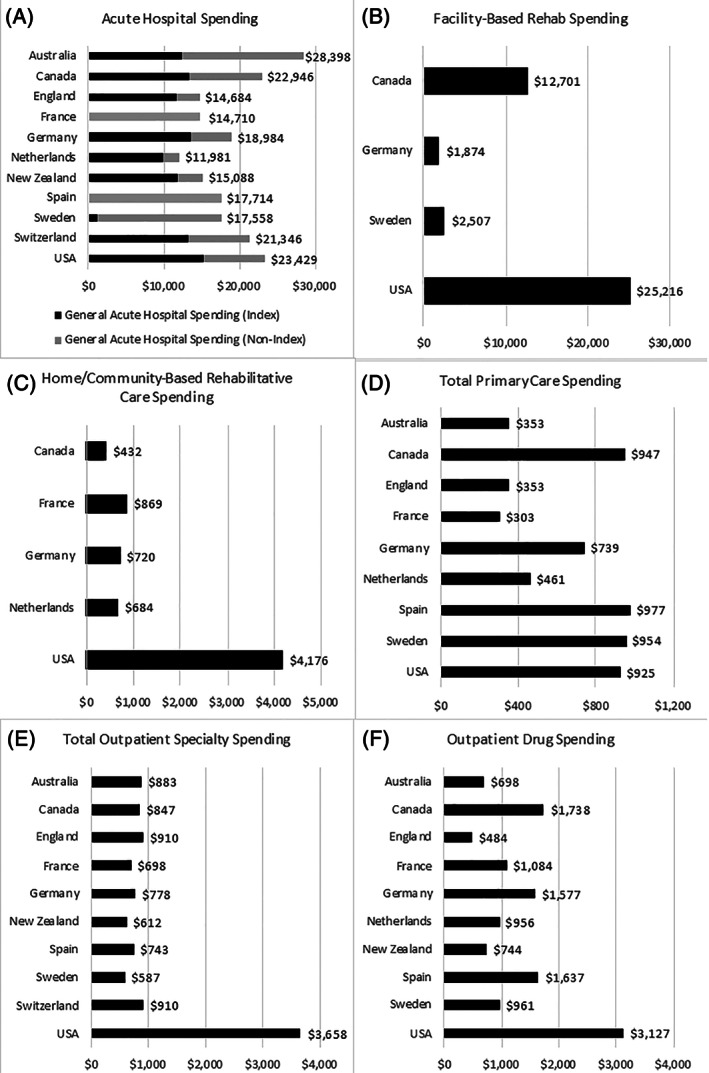
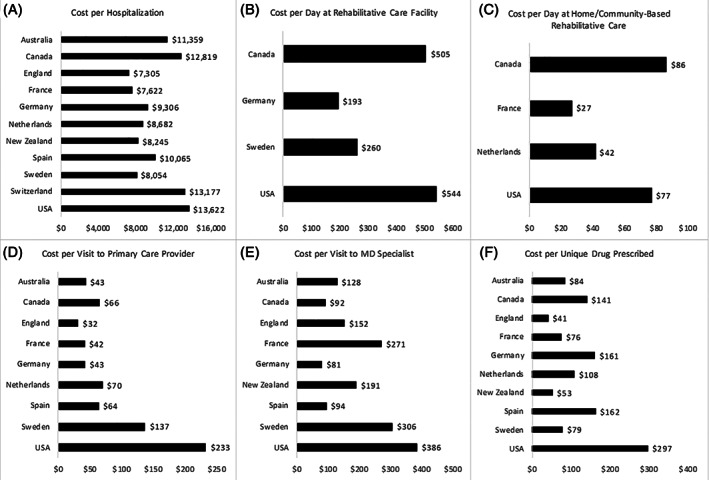
The sample ranged from 1859 patients in Spain to 42,849 in France. Mean age ranged from 81.2 in Switzerland to 84.7 in Australia. The majority of patients across countries were female. Relative to other countries, the United States had the lowest inpatient length of stay (11.3), but the highest number of days were spent in post-acute care rehab (100.7) and, on average, had more visits to specialist providers (6.8 per year) than primary care providers (4.0 per year). Across almost all sectors, the United States spent more per person than other countries per unit ($13,622 per hospitalization, $233 per primary care visit, $386 per MD specialist visit). Patients also had high expenditures in the year prior to the hip fracture, mostly concentrated in the inpatient setting.
Across 11 high-income countries, there is substantial variation in health care spending and utilization for an older person with frailty, both before and after a hip fracture. The United States is the most expensive country due to high prices and above average utilization of post-acute rehab care.
本研究探讨了一位体弱老年人髋部骨折前后医疗服务的支出和利用情况的差异。
我们使用了来自五个护理环境的个体患者数据。
我们比较了 11 个国家和五个护理领域(急性医院护理、初级护理、门诊专科护理、康复后护理和门诊药物)中 65 岁以上老年人在髋部骨折前后 365 天的利用情况和支出情况。利用情况和支出情况按年龄和性别标准化。
资料收集/提取方法:这些数据是由 11 个国家的国际成本、结果和护理需求协作组织(ICCONIC)汇编而成的,这些国家包括澳大利亚、加拿大、英国、法国、德国、荷兰、新西兰、西班牙、瑞典、瑞士和美国。
样本范围从西班牙的 1859 名患者到法国的 42849 名患者。平均年龄从瑞士的 81.2 岁到澳大利亚的 84.7 岁不等。大多数国家的患者都是女性。与其他国家相比,美国的住院时间最短(11.3 天),但在康复后护理方面的天数最多(100.7 天),平均每年就诊专科医生(6.8 次)多于初级保健医生(4.0 次)。在几乎所有部门,美国的人均支出都高于其他国家,每单位(每次住院治疗 13622 美元,每次初级保健就诊 233 美元,每次 MD 专科就诊 386 美元)。在髋部骨折之前的一年里,患者也有很高的支出,主要集中在住院治疗上。
在 11 个高收入国家中,体弱老年人髋部骨折前后的医疗支出和利用存在很大差异。美国是最昂贵的国家,原因是康复后护理的价格高,利用率也高于平均水平。