Medical and Clinical Affairs, Satellite Healthcare, San Jose, California; Clinical and Health Sciences, University of South Australia, Adelaide, South Australia, Australia.
Department of Internal Medicine and Rehabilitation Science, Tohoku University Graduate School of Medicine, Sendai City, Japan.
J Ren Nutr. 2022 Jul;32(4):441-449. doi: 10.1053/j.jrn.2021.06.007. Epub 2021 Aug 13.
Impairment in physical function and physical performance leads to decreased independence and health-related quality of life in people living with chronic kidney disease and end-stage kidney disease. Physical activity and exercise in kidney care are not priorities in policy development. We aimed to identify global policy-related enablers, barriers, and strategies to increase exercise participation and physical activity behavior for people living with kidney disease.
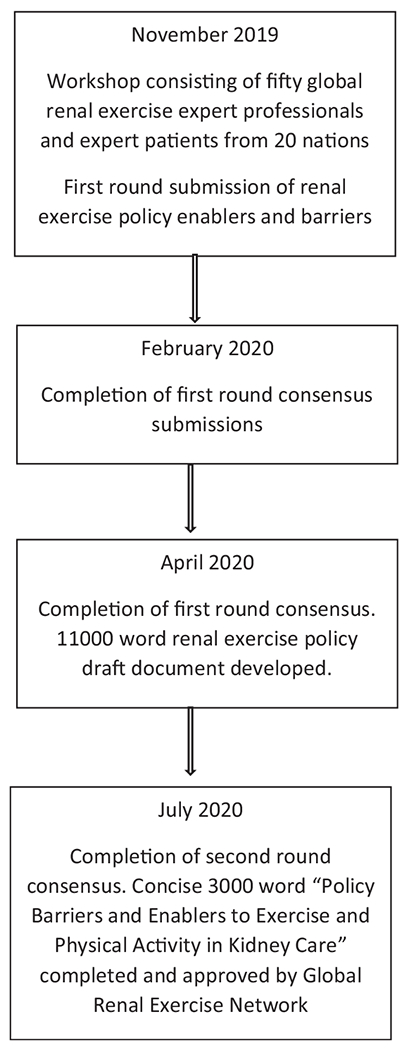
Guided by the Behavior Change Wheel theoretical framework, 50 global renal exercise experts developed policy barriers and enablers to exercise program implementation and physical activity promotion in kidney care. The consensus process consisted of developing themes from renal experts from North America, South America, Continental Europe, United Kingdom, Asia, and Oceania. Strategies to address enablers and barriers were identified by the group, and consensus was achieved.
We found that policies addressing funding, service provision, legislation, regulations, guidelines, the environment, communication, and marketing are required to support people with kidney disease to be physically active, participate in exercise, and improve health-related quality of life. We provide a global perspective and highlight Japanese, Canadian, and other regional examples where policies have been developed to increase renal physical activity and rehabilitation. We present recommendations targeting multiple stakeholders including nephrologists, nurses, allied health clinicians, organizations providing renal care and education, and renal program funders.
We strongly recommend the nephrology community and people living with kidney disease take action to change policy now, rather than idly waiting for indisputable clinical trial evidence that increasing physical activity, strength, fitness, and function improves the lives of people living with kidney disease.
身体功能和身体表现的损伤会导致慢性肾脏病和终末期肾病患者的独立性下降和健康相关生活质量下降。在肾脏保健中,身体活动和运动不是政策制定的重点。我们旨在确定全球与政策相关的促进因素、障碍因素和策略,以增加肾病患者的锻炼参与度和身体活动行为。
在行为改变轮理论框架的指导下,50 名全球肾脏运动专家制定了实施运动计划和促进肾脏保健中身体活动的政策障碍和促进因素。这一共识过程包括从北美、南美、欧洲大陆、英国、亚洲和大洋洲的肾脏专家中发展主题。专家组确定了解决促进因素和障碍的策略,并达成了共识。
我们发现,需要制定解决资金、服务提供、立法、法规、指南、环境、沟通和营销问题的政策,以支持肾病患者积极参与身体活动、参加运动并提高健康相关生活质量。我们提供了全球视角,并强调了日本、加拿大和其他地区制定政策以增加肾脏身体活动和康复的例子。我们提出了针对多个利益相关者的建议,包括肾病学家、护士、联合健康临床医生、提供肾脏护理和教育的组织以及肾脏项目资助者。
我们强烈建议肾脏病学界和肾病患者现在就采取行动改变政策,而不是无所事事地等待无可争议的临床试验证据表明增加身体活动、力量、健身和功能可以改善肾病患者的生活。