Department of Community Health and Primary Care, College of Medicine University of Lagos. Lagos State, Nigeria.
Federal Medical Centre Umuahia, Abia State, Nigeria.
Afr Health Sci. 2020 Dec;20(4):1943-1954. doi: 10.4314/ahs.v20i4.53.
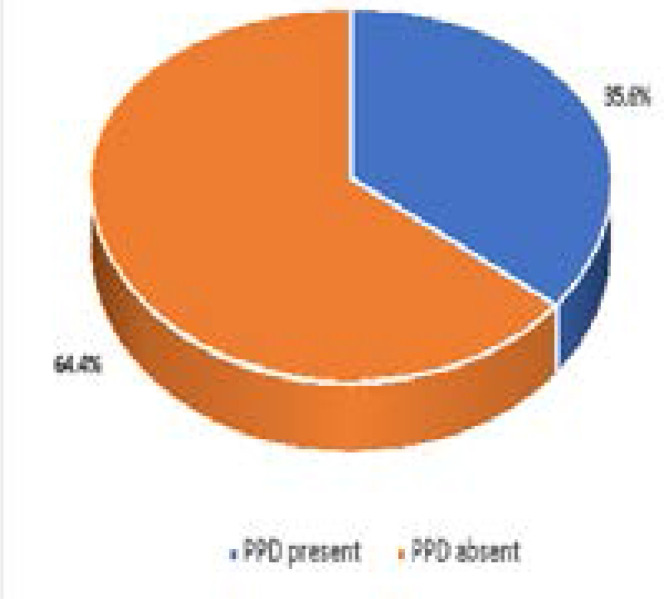
Globally, postpartum depression is one of the most common but often unrecognized complications of childbirth, yearly affecting about 10-15% of postnatal women. This study aimed to determine the prevalence of postpartum depression and its predictors among postnatal women in Lagos.
A descriptive cross-sectional study was conducted among 250 mothers in Eti-Osa Local Government Area of Lagos State, Nigeria, attending six Primary Health Care centers for infant immunization at six weeks post-delivery. Data was collected using a pretested semi-structured interviewer administered questionnaire which included the Edinburgh Postnatal Depression Scale. Analysis was carried out using SPSS version 23TM. Chi-square and logistic regression analyses were used to determine associations and predictive relationships between various factors and the presence of postpartum depression. The level of significance was set at <0.05.
The prevalence of postpartum depression was 35.6%. Multiparity, delivery by cesarean section, mother being unwell after delivery, and not exclusively breastfeeding the baby were the factors linked with postpartum depression. Following multiple logistic regression, having postpartum blues (p=0.000; OR=32.77; 95%CI=7.23-148.58)., not getting help with caring for the baby (p=0.008; OR=2.64; 95%CI=1.29-5.42), experiencing intimate partner violence (p=0.000; OR=5.2; 95%CI=2.23-11.91) and having an unsupportive partner (p=0.018; OR=2.6; 95%CI=1.17-5.78) were identified as predictors of postpartum depression.
This study revealed a high prevalence of postpartum depression, identifying both the obstetric and psychosocial predictors. Social support for women both in the pre- and postnatal periods and routine screening of women for postpartum depression should be encouraged for early detection and immediate intervention.
全球范围内,产后抑郁症是分娩后最常见但往往未被识别的并发症之一,每年约有 10-15%的产后女性受到影响。本研究旨在确定拉各斯产后女性产后抑郁症的患病率及其预测因素。
在尼日利亚拉各斯州埃蒂-奥萨地方政府区的六家初级保健中心,对 250 名产后六周内为婴儿进行免疫接种的母亲进行了一项描述性横断面研究。使用经过预测试的半结构式访谈者管理问卷收集数据,其中包括爱丁堡产后抑郁量表。使用 SPSS 版本 23TM 进行分析。卡方检验和逻辑回归分析用于确定各种因素与产后抑郁症之间的关联和预测关系。显著性水平设为<0.05。
产后抑郁症的患病率为 35.6%。多胎妊娠、剖宫产分娩、产后母亲身体不适以及婴儿未纯母乳喂养是与产后抑郁症相关的因素。经多因素逻辑回归分析,产后出现忧郁(p=0.000;OR=32.77;95%CI=7.23-148.58)、无法获得照顾婴儿的帮助(p=0.008;OR=2.64;95%CI=1.29-5.42)、遭受亲密伴侣暴力(p=0.000;OR=5.2;95%CI=2.23-11.91)和伴侣不支持(p=0.018;OR=2.6;95%CI=1.17-5.78)是产后抑郁症的预测因素。
本研究显示产后抑郁症的患病率较高,确定了产科和心理社会预测因素。应鼓励在产前和产后为妇女提供社会支持,并对妇女进行产后抑郁症常规筛查,以早期发现并立即进行干预。