Jilin University School of Nursing, Changchun City, Jilin, P.R. China.
Jilin Province People's Hospital, Changchun City, Jilin, P.R. China.
Medicine (Baltimore). 2021 Jul 30;100(30):e26701. doi: 10.1097/MD.0000000000026701.
Advanced cancer (AC) patients experience serious physical and psychological problems with the disease progression. When approaching the end of life, these patients have to cope with not only the bodily illness, but also the spiritual crisis. Conventional psychological treatments reduce distress to a certain extent, but for patients with AC, especially when they face progressive illness and are approaching death, their psychological problems are complex, and no simple solutions are in sight. Therefore, we designed this study to evaluate the efficacy of the combined Naikan therapy (NT) and Morita therapy (MT) on psychological distress and posttraumatic growth in patients with AC.
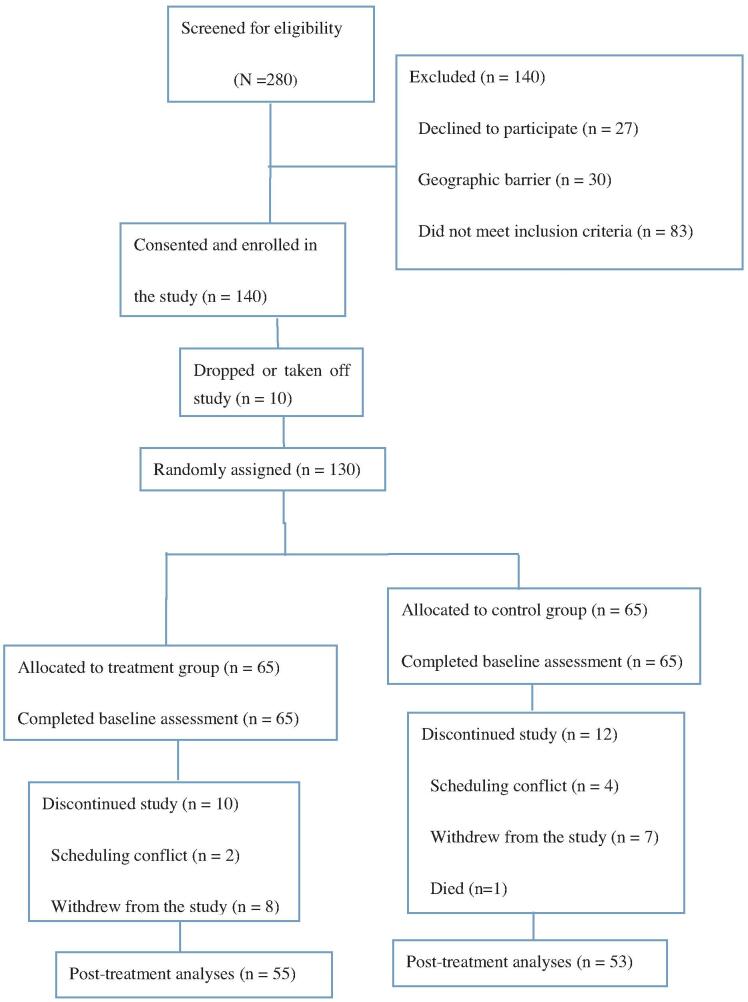
One hundred thirty patients newly diagnosed with AC were allocated randomly into treatment (n = 65) and control (n = 65) groups. Patients in the treatment group received combined NT and MT for 7 consecutive weeks, while the control group received normal medical treatments without NT and MT. Patients were assessed before and after the therapies. The primary outcome measures include distress thermometer (DT) and posttraumatic growth, and the secondary outcome measure contains the list of distress problems.
At the post-treatment stage, the treatment group displayed a decreased score of psychological distress as compared to that in the control group, which accompanied by a higher post-traumatic growth total score and subscale scores in relationship to others, new possibilities, personal strength, spiritual changes, and appreciation of life. A significant decrease in fear, sleeping difficulty/insomnia, nervousness/anxiety, and loss of appetite was also observed in the treatment group.
The results proved that the combined Naikan and Morita therapies decreased the psychological distress and improved the posttraumatic growth of the patients with AC.
ChiCTR1900026691.
晚期癌症(AC)患者随着疾病的进展会经历严重的身体和心理问题。当接近生命的尽头时,这些患者不仅要应对身体上的疾病,还要应对精神危机。传统的心理治疗在一定程度上减轻了痛苦,但对于 AC 患者,尤其是当他们面临进行性疾病并接近死亡时,他们的心理问题是复杂的,没有简单的解决办法。因此,我们设计了这项研究来评估内观疗法(NT)和森田疗法(MT)联合治疗对 AC 患者心理困扰和创伤后成长的疗效。
将 130 名新诊断为 AC 的患者随机分为治疗组(n=65)和对照组(n=65)。治疗组连续 7 周接受 NT 和 MT 联合治疗,对照组仅接受常规医疗治疗,不接受 NT 和 MT。在治疗前后对患者进行评估。主要结局指标包括痛苦温度计(DT)和创伤后成长,次要结局指标包括痛苦问题清单。
在治疗后阶段,与对照组相比,治疗组的心理困扰评分降低,同时在与他人的关系、新的可能性、个人力量、精神变化和对生活的欣赏方面,创伤后成长的总分和子量表评分也更高。治疗组还观察到恐惧、睡眠困难/失眠、紧张/焦虑和食欲不振的显著减少。
结果表明,内观和森田疗法联合治疗降低了 AC 患者的心理困扰,提高了他们的创伤后成长。
ChiCTR1900026691。