Sikorski Franziska, König Hans-Helmut, Wegscheider Karl, Zapf Antonia, Löwe Bernd, Kohlmann Sebastian
Department of Psychosomatic Medicine and Psychotherapy, University Medical Centre Hamburg-Eppendorf, Hamburg, Germany.
Department of Health Economics and Health Services Research, University Medical Centre Hamburg-Eppendorf, Hamburg, Germany.
Internet Interv. 2021 Jul 21;25:100435. doi: 10.1016/j.invent.2021.100435. eCollection 2021 Sep.
Depression is one of the most disabling disorders worldwide, yet it often remains undetected. One promising approach to address both early detection and disease burden is depression screening followed by direct feedback to patients. Evidence suggests that individuals often seek information regarding mental health on the internet. Thus, internet-based screening with automated feedback has great potential to address individuals with undetected depression.
To determine whether automated feedback after internet-based depression screening reduces depression severity as compared to no feedback.
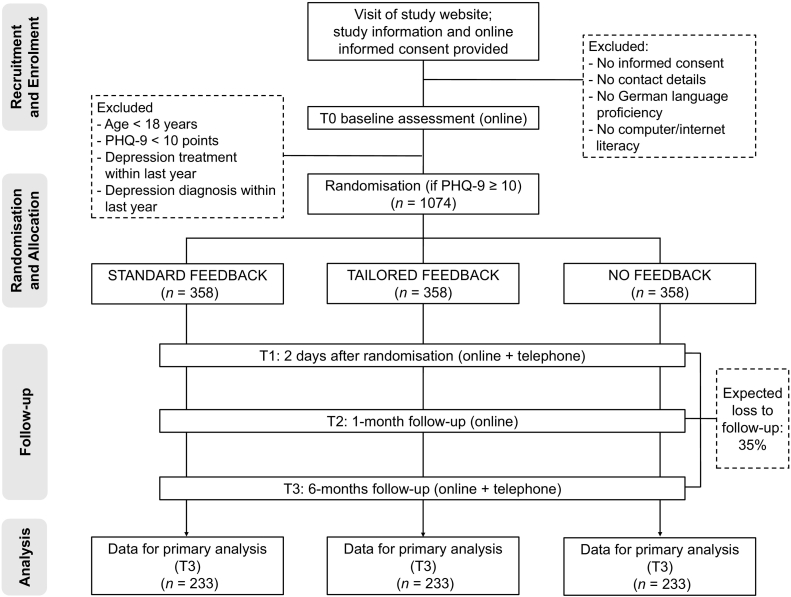
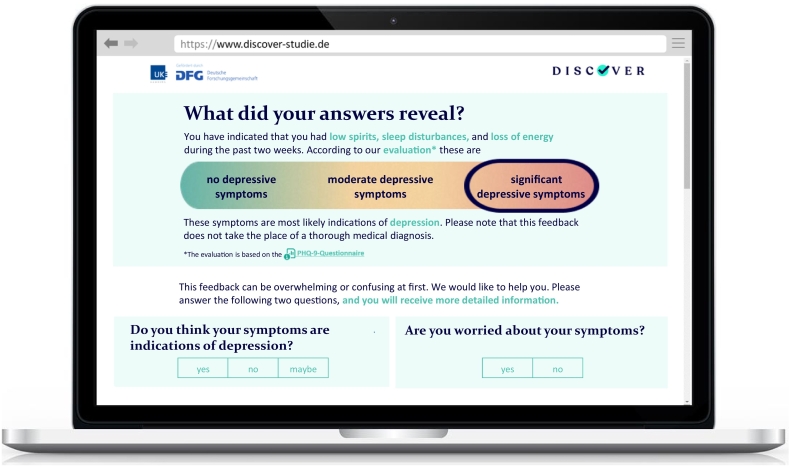
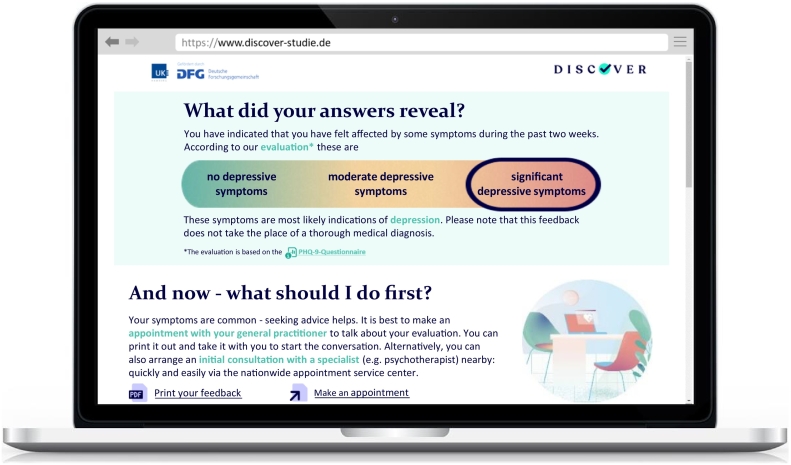
The internet-based, observer-blinded DISCOVER RCT aims to recruit a total of 1074 individuals. Participants will be screened for depression using the Patient Health Questionnaire (PHQ-9). In case of a positive screening result (PHQ-9 ≥ 10), participants with undetected depression will be randomised into one of three balanced study arms to receive either (a) no feedback (control arm), (b) standard feedback, or (c) tailored feedback on their screening result. The tailored feedback version will be adapted to participants' characteristics, i.e. symptom profile, preferences, and demographic characteristics. The primary hypothesis is that feedback reduces depression severity six months after screening compared to no feedback. The secondary hypothesis is that tailored feedback is more efficacious compared to standard feedback. Further outcomes are depression care, help-seeking behaviour, health-related quality of life, anxiety, somatic symptom severity, intervention acceptance, illness beliefs, adverse events, and a health economic evaluation. Follow-ups will be conducted one month and six months after screening by self-report questionnaires and clinical interviews. According to a statistical analysis plan, the primary outcome will be analysed on an intention-to-treat basis applying multilevel modelling.
The results of the DISCOVER RCT will inform about how automated feedback after internet-based screening could improve early detection and resolution of depression. Ways of dissemination and how the trial can contribute to an understanding of help-seeking behaviour processes will be discussed. If the results show that automated feedback after internet-based depression screening can reduce depression severity, the intervention could be easily implemented and might substantially reduce the disease burden of individuals with undetected depression.
The study is approved by the Ethics Committee of the Hamburg Medical Association.
The trial was registered at ClinicalTrials.gov in November 2020 (identifier: NCT04633096).
抑郁症是全球最具致残性的疾病之一,但往往未被发现。一种有望解决早期检测和疾病负担问题的方法是进行抑郁症筛查,然后直接向患者反馈结果。有证据表明,人们经常在互联网上寻求有关心理健康的信息。因此,基于互联网的自动反馈筛查对于发现未被诊断的抑郁症患者具有巨大潜力。
确定与无反馈相比,基于互联网的抑郁症筛查后的自动反馈是否能降低抑郁严重程度。
基于互联网的、观察者盲法的DISCOVER随机对照试验旨在招募总共1074名个体。使用患者健康问卷(PHQ-9)对参与者进行抑郁症筛查。如果筛查结果为阳性(PHQ-9≥10),未被发现患有抑郁症的参与者将被随机分为三个均衡的研究组之一,以接受以下三种情况之一:(a)无反馈(对照组),(b)标准反馈,或(c)根据其筛查结果提供的个性化反馈。个性化反馈版本将根据参与者的特征进行调整,即症状概况、偏好和人口统计学特征。主要假设是,与无反馈相比,反馈在筛查后六个月可降低抑郁严重程度。次要假设是,与标准反馈相比,个性化反馈更有效。其他结果包括抑郁护理、求助行为、健康相关生活质量、焦虑、躯体症状严重程度、干预接受度、疾病认知、不良事件以及健康经济学评估。筛查后一个月和六个月将通过自我报告问卷和临床访谈进行随访。根据统计分析计划,主要结果将采用多水平模型在意向性分析的基础上进行分析。
DISCOVER随机对照试验的结果将为基于互联网筛查后的自动反馈如何改善抑郁症的早期检测和解决提供信息。将讨论传播方式以及该试验如何有助于理解求助行为过程。如果结果表明基于互联网的抑郁症筛查后的自动反馈可以降低抑郁严重程度,那么该干预措施可以很容易地实施,并可能大幅减轻未被发现患有抑郁症个体的疾病负担。
该研究已获得汉堡医学协会伦理委员会的批准。
该试验于2020年11月在ClinicalTrials.gov注册(标识符:NCT04633096)。