Baros Jorquera Carla, Moreno-Switt Andrea I, Sallaberry-Pincheira Nicole, Munita Jose M, Flores Navarro Camila, Tardone Rodolfo, González-Rocha Gerardo, Singer Randall S, Bueno Irene
Escuela de Medicina Veterinaria, Facultad Ciencias de la Vida, Universidad Andrés Bello. Av. República 440, Santiago, Chile.
Escuela de Medicina Veterinaria, Facultad de Agronomía e Ingeniería Forestal, Facultad de Ciencias Biológicas, Facultad de Medicina, Pontificia Universidad Católica de Chile. Av. Vicuña Mackenna 4860 Macul, Santiago, Chile.
One Health. 2021 Jul 28;13:100298. doi: 10.1016/j.onehlt.2021.100298. eCollection 2021 Dec.
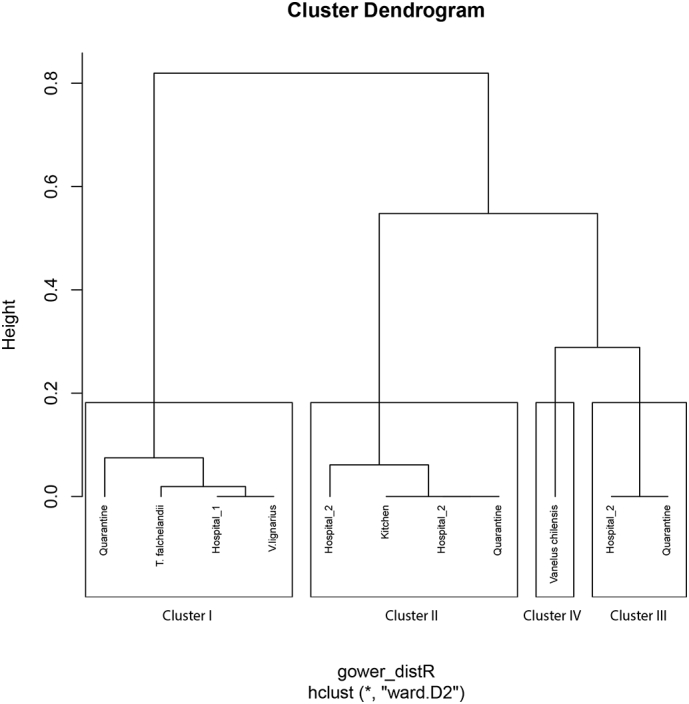
Injured and orphaned wildlife are often brought to Wildlife Rehabilitation Centers (WRC) to be cared for by professionals to ultimately be released back to their natural habitats. In these centers, animals may spend months and frequently receive prolonged antibiotic therapy. Therefore, WRC may play a role in the emergence and dissemination of antimicrobial resistance (AMR). The goal of this study was to investigate the presence and antibiotic resistance profiles of Gram-negative bacteria with reduced susceptibility to cephalosporins in both the wildlife admitted to a WRC and in the WRC built environment in Chile. A cross-sectional study was conducted sampling animals undergoing rehabilitation ( = 64) and the WRC environment ( = 160). Isolated bacterial species were identified with MALDI-TOF, and antimicrobial susceptibility determined using the disk diffusion method. and were the dominant bacterial families among the environmental ( = 78) and animal ( = 31) isolates. For , isolates of the most abundant species () were classified into 20 antibiotic resistance profiles, with eight of those isolates being resistant to more than nine antibiotics, including imipenem. Isolates of the family identified 11 isolates with resistance to antibiotics such as carbapenems and quinolones. Even though a cluster analysis based on antibiotic resistance patterns did not show a clear overlap between environmental and animal isolates, it is important to highlight the identification of isolates resistant to carbapenems, which is very relevant from a public health perspective. Further, numerous antibiotic resistance profiles were observed in different bacterial species, indicating not only environmental contamination with a wide diversity of bacteria, but also a wide diversity of resistant bacteria in animals at the WRC. The approach taken by sampling animals and their hospital environment can be useful in understanding AMR dynamics in wildlife rehabilitation settings, as well as the potential dissemination of AMR into the natural environment.
受伤和孤儿野生动物经常被带到野生动物康复中心(WRC),由专业人员照料,最终放归自然栖息地。在这些中心,动物可能要待上数月,还经常接受长期抗生素治疗。因此,WRC可能在抗菌药物耐药性(AMR)的出现和传播中发挥作用。本研究的目的是调查智利一家WRC收治的野生动物以及该WRC建筑环境中对头孢菌素敏感性降低的革兰氏阴性菌的存在情况和抗生素耐药谱。进行了一项横断面研究,对正在接受康复治疗的动物(n = 64)和WRC环境(n = 160)进行采样。使用基质辅助激光解吸电离飞行时间质谱(MALDI - TOF)鉴定分离出的细菌种类,并采用纸片扩散法测定抗菌药物敏感性。肠杆菌科和假单胞菌科是环境(n = 78)和动物(n = 31)分离株中的主要细菌家族。对于肠杆菌科,最常见物种(肺炎克雷伯菌)的分离株被分为20种抗生素耐药谱,其中8株对包括亚胺培南在内的9种以上抗生素耐药。假单胞菌科的分离株鉴定出11株对碳青霉烯类和喹诺酮类等抗生素耐药。尽管基于抗生素耐药模式的聚类分析未显示环境和动物分离株之间有明显重叠,但必须强调碳青霉烯类耐药分离株的鉴定,这从公共卫生角度来看非常重要。此外,在不同细菌物种中观察到众多抗生素耐药谱,这不仅表明环境受到多种细菌的污染,也表明WRC动物体内存在多种耐药细菌。对动物及其医院环境进行采样的方法有助于了解野生动物康复环境中的AMR动态,以及AMR向自然环境的潜在传播。