Brooks Marquita S, Bennett Aleena, Lovasi Gina S, Hurvitz Philip M, Colabianchi Natalie, Howard Virginia J, Manly Jennifer, Judd Suzanne E
Department of Biostatistics, University of Alabama at Birmingham (UAB), Birmingham, AL, USA.
Urban Health Collaborative, Dornsife School of Public Health, Drexel University, Philadelphia, PA, USA.
SSM Popul Health. 2021 Aug 3;15:100887. doi: 10.1016/j.ssmph.2021.100887. eCollection 2021 Sep.
Epidemiological studies utilize residential histories to assess environmental exposure risk. The validity from using commercially-sourced residential histories within national longitudinal studies remains unclear. Our study assessed predictors of non-agreement between baseline addresses from the commercially-sourced LexisNexis database and participants in the national longitudinal study, REasons for Geographic and Racial Differences in Stroke (REGARDS). Additionally, we assessed differences in stroke risk by neighborhood socioeconomic score (nSES) based on participant reported address compared to nSES from LexisNexis/REGARDS matched baseline address.
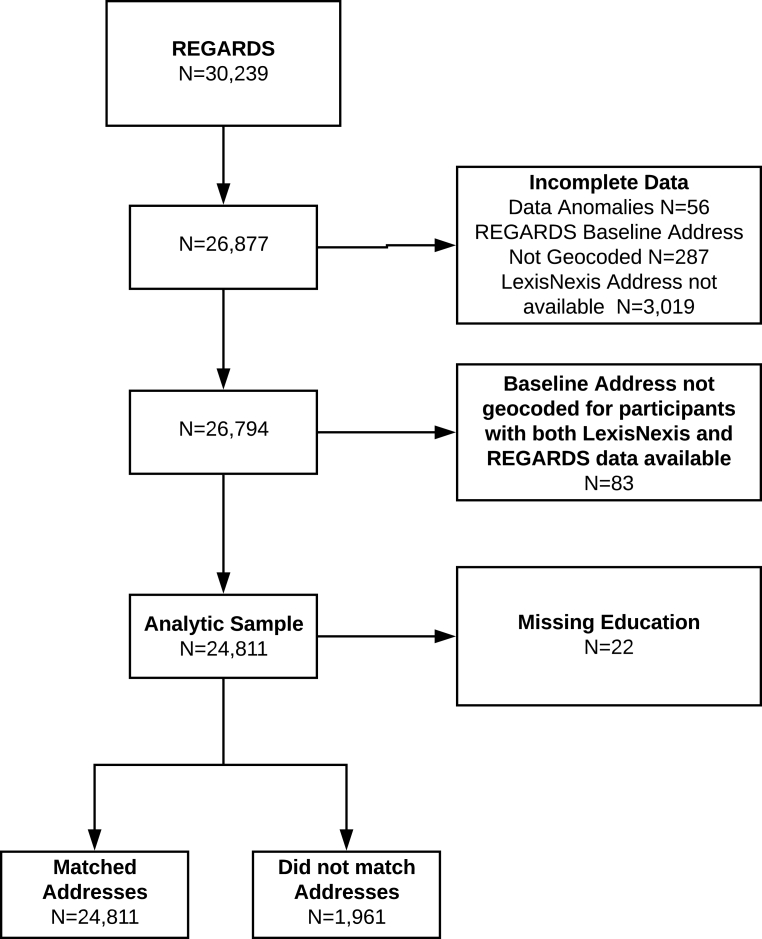
From January 2003-October 2007, REGARDS enrolled 30,239 black and white adults aged 45 and older within the continental United States and collected their baseline address. ArcGIS Desktop 10.5.1 with ESRI 2016 Business Analyst Data was used to geocode baseline addresses from LexisNexis and REGARDS. Logistic regression was used to estimate the likelihood that LexisNexis address matched REGARDS baseline address for each participant. Survival analysis was used to estimate association between nSES and incident stroke.
Approximately 91% of REGARDS participants had a LexisNexis address. Of these geocoded addresses, 93% of REGARDS baseline addresses matched LexisNexis addresses. Odds of agreement between LexisNexis and REGARDS was higher for older-aged participants (OR = 1.02 per year, 95% CI: 1.01, 1.02), blacks compared to whites (OR = 1.16, 95% CI: 1.05, 1.29), females compared to males (OR = 1.15, 95% CI: 1.04, 1.26), participants with an income of $34k-74k compared to an income less than $20k (OR = 1.62, 95% CI: 1.39, 1.89). Odds of agreement were lower for residents in Midwest compared to residents in the south (OR = 0.82, 95% CI: 0.73, 0.94). No significant differences in nSES-stroke associations were observed between REGARDS only and LexisNexis/REGARDS matched addresses; however, differences in interactions were observed.
Agreement between LexisNexis and REGARDS addresses varied by sociodemographic groups, potentially introducing bias in studies reliant on LexisNexis alone for residential address data.
流行病学研究利用居住史来评估环境暴露风险。在国家纵向研究中使用商业来源的居住史的有效性仍不明确。我们的研究评估了商业来源的LexisNexis数据库中的基线地址与国家纵向研究“中风地理和种族差异原因(REGARDS)”的参与者之间不一致的预测因素。此外,我们根据参与者报告的地址与LexisNexis/REGARDS匹配的基线地址的邻里社会经济得分(nSES)评估了中风风险的差异。
2003年1月至2007年10月,REGARDS在美国大陆招募了30239名45岁及以上的黑人和白人成年人,并收集了他们的基线地址。使用带有ESRI 2016商业分析师数据的ArcGIS Desktop 10.5.1对LexisNexis和REGARDS的基线地址进行地理编码。使用逻辑回归估计每个参与者的LexisNexis地址与REGARDS基线地址匹配的可能性。使用生存分析估计nSES与中风事件之间的关联。
约91%的REGARDS参与者有LexisNexis地址。在这些地理编码地址中,93%的REGARDS基线地址与LexisNexis地址匹配。LexisNexis和REGARDS之间的一致几率在老年参与者中更高(每年OR = 1.02,95%CI:1.01,1.02),黑人与白人相比(OR = 1.16,95%CI:1.05,1.29),女性与男性相比(OR = 1.15,95%CI:1.04,1.26),收入为34k - 74k美元的参与者与收入低于20k美元的参与者相比(OR = 1.62,95%CI:1.39,1.89)。中西部居民与南部居民相比,一致几率较低(OR = 0.82,95%CI:0.73,0.94)。仅REGARDS和LexisNexis/REGARDS匹配地址之间在nSES-中风关联方面未观察到显著差异;然而,观察到了相互作用的差异。
LexisNexis和REGARDS地址之间的一致性因社会人口学群体而异,这可能会在仅依赖LexisNexis获取居住地址数据的研究中引入偏差。