Benjamin Laura A, Paterson Ross W, Moll Rachel, Pericleous Charis, Brown Rachel, Mehta Puja R, Athauda Dilan, Ziff Oliver J, Heaney Judith, Checkley Anna M, Houlihan Catherine F, Chou Michael, Heslegrave Amanda J, Chandratheva Arvind, Michael Benedict D, Blennow Kaj, Vivekanandam Vinojini, Foulkes Alexander, Mummery Catherine J, Lunn Michael P, Keddie Stephen, Spyer Moira J, Mckinnon Tom, Hart Melanie, Carletti Francesco, Jäger Hans Rolf, Manji Hadi, Zandi Michael S, Werring David J, Nastouli Eleni, Simister Robert, Solomon Tom, Zetterberg Henrik, Schott Jonathan M, Cohen Hannah, Efthymiou Maria
National Hospital for Neurology and Neurosurgery, University College London Hospitals NHS Foundation Trust, Queen Square, London WC1N 3BG, UK.
Laboratory of Molecular and Cell Biology, UCL, Gower St, Kings Cross, London WC1E 6BT, UK.
EClinicalMedicine. 2021 Sep;39:101070. doi: 10.1016/j.eclinm.2021.101070. Epub 2021 Aug 12.
A high prevalence of antiphospholipid antibodies has been reported in case series of patients with neurological manifestations and COVID-19; however, the pathogenicity of antiphospholipid antibodies in COVID-19 neurology remains unclear.
This single-centre cross-sectional study included 106 adult patients: 30 hospitalised COVID-neurological cases, 47 non-neurological COVID-hospitalised controls, and 29 COVID-non-hospitalised controls, recruited between March and July 2020. We evaluated nine antiphospholipid antibodies: anticardiolipin antibodies [aCL] IgA, IgM, IgG; anti-beta-2 glycoprotein-1 [aβGPI] IgA, IgM, IgG; anti-phosphatidylserine/prothrombin [aPS/PT] IgM, IgG; and anti-domain I βGPI (aD1β2GPI) IgG.
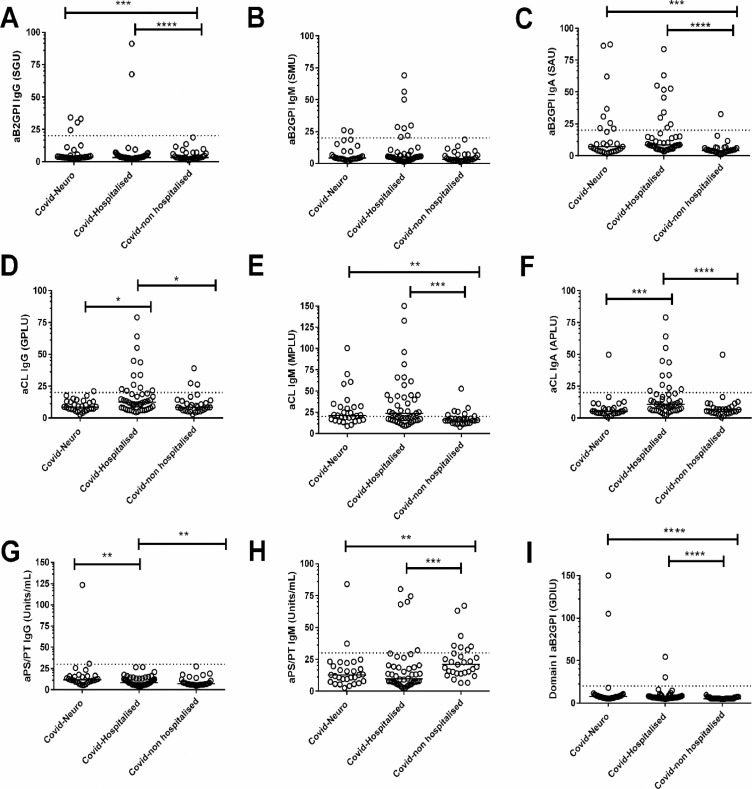
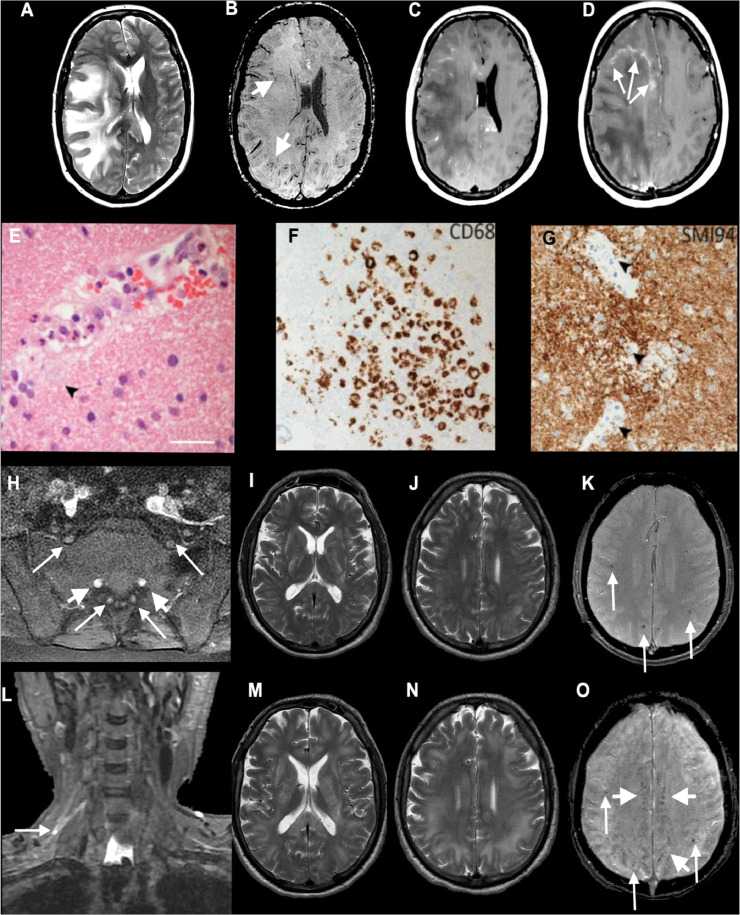
There was a high prevalence of antiphospholipid antibodies in the COVID-neurological (73.3%) and non-neurological COVID-hospitalised controls (76.6%) in contrast to the COVID-non-hospitalised controls (48.2%). aPS/PT IgG titres were significantly higher in the COVID-neurological group compared to both control groups ( < 0.001). Moderate-high titre of aPS/PT IgG was found in 2 out of 3 (67%) patients with acute disseminated encephalomyelitis [ADEM]. aPS/PT IgG titres negatively correlated with oxygen requirement (FiO =-0.15 = 0.040) and was associated with venous thromboembolism ( = 0.043). In contrast, aCL IgA ( < 0.001) and IgG ( < 0.001) was associated with non-neurological COVID-hospitalised controls compared to the other groups and correlated positively with d-dimer and creatinine but negatively with FiO.
Our findings show that aPS/PT IgG is associated with COVID-19-associated ADEM. In contrast, aCL IgA and IgG are seen much more frequently in non-neurological hospitalised patients with COVID-19. Characterisation of antiphospholipid antibody persistence and potential longitudinal clinical impact are required to guide appropriate management.
This work is supported by UCL Queen Square Biomedical Research Centre (BRC) and Moorfields BRC grants (#560441 and #557595). LB is supported by a Wellcome Trust Fellowship (222102/Z/20/Z). RWP is supported by an Alzheimer's Association Clinician Scientist Fellowship (AACSF-20-685780) and the UK Dementia Research Institute. KB is supported by the Swedish Research Council (#2017-00915) and the Swedish state under the agreement between the Swedish government and the County Councils, the ALF-agreement (#ALFGBG-715986). HZ is a Wallenberg Scholar supported by grants from the Swedish Research Council (#2018-02532), the European Research Council (#681712), Swedish State Support for Clinical Research (#ALFGBG-720931), the Alzheimer Drug Discovery Foundation (ADDF), USA (#201809-2016862), and theUK Dementia Research Institute at UCL. BDM is supported by grants from the MRC/UKRI (MR/V007181/1), MRC (MR/T028750/1) and Wellcome (ISSF201902/3). MSZ, MH and RS are supported by the UCL/UCLH NIHR Biomedical Research Centre and MSZ is supported by Queen Square National Brain Appeal.
在有神经症状的新冠肺炎患者病例系列中,抗磷脂抗体的高患病率已有报道;然而,抗磷脂抗体在新冠肺炎神经病变中的致病性仍不明确。
这项单中心横断面研究纳入了106例成年患者:2020年3月至7月招募的30例新冠肺炎神经病变住院病例、47例非神经病变新冠肺炎住院对照以及29例非住院新冠肺炎对照。我们评估了九种抗磷脂抗体:抗心磷脂抗体[aCL] IgA、IgM、IgG;抗β2糖蛋白1[aβGPI] IgA、IgM、IgG;抗磷脂酰丝氨酸/凝血酶原[aPS/PT] IgM、IgG;以及抗结构域IβGPI(aD1β2GPI)IgG。
与非住院新冠肺炎对照(48.2%)相比,新冠肺炎神经病变组(73.3%)和非神经病变新冠肺炎住院对照组(76.6%)中抗磷脂抗体的患病率较高。与两个对照组相比,新冠肺炎神经病变组的aPS/PT IgG滴度显著更高(<0.001)。在3例急性播散性脑脊髓炎[ADEM]患者中的2例(67%)发现了中度 - 高滴度的aPS/PT IgG。aPS/PT IgG滴度与氧需求呈负相关(FiO = -0.15,P = 0.040),并与静脉血栓栓塞相关(P = 0.043)。相比之下,与其他组相比,aCL IgA(<0.001)和IgG(<0.001)与非神经病变新冠肺炎住院对照组相关,且与D - 二聚体和肌酐呈正相关,但与FiO呈负相关。
我们的研究结果表明,aPS/PT IgG与新冠肺炎相关的ADEM有关。相比之下,aCL IgA和IgG在非神经病变的新冠肺炎住院患者中更为常见。需要对抗磷脂抗体的持续存在及其潜在的纵向临床影响进行特征描述,以指导适当的管理。
这项工作得到了伦敦大学学院皇后广场生物医学研究中心(BRC)和摩尔菲尔德BRC基金(#560441和#557595)的支持。LB得到了惠康信托基金会奖学金(222102/Z/20/Z)的支持。RWP得到了阿尔茨海默病协会临床科学家奖学金(AACSF - 20 - 685780)和英国痴呆症研究所的支持。KB得到了瑞典研究理事会(#2017 - 00915)以及瑞典政府与郡议会协议下的瑞典国家资助,ALF协议(#ALFGBG - 715986)。HZ是一名瓦伦贝格学者,得到了瑞典研究理事会(#2018 - 02532)、欧洲研究理事会(#681712)、瑞典国家临床研究支持(#ALFGBG - 720931)、美国阿尔茨海默病药物发现基金会(ADDF)(#201809 - 2016862)以及伦敦大学学院英国痴呆症研究所的资助。BDM得到了医学研究理事会/英国研究与创新(MR/V007181/1)、医学研究理事会(MR/T028750/1)和惠康基金会(ISSF201902/3)的资助。MSZ、MH和RS得到了伦敦大学学院/伦敦大学学院医院国民保健服务信托基金国家卫生研究院生物医学研究中心的支持,MSZ得到了皇后广场国家脑部呼吁组织的支持。