Institute for Hygiene and Public Health, Medical Faculty, University of Bonn, Venusberg-Campus 1, 53127, Bonn, Germany.
Institute of Animal Sciences, University of Bonn, Bonn, Germany.
Sci Rep. 2021 Aug 17;11(1):16622. doi: 10.1038/s41598-021-96169-y.
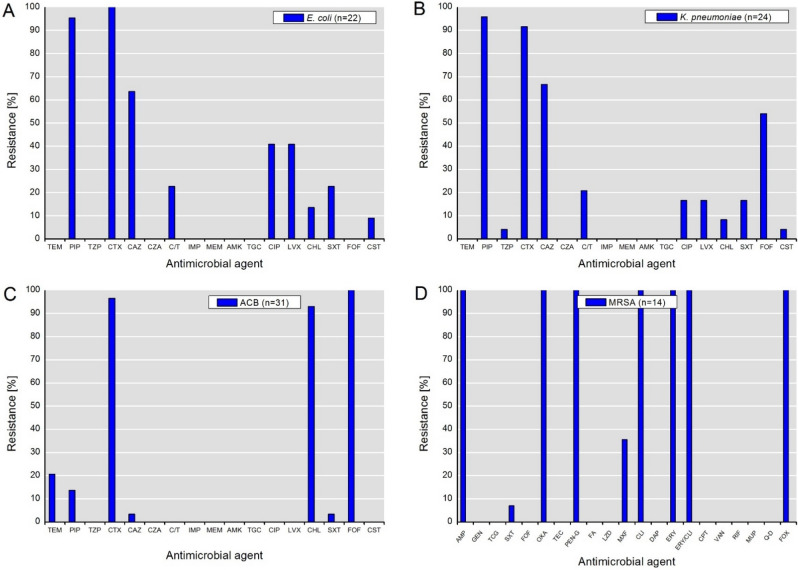
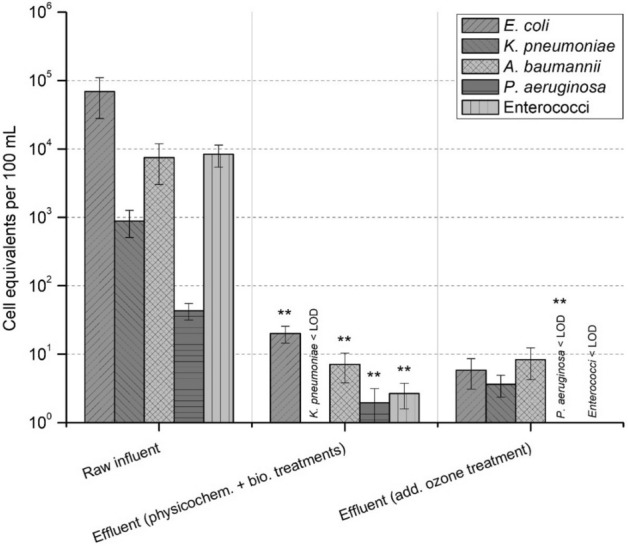
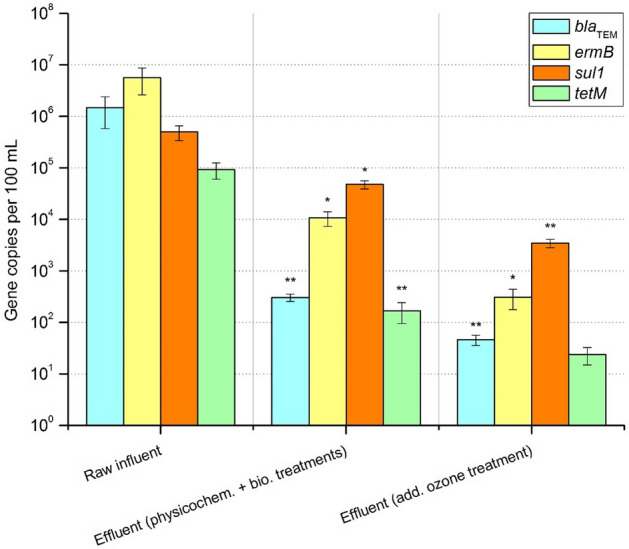
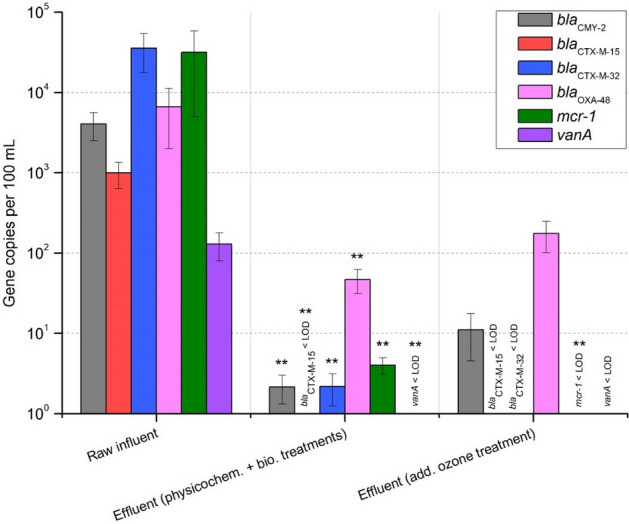
Slaughterhouse wastewater is considered a reservoir for antibiotic-resistant bacteria and antibiotic residues, which are not sufficiently removed by conventional treatment processes. This study focuses on the occurrence of ESKAPE bacteria (Enterococcus spp., S. aureus, K. pneumoniae, A. baumannii, P. aeruginosa, Enterobacter spp.), ESBL (extended-spectrum β-lactamase)-producing E. coli, antibiotic resistance genes (ARGs) and antibiotic residues in wastewater from a poultry slaughterhouse. The efficacy of conventional and advanced treatments (i.e., ozonation) of the in-house wastewater treatment plant regarding their removal was also evaluated. Target culturable bacteria were detected only in the influent and effluent after conventional treatment. High abundances of genes (e.g., bla, bla, bla, bla, bla and mcr-1) of up to 1.48 × 10 copies/100 mL were detected in raw influent. All of them were already significantly reduced by 1-4.2 log units after conventional treatment. Following ozonation, mcr-1 and bla were further reduced below the limit of detection. Antibiotic residues were detected in 55.6% (n = 10/18) of the wastewater samples. Despite the significant reduction through conventional and advanced treatments, effluents still exhibited high concentrations of some ARGs (e.g., sul1, ermB and bla), ranging from 1.75 × 10 to 3.44 × 10 copies/100 mL. Thus, a combination of oxidative, adsorptive and membrane-based technologies should be considered.
屠宰废水被认为是抗生素耐药菌和抗生素残留的储存库,这些物质不能通过常规处理过程充分去除。本研究重点关注家禽屠宰场废水中 ESKAPE 细菌(肠球菌属、金黄色葡萄球菌、肺炎克雷伯菌、鲍曼不动杆菌、铜绿假单胞菌、肠杆菌属)、产 ESBL(扩展谱β-内酰胺酶)的大肠杆菌、抗生素耐药基因(ARGs)和抗生素残留的情况。还评估了内部废水处理厂常规和先进处理(即臭氧处理)对其去除效果的影响。只有在经过常规处理后,才能在进水和出水口检测到可培养目标细菌。在原始进水口检测到高达 1.48×10 拷贝/100 毫升的高丰度基因(如 bla、bla、bla、bla、bla 和 mcr-1)。所有这些基因在经过常规处理后都已经显著减少了 1-4.2 个对数单位。经过臭氧处理后,mcr-1 和 bla 进一步减少到检测限以下。在 55.6%(n=10/18)的废水样品中检测到抗生素残留。尽管经过常规和先进处理后有显著减少,但废水中仍存在高浓度的一些 ARGs(如 sul1、ermB 和 bla),浓度范围为 1.75×10 到 3.44×10 拷贝/100 毫升。因此,应考虑采用氧化、吸附和膜基等多种技术的组合。