Department of Ophthalmology, Saarland University Medical Center (UKS), Homburg, Saar, Germany.
Institute of Medical Microbiology and Hygiene, Saarland University, Homburg, Saar, Germany.
Graefes Arch Clin Exp Ophthalmol. 2022 Jan;260(1):173-180. doi: 10.1007/s00417-021-05344-4. Epub 2021 Aug 18.
Epidemic keratoconjunctivitis (EKC) is one of the most severe ocular viral infections. The aim of this interruptive time series study was to quantitatively evaluate the effectiveness of a hygienic EKC outbreak management concept developed in our ophthalmological department.
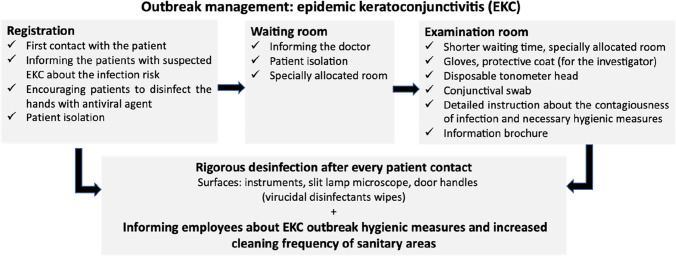
All patients with suspected EKC in the period from August to November 2018 were included in the study. Data were retrospectively collected from the patient's medical documents and records. The disease was diagnosed clinically and confirmed by virus detection through polymerase chain reaction (PCR) from conjunctival swabs. With the beginning of the epidemic, an outbreak management plan was implemented to reduce the nosocomial spread.
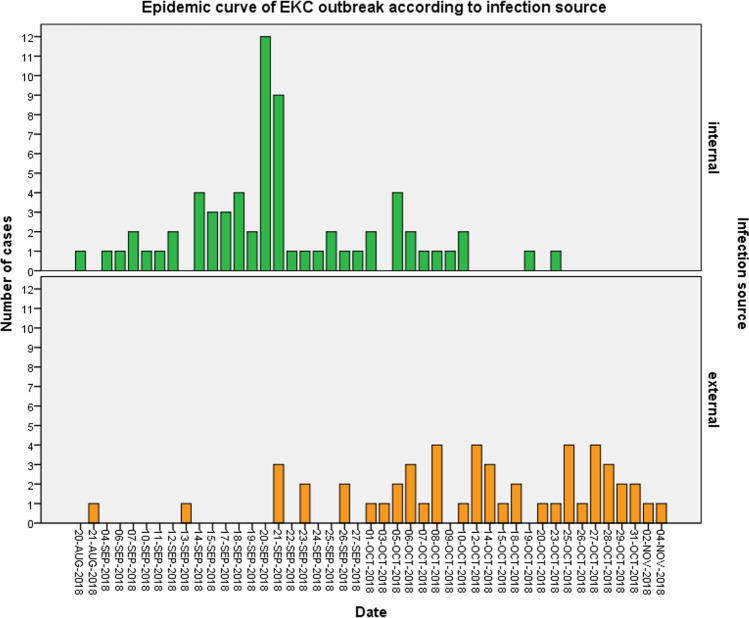
The outbreak lasted 77 days (20th August 2018 to 4th November 2018) and affected a total of 120 patients. This corresponds to a mean of 1.5 patients per outbreak day. The median age was 58 [1-92] years. Of all patients, 61 (50.8%) were female. Conjunctival swabs were collected in 100/120 (83.3%) cases, the adenovirus being detected in all positive smears (63/63, 100%). The implementation of our outbreak management plan reduced significantly the number of EKC cases per outbreak day and resulted in a reduction of the basic reproduction number by a factor of 2.2.
The detection of EKC together with the immediate implementation of hygienic outbreak measures can significantly reduce the spread of infection. The implementation of a strict outbreak management concept can significantly reduce the number of EKC cases, thus avoiding possible complications and therefore unnecessary health-related costs.
流行性角膜结膜炎(EKC)是最严重的眼部病毒性感染之一。本中断时间序列研究的目的是定量评估我们眼科部门开发的卫生 EKC 暴发管理概念的有效性。
纳入 2018 年 8 月至 11 月期间疑似 EKC 的所有患者。从患者的病历和记录中回顾性收集数据。通过聚合酶链反应(PCR)从结膜拭子检测病毒,对疾病进行临床诊断和确诊。随着疫情的开始,实施了暴发管理计划以减少医院内传播。
暴发持续了 77 天(2018 年 8 月 20 日至 11 月 4 日),共影响了 120 名患者。这相当于暴发日平均有 1.5 例患者。中位年龄为 58 [1-92] 岁。所有患者中,女性 61 例(50.8%)。120 例患者中有 100 例(83.3%)采集了结膜拭子,所有阳性涂片均检测到腺病毒(63/63,100%)。实施暴发管理计划后,暴发日 EKC 病例数显著减少,基本繁殖数减少了 2.2 倍。
检测 EKC 并立即实施卫生暴发措施可显著减少感染传播。实施严格的暴发管理概念可显著减少 EKC 病例数,从而避免可能的并发症和不必要的健康相关费用。