Raja Srinivasa N, Buvanendran Asokumar, Marcondes Lizandra
Anesthesiology & Critical Care Medicine, Division of Pain Medicine, Johns Hopkins University, Baltimore, MD, USA.
William Gottschalk, Endowed Chair of Anesthesiology, Rush University Medical Center, Chicago, IL, USA.
J Pain Res. 2021 Aug 10;14:2391-2401. doi: 10.2147/JPR.S317648. eCollection 2021.
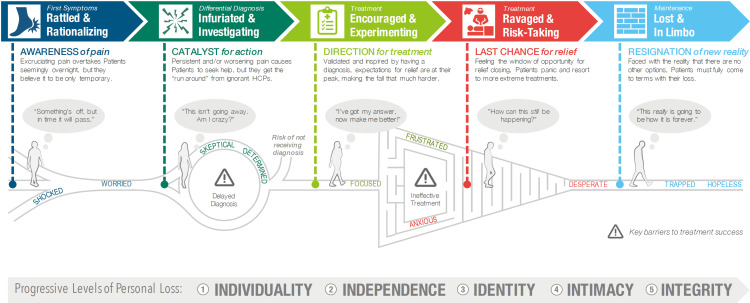
This qualitative research study aimed to characterize the "patient journey" for patients with complex regional pain syndrome (CRPS) and identify the unmet needs related to the management and treatment of the condition for healthcare providers (HCPs), patients, and their caregivers.
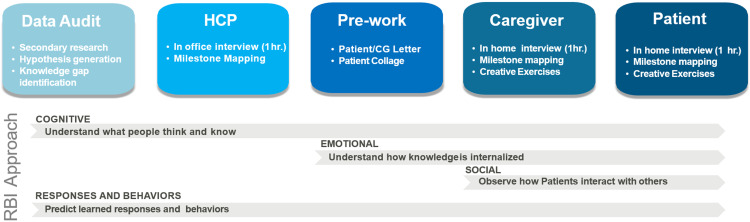
Multifaceted, dynamic methodology, iteratively gathering cognitive, emotional and social insights, was used to support and conduct in-depth, immersion interviews across the USA with 59 HCPs in-office and in roundtable discussions, and 20 patient-support partner dyads in-home.
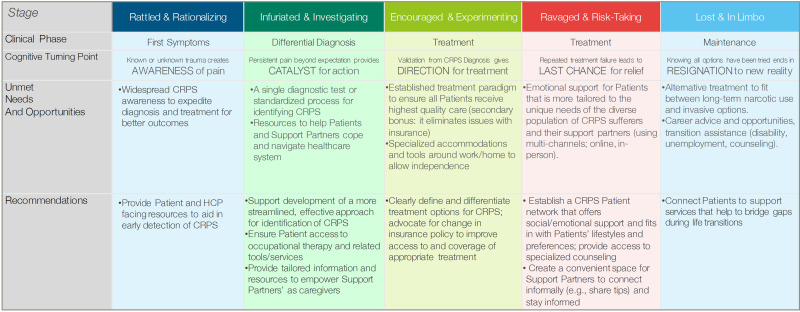
Patients were aged >18 years, primarily female, and all were diagnosed with CRPS (limited to type 1 in this patient cohort). Results show that the current state of CRPS treatment may fall short in multiple key areas. In some cases, poor awareness of CRPS causes delayed diagnoses impacting the opportunity for early treatment, resulting in long-term poor health outcomes. Consequently, the CRPS "patient journey" may be characterized by clinical frustration of physicians and disappointment for some patients. The poor treatment experiences and outcomes for some patients and HCPs may build the perception of a non-collaborative relationship. HCPs and patients agree that an effective treatment would be one that addresses CRPS rather than its symptoms, and the availability of such an option would transform the treatment experience.
CRPS leads to cognitive, social and emotional burdens for patients and their caregivers. There is an unmet need for improved CRPS disease awareness and successful therapeutic options to aid in earlier diagnoses, effective treatment and better outcomes for HCPs, patients, and their caregivers.
本定性研究旨在描述复杂性区域疼痛综合征(CRPS)患者的“就医过程”,并确定医疗服务提供者(HCPs)、患者及其护理人员在该疾病管理和治疗方面未满足的需求。
采用多方面、动态的方法,反复收集认知、情感和社会方面的见解,以支持并在美国各地对59名门诊和参加圆桌讨论的HCPs以及20对患者-支持伙伴进行深入的沉浸式访谈。
患者年龄大于18岁,主要为女性,且均被诊断为CRPS(本患者队列中仅限于1型)。结果表明,CRPS治疗的现状在多个关键领域可能存在不足。在某些情况下,对CRPS的认识不足导致诊断延迟,影响早期治疗机会,从而导致长期健康状况不佳。因此,CRPS的“就医过程”可能表现为医生的临床挫败感和部分患者的失望情绪。部分患者和HCPs不佳的治疗体验和结果可能会形成一种非合作关系的认知。HCPs和患者一致认为,有效的治疗应针对CRPS而非其症状,而有这样一种选择将改变治疗体验。
CRPS给患者及其护理人员带来认知、社会和情感负担。在提高对CRPS疾病的认识以及提供成功的治疗选择以帮助HCPs、患者及其护理人员更早诊断、有效治疗并获得更好结果方面,存在未满足的需求。