Dou Baomin, Li Yanan, Ma Jie, Xu Zhifang, Fan Wen, Tian Lixin, Chen Zhihan, Li Ningcen, Gong Yinan, Lyu Zhongxi, Fang Yuxin, Liu Yangyang, Xu Yuan, Wang Shenjun, Chen Bo, Guo Yongming, Guo Yi, Lin Xiaowei
Research Center of Experimental Acupuncture Science, Tianjin University of Traditional Chinese Medicine, Tianjin, China.
National Clinical Research Center for Chinese Medicine Acupuncture and Moxibustion, Tianjin, China.
Front Neurosci. 2021 Aug 2;15:695670. doi: 10.3389/fnins.2021.695670. eCollection 2021.
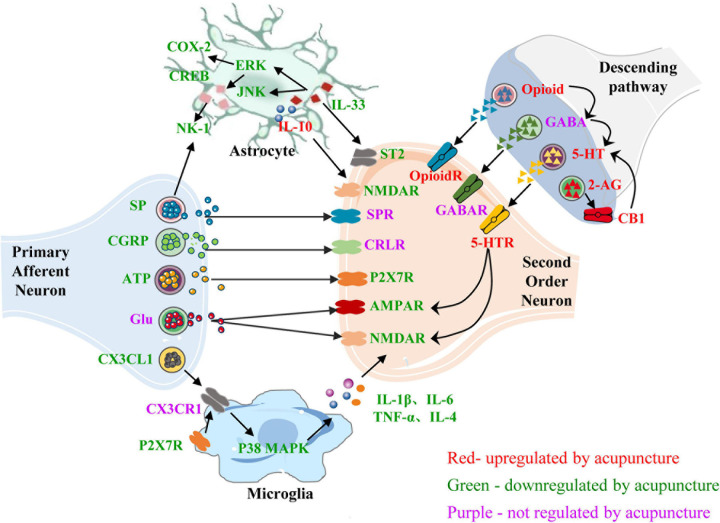
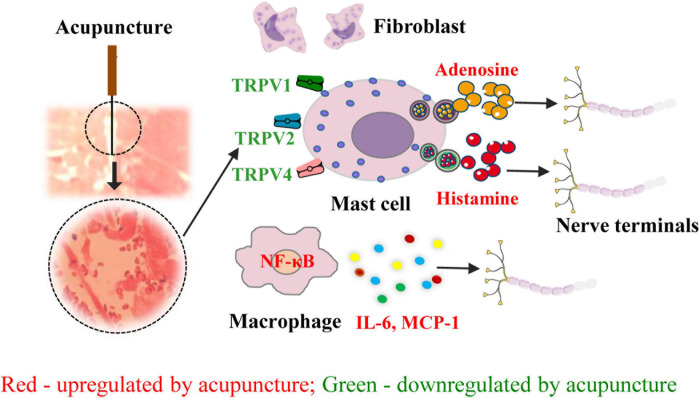
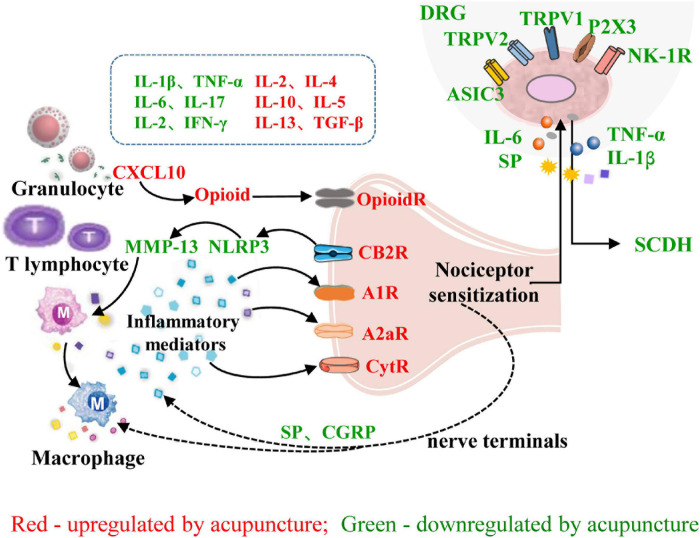
Inflammatory pain is caused by peripheral tissue injury and inflammation. Inflammation leads to peripheral sensitization, which may further cause central sensitization, resulting in chronic pain and progressive functional disability. Neuroimmune crosstalk plays an essential role in the development and maintenance of inflammatory pain. Studies in recent years have shown that acupuncture can exert anti-inflammatory and analgesic effects by regulating peripheral (i.e., involving local acupoints and inflamed regions) and central neuroimmune interactions. At the local acupoints, acupuncture can activate the TRPV1 and TRPV2 channels of mast cells, thereby promoting degranulation and the release of histamine, adenosine, and other immune mediators, which interact with receptors on nerve endings and initiate neuroimmune regulation. At sites of inflammation, acupuncture enables the recruitment of immune cells, causing the release of opioid peptides, while also exerting direct analgesic effects via nerve endings. Furthermore, acupuncture promotes the balance of immune cells and regulates the release of inflammatory factors, thereby reducing the stimulation of nociceptive receptors in peripheral organs. Acupuncture also alleviates peripheral neurogenic inflammation by inhibiting the release of substance P (SP) and calcitonin gene-related peptide from the dorsal root ganglia. At the central nervous system level, acupuncture inhibits the crosstalk between glial cells and neurons by inhibiting the p38 MAPK, ERK, and JNK signaling pathways and regulating the release of inflammatory mediators. It also reduces the excitability of the pain pathway by reducing the release of excitatory neurotransmitters and promoting the release of inhibitory neurotransmitters from neurons and glial cells. In conclusion, the regulation of neuroimmune crosstalk at the peripheral and central levels mediates the anti-inflammatory and analgesic effects of acupuncture on inflammatory pain in an integrated manner. These findings provide novel insights enabling the clinical application of acupuncture in the treatment of inflammatory diseases.
炎性疼痛由外周组织损伤和炎症引起。炎症导致外周敏化,这可能进一步引起中枢敏化,从而导致慢性疼痛和进行性功能障碍。神经免疫相互作用在炎性疼痛的发生和维持中起重要作用。近年来的研究表明,针刺可通过调节外周(即涉及局部穴位和炎症区域)和中枢神经免疫相互作用发挥抗炎和镇痛作用。在局部穴位,针刺可激活肥大细胞的TRPV1和TRPV2通道,从而促进脱颗粒以及组胺、腺苷等免疫介质的释放,这些介质与神经末梢上的受体相互作用并启动神经免疫调节。在炎症部位,针刺促使免疫细胞募集,导致阿片肽释放,同时还通过神经末梢发挥直接镇痛作用。此外,针刺促进免疫细胞平衡并调节炎性因子的释放,从而减少外周器官中伤害性感受器的刺激。针刺还通过抑制背根神经节中P物质(SP)和降钙素基因相关肽的释放来减轻外周神经源性炎症。在中枢神经系统水平,针刺通过抑制p38 MAPK、ERK和JNK信号通路并调节炎性介质的释放来抑制神经胶质细胞与神经元之间的相互作用。它还通过减少兴奋性神经递质的释放并促进神经元和神经胶质细胞释放抑制性神经递质来降低疼痛通路的兴奋性。总之,外周和中枢水平的神经免疫相互作用调节以整合方式介导了针刺对炎性疼痛的抗炎和镇痛作用。这些发现为针刺在炎性疾病治疗中的临床应用提供了新的见解。