Khananshvili Daniel
Department of Physiology and Pharmacology, Sackler Faculty of Medicine, Tel-Aviv University, Tel-Aviv, Israel.
Front Chem. 2021 Jul 30;9:722336. doi: 10.3389/fchem.2021.722336. eCollection 2021.
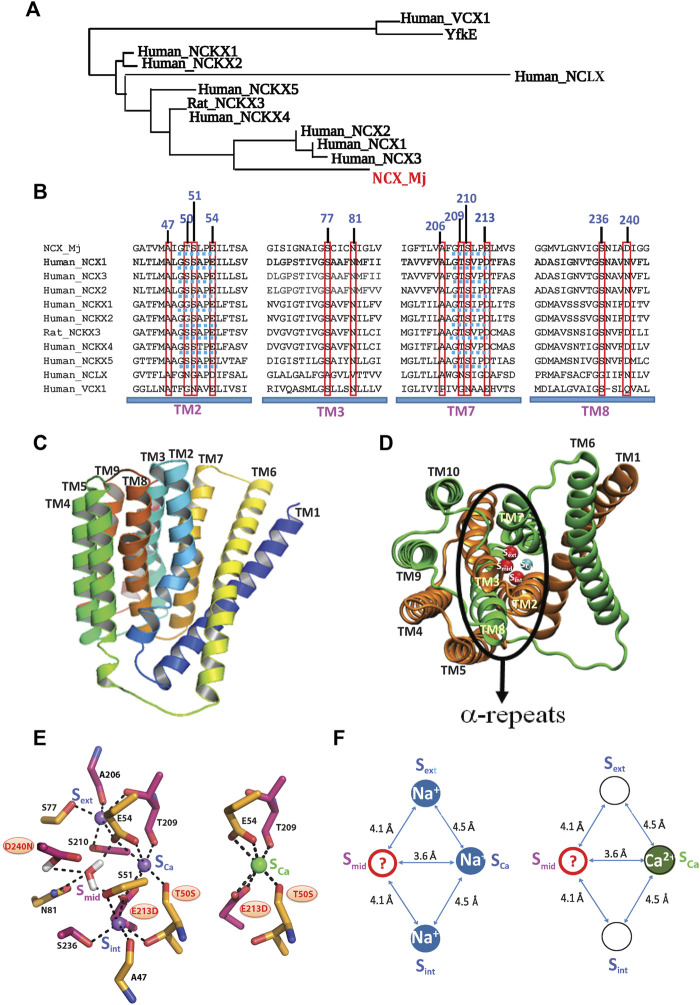
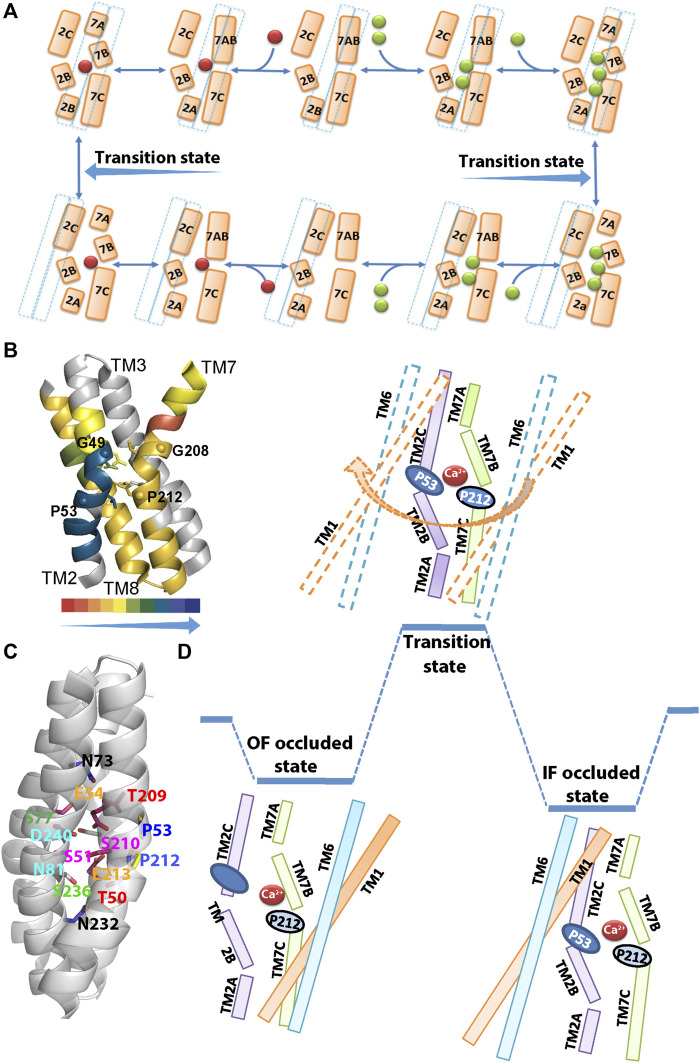
The superfamily of Calcium/Cation (Ca/CA) antiporters extrude Ca from the cytosol or subcellular compartments in exchange with Na, K, H, Li, or Mg and thereby provide a key mechanism for Ca signaling and ion homeostasis in biological systems ranging from bacteria to humans. The structure-dynamic determinants of ion selectivity and transport rates remain unclear, although this is of primary physiological significance. Despite wide variances in the ion selectivity and transport rates, the Ca/CA proteins share structural motifs, although it remains unclear how the ion recognition/binding is coupled to the ion translocation events. Here, the archaeal Na/Ca exchanger (NCX_Mj) is considered as a structure-based model that can help to resolve the ion transport mechanisms by using X-ray, HDX-MS, ATR-FTIR, and computational approaches in conjunction with functional analyses of mutants. Accumulating data reveal that the local backbone dynamics at ion-coordinating residues is characteristically constrained in apo NCX_Mj, which may predefine the affinity and stability of ion-bound species in the ground and transition states. The 3Na or 1Ca binding to respective sites of NCX_Mj rigidify the backbone dynamics at specific segments, where the ion-dependent compression of the ion-permeating four-helix bundle (TM2, TM3, TM7, and TM8) induces the sliding of the two-helix cluster (TM1/TM6) on the protein surface to switch the OF (outward-facing) and IF (inward-facing) conformations. Taking into account the common structural elements shared by Ca/CAs, NCX_Mj may serve as a model for studying the structure-dynamic and functional determinants of ion-coupled alternating access, transport catalysis, and ion selectivity in Ca/CA proteins.
钙/阳离子(Ca/CA)反向转运蛋白超家族将Ca从细胞质或亚细胞区室中排出,以与Na、K、H、Li或Mg进行交换,从而为从细菌到人类的生物系统中的Ca信号传导和离子稳态提供关键机制。尽管离子选择性和转运速率具有重要的生理意义,但其结构动力学决定因素仍不清楚。尽管离子选择性和转运速率存在很大差异,但Ca/CA蛋白具有共同的结构基序,不过离子识别/结合如何与离子转运事件耦合仍不清楚。在此,古菌钠/钙交换蛋白(NCX_Mj)被视为一个基于结构的模型,通过结合X射线、氢氘交换质谱(HDX-MS)、衰减全反射傅里叶变换红外光谱(ATR-FTIR)和计算方法以及突变体的功能分析,有助于解析离子转运机制。越来越多的数据表明,在无配体的NCX_Mj中,离子配位残基处的局部主链动力学受到特征性限制,这可能预先确定了离子结合物种在基态和过渡态的亲和力和稳定性。3个Na或1个Ca与NCX_Mj的各自位点结合,使特定片段的主链动力学刚性化,其中离子渗透四螺旋束(TM2、TM3、TM7和TM8)的离子依赖性压缩诱导两螺旋簇(TM1/TM6)在蛋白质表面滑动,以切换外向(OF)和内向(IF)构象。考虑到Ca/CAs共有的共同结构元件,NCX_Mj可作为研究Ca/CA蛋白中离子偶联交替通道、转运催化和离子选择性的结构动力学和功能决定因素的模型。