Naumova Nataliia, Iop Laura
Department of Cardiac Thoracic Vascular Sciences and Public Health, University of Padua, Padua, Italy.
Front Bioeng Biotechnol. 2021 Aug 2;9:673477. doi: 10.3389/fbioe.2021.673477. eCollection 2021.
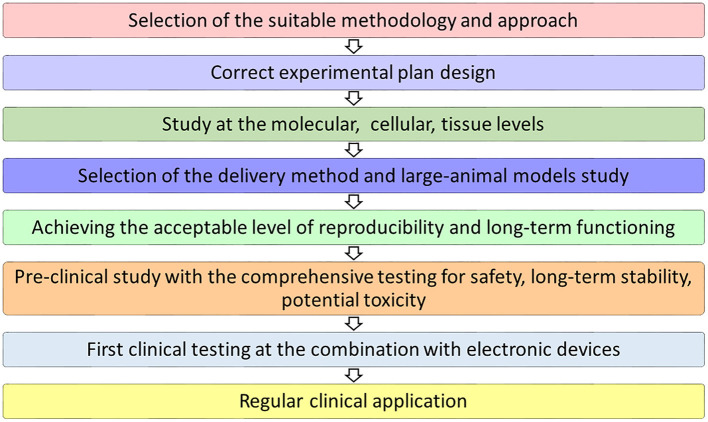
Heart rhythm disturbances caused by different etiologies may affect pediatric and adult patients with life-threatening consequences. When pharmacological therapy is ineffective in treating the disturbances, the implantation of electronic devices to control and/or restore normal heart pacing is a unique clinical management option. Although these artificial devices are life-saving, they display many limitations; not least, they do not have any capability to adapt to somatic growth or respond to neuroautonomic physiological changes. A biological pacemaker could offer a new clinical solution for restoring heart rhythms in the conditions of disorder in the cardiac conduction system. Several experimental approaches, such as cell-based, gene-based approaches, and the combination of both, for the generation of biological pacemakers are currently established and widely studied. Pacemaker bioengineering is also emerging as a technology to regenerate nodal tissues. This review analyzes and summarizes the strategies applied so far for the development of biological pacemakers, and discusses current translational challenges toward the first-in-human clinical application.
由不同病因引起的心律失常可能会影响儿童和成人患者,带来危及生命的后果。当药物治疗对心律失常无效时,植入电子设备以控制和/或恢复正常心脏起搏是一种独特的临床管理选择。尽管这些人工设备能挽救生命,但它们存在许多局限性;其中最主要的是,它们没有任何适应躯体生长或响应神经自主生理变化的能力。生物起搏器可为心脏传导系统紊乱情况下恢复心律提供一种新的临床解决方案。目前已经确立并广泛研究了几种用于生成生物起搏器的实验方法,如基于细胞的方法、基于基因的方法以及两者的结合。起搏器生物工程也正在成为一种用于再生结组织的技术。本综述分析并总结了迄今为止用于生物起搏器开发的策略,并讨论了首次人体临床应用面临的当前转化挑战。