Department of Cancer Physiology, H. Lee Moffitt Cancer Center and Research Institute, Tampa, FL, USA.
Department of Radiology, First Hospital of Shanxi Medical University, Taiyuan, Shanxi Province, China.
JNCI Cancer Spectr. 2021 May 13;5(4). doi: 10.1093/jncics/pkab048. eCollection 2021 Aug.
Immunotherapy yields survival benefit for some advanced stage non-small cell lung cancer (NSCLC) patients. Because highly predictive biomarkers of immunotherapy response are an unmet clinical need, we used pretreatment radiomics and clinical data to train and validate a parsimonious model associated with survival outcomes among NSCLC patients treated with immunotherapy.
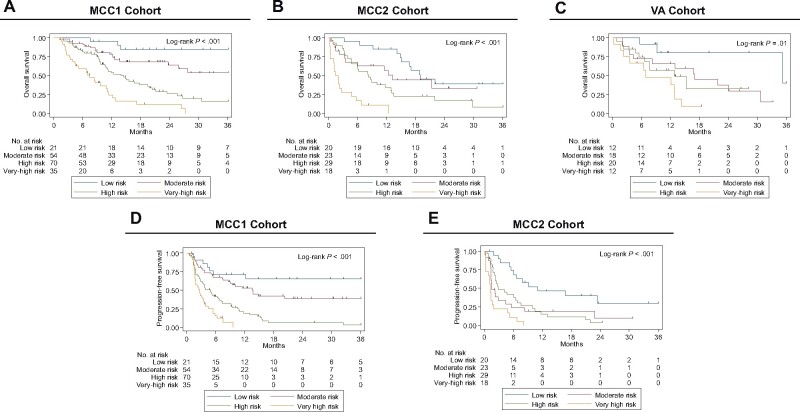
Three cohorts of NSCLC patients treated with immunotherapy were analyzed: training (n = 180), validation 1 (n = 90), and validation 2 (n = 62). The most informative clinical and radiomic features were subjected to decision tree analysis, which stratified patients into risk groups of low, moderate, high, and very high risk of death after initiation of immunotherapy. All statistical tests were 2-sided.
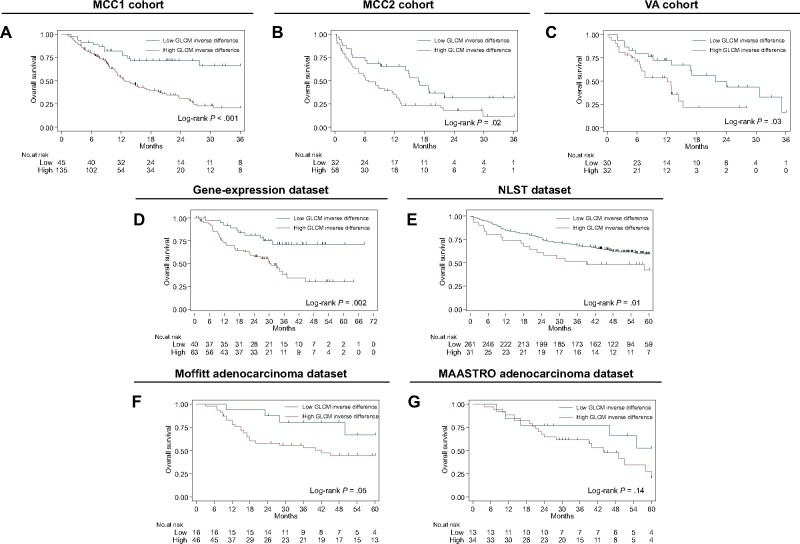
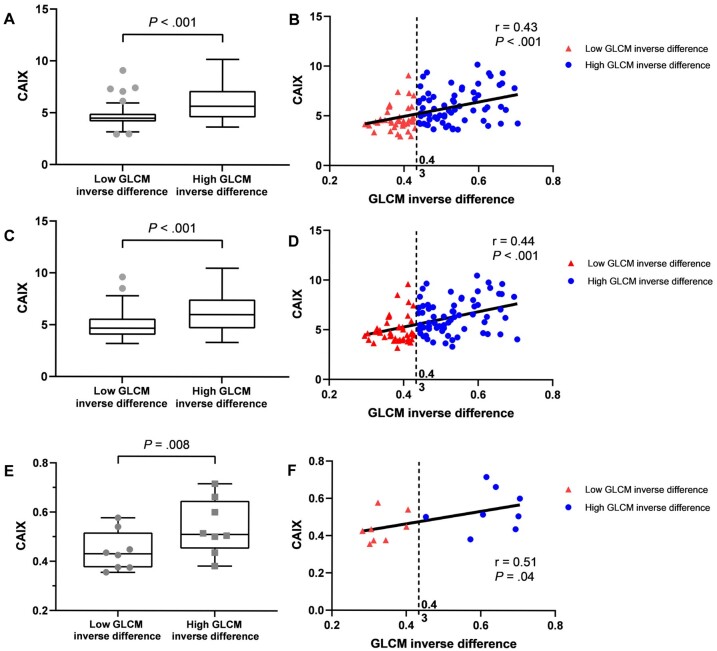
The very high-risk group was associated with extremely poor overall survival (OS) in validation cohorts 1 (hazard ratio [HR] = 5.35, 95% confidence interval [CI] = 2.14 to 13.36; 1-year OS = 11.1%, 95% CI = 1.9% to 29.8%; 3-year OS = 0%) and 2 (HR = 13.81, 95% CI = 2.58 to 73.93; 1-year OS = 47.6%, 95% CI = 18.2% to 72.4%; 3-year OS = 0%) when compared with the low-risk group (HR = 1.00) in validation cohorts 1 (1-year OS = 85.0%, 95% CI = 60.4% to 94.9%; 3-year OS = 38.9%, 95% CI = 17.1% to 60.3%) and 2 (1-year OS = 80.2%, 95% CI = 40.3% to 94.8%; 3-year OS = 40.1%, 95% CI = 1.3% to 83.5%). The most informative radiomic feature, gray-level co-occurrence matrix (GLCM) inverse difference, was positively associated with hypoxia-related carbonic anhydrase 9 using gene-expression profiling and immunohistochemistry.
Utilizing standard-of-care imaging and clinical data, we identified and validated a novel parsimonious model associated with survival outcomes among NSCLC patients treated with immunotherapy. Based on this model, clinicians can identify patients who are unlikely to respond to immunotherapy.
免疫疗法为一些晚期非小细胞肺癌(NSCLC)患者带来了生存获益。由于免疫治疗反应的高度预测性生物标志物是未满足的临床需求,我们使用预处理的放射组学和临床数据来训练和验证与接受免疫治疗的 NSCLC 患者生存结果相关的简约模型。
对接受免疫治疗的三组 NSCLC 患者进行分析:训练队列(n=180)、验证队列 1(n=90)和验证队列 2(n=62)。对最具信息量的临床和放射组学特征进行决策树分析,将患者分为低、中、高和极高死亡风险组,以预测免疫治疗开始后的死亡风险。所有统计检验均为双侧检验。
在验证队列 1 中,极高风险组的总体生存率(OS)极差(风险比[HR] = 5.35,95%置信区间[CI] = 2.14 至 13.36;1 年 OS = 11.1%,95%CI = 1.9%至 29.8%;3 年 OS = 0%)和验证队列 2(HR = 13.81,95%CI = 2.58 至 73.93;1 年 OS = 47.6%,95%CI = 18.2%至 72.4%;3 年 OS = 0%)与低风险组(HR = 1.00)相比,差异具有统计学意义(在验证队列 1 中,1 年 OS = 85.0%,95%CI = 60.4%至 94.9%;3 年 OS = 38.9%,95%CI = 17.1%至 60.3%)和验证队列 2(1 年 OS = 80.2%,95%CI = 40.3%至 94.8%;3 年 OS = 40.1%,95%CI = 1.3%至 83.5%)。最具信息量的放射组学特征是灰度共生矩阵(GLCM)倒数,与基于基因表达谱和免疫组织化学的缺氧相关碳酸酐酶 9 呈正相关。
本研究利用标准护理成像和临床数据,确定并验证了一个与接受免疫治疗的 NSCLC 患者生存结果相关的简约模型。基于该模型,临床医生可以识别出不太可能对免疫治疗有反应的患者。