Faculty of Medical Sciences, Newcastle University, Framlington Place, Newcastle Upon Tyne, UK.
Department of Paediatric Immunology and Infectious Diseases, Great North Children's Hospital, Newcastle Upon Tyne Hospitals NHS Foundation Trust, Newcastle upon Tyne, UK.
Glob Health Res Policy. 2021 Aug 20;6(1):31. doi: 10.1186/s41256-021-00216-0.
Antibiotic resistance is a major problem in every region of the globe and Sub-Saharan Africa (SSA) is no exception. Several systematic reviews have addressed the prevalence of resistant organisms but few have examined the underlying causes in this region. This systematic review of qualitative literature aims to highlight barriers and facilitators to antimicrobial stewardship in SSA.
A literature search of Embase and MEDLINE(R) was carried out. Studies were included if they were in English, conducted in SSA, and reported qualitative data on the barriers and facilitators of antimicrobial stewardship or on attitudes towards resistance promoting behaviours. Studies were screened with a simple critical appraisal tool. Secondary constructs were extracted and coded into concepts, which were then reviewed and grouped into themes in light of the complete dataset.
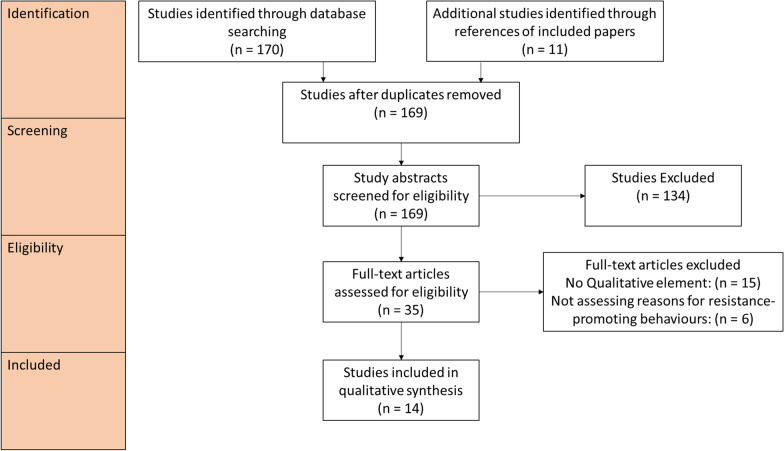
The literature search yielded 169 results, of which 14 studies from 11 countries were included in the final analysis. No studies were excluded as a result of the critical appraisal. Eight concepts emerged from initial coding, which were consolidated into five major themes: ineffective regulation, health system factors, clinical governance, patient factors and lack of resources. The ineffective regulation theme highlighted the balance between tightening drugstore regulation, reducing over-the-counter sale of antibiotics, and maintaining access to medicines for rural communities. Meanwhile, health system factors explored the tension between antimicrobial stewardship and the need of pharmacy workers to maintain profitable businesses. Additionally, a lack of resources, actions by patients and the day-to-day challenges of providing healthcare were shown to directly impede antimicrobial stewardship and exacerbate other factors which promote resistance.
Antibiotic resistance in SSA is a multi-faceted issue and while limited resources contribute to the problem they should be viewed in the context of other factors. We identify several contextual factors that affect resistance and stewardship that should be considered by policy makers when planning interventions. This literature base is also incomplete, with only 11 nations accounted for and many studies being confined to regions within countries, so more research is needed. Specifically, further studies on implementing stewardship interventions, successful or not, would be beneficial to inform future efforts.
抗生素耐药性是全球每个地区的主要问题,撒哈拉以南非洲(SSA)也不例外。已经有几项系统评价研究了耐药生物的流行情况,但很少有研究考察该地区的根本原因。本系统评价的定性文献旨在强调 SSA 中抗菌药物管理的障碍和促进因素。
对 Embase 和 MEDLINE(R)进行文献检索。如果研究是用英文进行的,并且在 SSA 进行,并且报告了关于抗菌药物管理的障碍和促进因素或关于对抗生素耐药促进行为的态度的定性数据,则纳入研究。使用简单的批判性评价工具对研究进行筛选。提取次要结构并编码为概念,然后根据完整数据集进行审查和分组为主题。
文献检索产生了 169 项结果,其中来自 11 个国家的 14 项研究最终被纳入分析。没有研究因批判性评价而被排除。从初步编码中出现了 8 个概念,这些概念被整合为 5 个主要主题:监管不力、卫生系统因素、临床治理、患者因素和资源匮乏。监管不力主题突出了加强药店监管、减少抗生素非处方销售与维持农村社区获得药物之间的平衡。同时,卫生系统因素探讨了抗菌药物管理与药剂师维持有利可图的业务之间的紧张关系。此外,缺乏资源、患者的行动以及提供医疗保健的日常挑战被证明直接阻碍了抗菌药物管理,并加剧了其他促进耐药性的因素。
SSA 的抗生素耐药性是一个多方面的问题,虽然有限的资源是造成这一问题的原因之一,但应在其他因素的背景下看待这些资源。我们确定了影响耐药性和管理的几个背景因素,政策制定者在规划干预措施时应考虑这些因素。由于只有 11 个国家被纳入,而且许多研究仅限于国家内的某些地区,因此该文献基础也不完整,因此需要进行更多的研究。具体来说,关于实施管理干预措施(成功或失败)的进一步研究将有助于为未来的努力提供信息。