Norwegian Institute for Nature Research (NINA), Torgarden, PO Box 5685, 7485, Trondheim, Norway.
Faculty of Bioscience and Aquaculture, Nord University, Bodo, Norway.
Parasit Vectors. 2021 Aug 21;14(1):422. doi: 10.1186/s13071-021-04935-8.
Gastrointestinal parasitic nematodes can impact fecundity, development, behaviour, and survival in wild vertebrate populations. Conventional monitoring of gastrointestinal parasitic nematodes in wild populations involves morphological identification of eggs, larvae, and adults from faeces or intestinal samples. Adult worms are typically required for species-level identification, meaning intestinal material from dead animals is needed to characterize the nematode community with high taxonomic resolution. DNA metabarcoding of environmental samples is increasingly used for time- and cost-effective, high-throughput biodiversity monitoring of small-bodied organisms, including parasite communities. Here, we evaluate the potential of DNA metabarcoding of faeces and soil samples for non-invasive monitoring of gastrointestinal parasitic nematode communities in a wild ruminant population.
Faeces and intestines were collected from a population of wild reindeer, and soil was collected both from areas showing signs of animal congregation, as well as areas with no signs of animal activity. Gastrointestinal parasitic nematode faunas were characterized using traditional morphological methods that involve flotation and sedimentation steps to concentrate nematode biomass, as well as using DNA metabarcoding. DNA metabarcoding was conducted on bulk samples, in addition to samples having undergone sedimentation and flotation treatments.
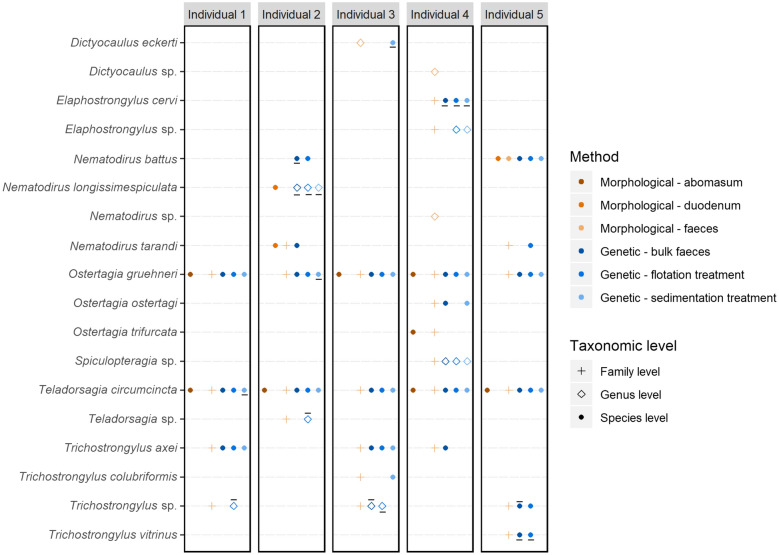
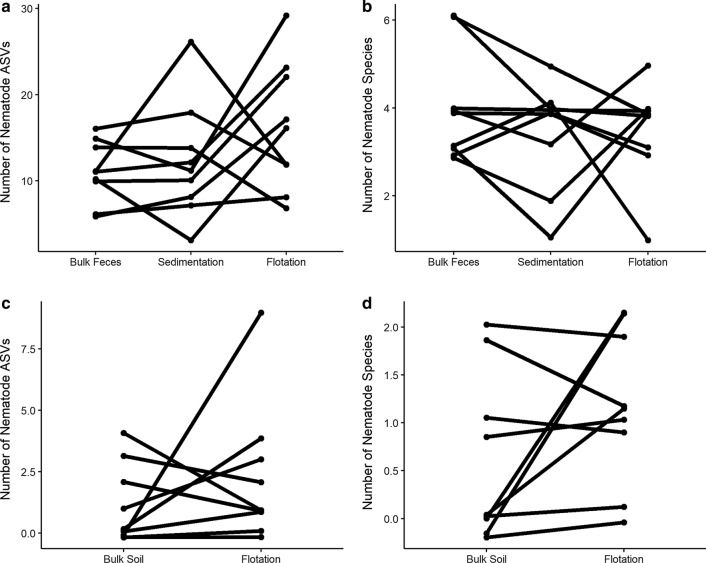
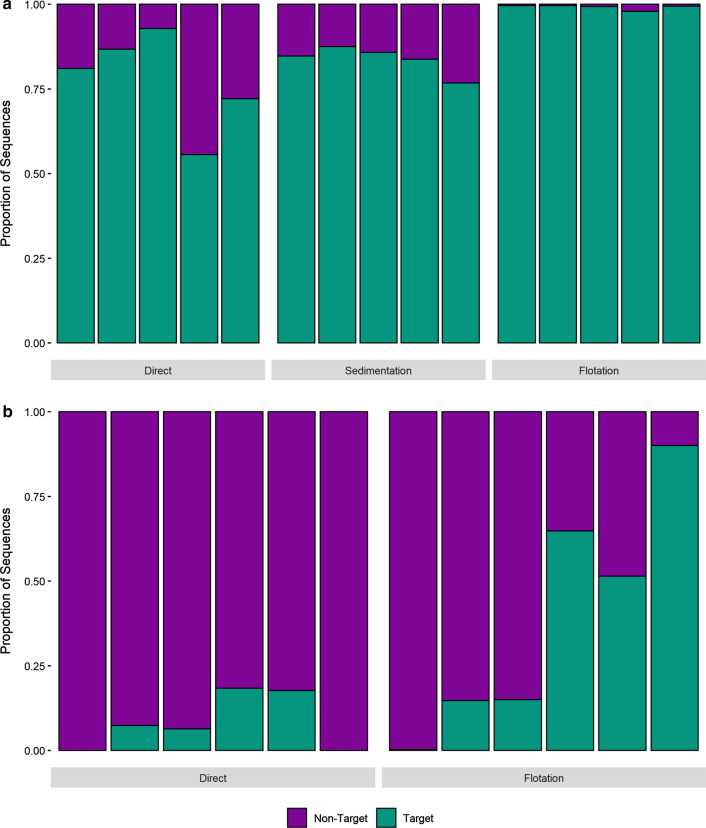
DNA metabarcoding and morphological approaches were largely congruent, recovering similar nematode faunas from all samples. However, metabarcoding provided higher-resolution taxonomic data than morphological identification in both faeces and soil samples. Although concentration of nematode biomass by sedimentation or flotation prior to DNA metabarcoding reduced non-target amplification and increased the diversity of sequence variants recovered from each sample, the pretreatments did not improve species detection rates in soil and faeces samples.
DNA metabarcoding of bulk faeces samples is a non-invasive, time- and cost-effective method for assessing parasitic nematode populations that provides data with comparable taxonomic resolution to morphological methods that depend on parasitological investigations of dead animals. The successful detection of parasitic gastrointestinal nematodes from soils demonstrates the utility of this approach for mapping distribution and occurrences of the free-living stages of gastrointestinal parasitic nematodes.
胃肠道寄生线虫会影响野生动物种群的繁殖力、发育、行为和生存。在野生种群中,胃肠道寄生线虫的常规监测包括从粪便或肠道样本中鉴定虫卵、幼虫和成虫的形态学方法。通常需要成虫来进行物种鉴定,这意味着需要从死亡动物的肠道组织来对寄生线虫群落进行高分类分辨率的特征描述。环境样本的 DNA 宏条形码技术越来越多地用于对包括寄生虫群落在内的小体型生物进行具有时间和成本效益的高通量生物多样性监测。在这里,我们评估了粪便和土壤样本的 DNA 宏条形码技术在监测野生反刍动物种群胃肠道寄生线虫群落方面的非侵入性潜力。
从野生驯鹿种群中收集粪便和肠道样本,并从动物聚集区以及无动物活动区收集土壤样本。通过传统的形态学方法,包括浮集和沉淀步骤来浓缩线虫生物量,以及使用 DNA 宏条形码技术来描述胃肠道寄生线虫区系。对大块样本以及经过沉淀和浮集处理的样本进行 DNA 宏条形码分析。
DNA 宏条形码和形态学方法基本一致,从所有样本中回收了相似的线虫区系。然而,与形态学鉴定相比,宏条形码在粪便和土壤样本中提供了更高分辨率的分类学数据。虽然在进行 DNA 宏条形码分析之前通过沉淀或浮集浓缩线虫生物量可以减少非目标扩增并增加从每个样本中回收的序列变异体的多样性,但这些预处理并不能提高土壤和粪便样本中物种检测率。
批量粪便样本的 DNA 宏条形码是一种非侵入性、省时且具有成本效益的方法,可用于评估寄生线虫种群,其提供的数据与依赖于对死亡动物进行寄生虫学研究的形态学方法具有可比的分类分辨率。从土壤中成功检测到寄生性胃肠道线虫表明,这种方法可用于绘制胃肠道寄生线虫自由生活阶段的分布和出现情况。