Gao Huichang, Xiao Jin, Wei Yingqi, Wang Hao, Wan Hongxia, Liu Shan
School of Medicine, South China University of Technology, Guangzhou 510006, China.
A National Engineering Research Centre for Tissue Restoration and Reconstruction, Guangzhou 510006, China.
ACS Omega. 2021 Aug 5;6(32):20931-20940. doi: 10.1021/acsomega.1c02347. eCollection 2021 Aug 17.
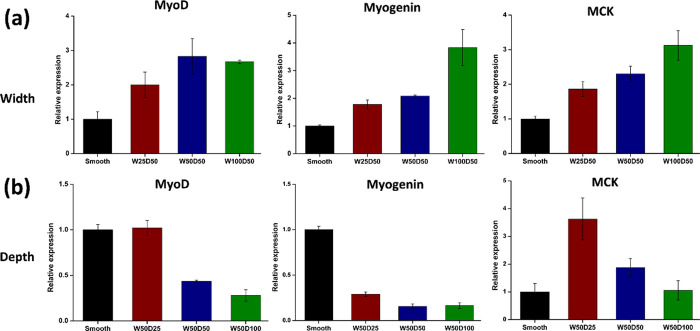
Inspired by the natural topological structure of skeletal muscle tissue, the topological surface construction of bionic scaffolds for skeletal muscle repair has attracted great interest. Many previous studies have focused on the effects of the topological structure on myoblasts. However, these studies used only specific repeating sizes and shapes to achieve the myoblast alignment and myotube formation; moreover, the regulatory effects of the size of a topological structure on myogenic differentiation are often neglected, leading to a lack of guidance for the design of scaffolds for skeletal muscle tissue engineering. In this study, we fabricated a series of microgroove topographies with various widths and depths via a combination of soft lithography and melt-casting and studied their effects on the behaviors of skeletal muscle cells, especially myogenic differentiation, in detail. Microgrooved poly(lactic-co-glycolic acid) substrates were found to effectively regulate the proliferation, myogenic differentiation, and myotube formation of C2C12 cells, and the degree of myogenic differentiation was significantly dependent on signals in response to the size of the microgroove structure. Compared with their depth, the width of the microgroove structures can more strongly affect the myogenic differentiation of C2C12 cells, and the degree of myoblast differentiation was enhanced with increasing groove width. Microgroove structures with relatively large groove widths and small groove depths promoted the myogenic differentiation of C2C12 cells. In addition, the integrin-mediated focal adhesion kinase signaling pathway and MAPK signaling pathway were activated in cells in response to the external topological structure, and the size of the topological structure of the material surface effectively regulated the degree of the cellular response to the external topological structure. These results can guide the design of scaffolds for skeletal muscle tissue engineering and the construction of effective bionic scaffold surfaces for skeletal muscle regeneration.
受骨骼肌组织天然拓扑结构的启发,用于骨骼肌修复的仿生支架的拓扑表面构建引起了极大关注。以往许多研究聚焦于拓扑结构对成肌细胞的影响。然而,这些研究仅使用特定的重复尺寸和形状来实现成肌细胞排列和肌管形成;此外,拓扑结构尺寸对成肌分化的调节作用常被忽视,导致骨骼肌组织工程支架设计缺乏指导。在本研究中,我们通过软光刻和熔铸相结合的方法制备了一系列具有不同宽度和深度的微槽形貌,并详细研究了它们对骨骼肌细胞行为,尤其是成肌分化的影响。发现微槽聚(乳酸 - 乙醇酸共聚物)底物能有效调节C2C12细胞的增殖、成肌分化和肌管形成,成肌分化程度显著依赖于对微槽结构尺寸响应的信号。与微槽深度相比,微槽结构的宽度对C2C12细胞的成肌分化影响更强,成肌细胞分化程度随槽宽增加而增强。具有相对较大槽宽和较小槽深的微槽结构促进了C2C12细胞的成肌分化。此外,整合素介导的粘着斑激酶信号通路和丝裂原活化蛋白激酶信号通路在细胞中因外部拓扑结构而被激活,材料表面拓扑结构的尺寸有效调节了细胞对外部拓扑结构的响应程度。这些结果可为骨骼肌组织工程支架设计及构建用于骨骼肌再生的有效仿生支架表面提供指导。