Mao Weipu, Sun Si, He Ting, Jin Xin, Wu Jianping, Xu Bin, Zhang Guangyuan, Wang Keyi, Chen Ming
Department of Urology, Affiliated Zhongda Hospital of Southeast University, Nanjing, 210009, People's Republic of China.
Surgical Research Center, Institute of Urology, Southeast University Medical School, Nanjing, 210009, People's Republic of China.
Cancer Manag Res. 2021 Aug 16;13:6437-6450. doi: 10.2147/CMAR.S328213. eCollection 2021.
We conducted a multicenter clinical study to examine the prognostic value of the systemic inflammation response index (SIRI) in renal cell carcinoma (RCC) patients.
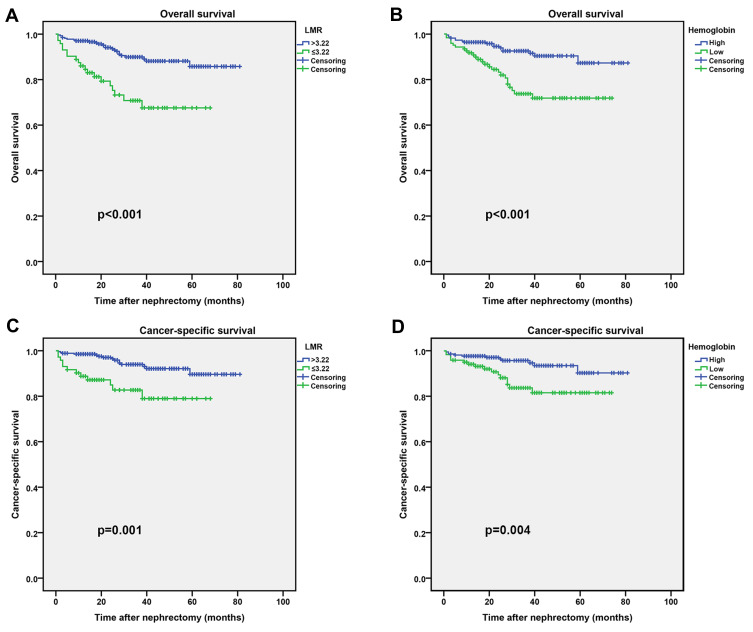
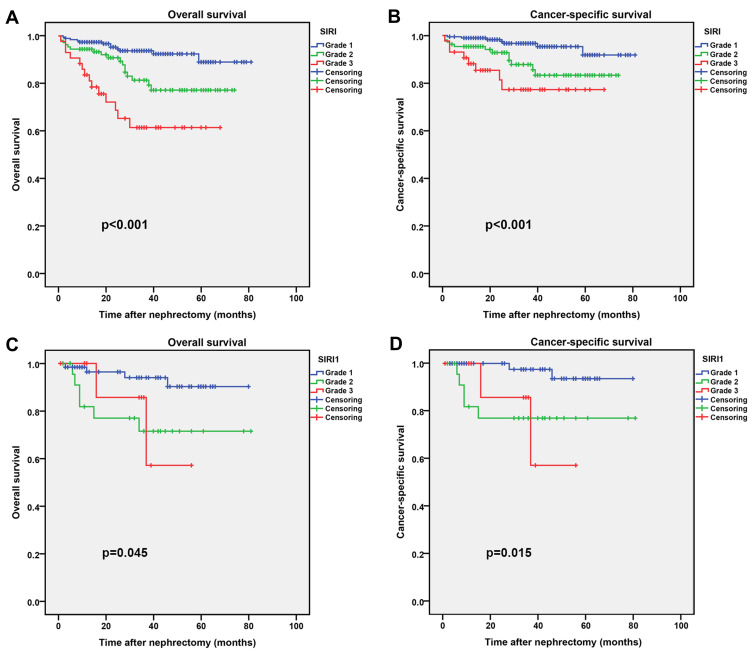
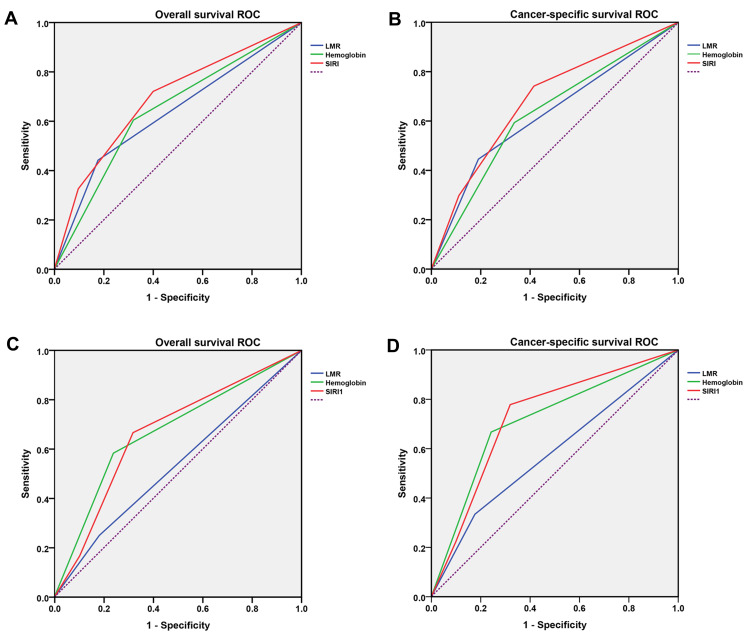
We collected patients who underwent nephrectomy from 2014 to 2019 at three centers (343 in the training group and 100 in the validation group). SIRI was created based on hemoglobin and lymphocyte to monocyte ratio (LMR). Kaplan-Meier curves and receiver operating characteristic (ROC) curves were used to analyze the effect of LMR, hemoglobin and SIRI on overall survival (OS) and cancer-specific survival (CSS) effects.
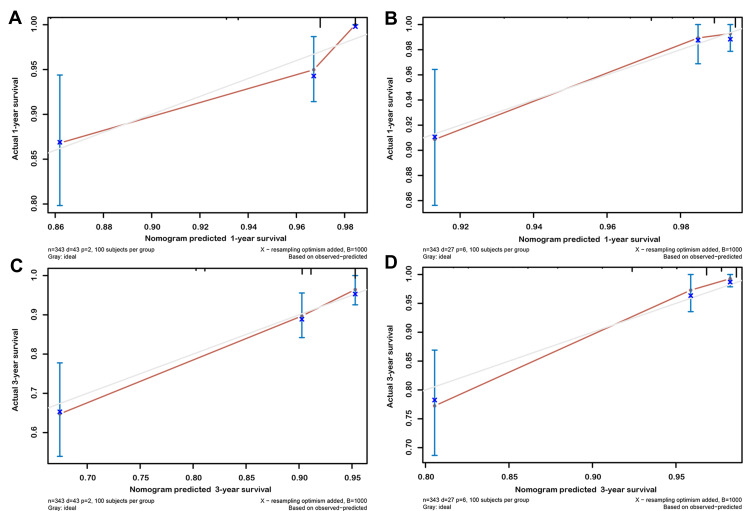
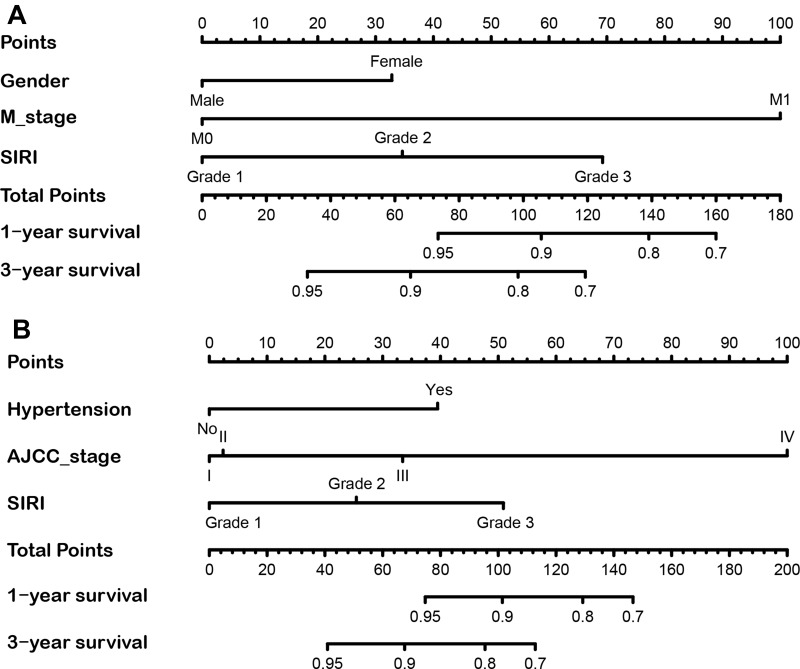
In both the training and validation groups, SIRI was a better predictor of OS and CSS than LMR and hemoglobin. A total of 192 (56.0%) patients were included in grade 1, 108 (31.5%) in grade 2, and 43 (12.5%) in grade 3 based on SIRI in the training group. Higher SIRI was associated with worse prognosis. Multivariate cox regression analysis showed that SIRI was an independent prognostic risk factor for OS (grade 3 vs grade 1: HR=4.93; 95% CI 2.21-11.00, p < 0.001) and CSS (grade 3 vs grade 1: HR=6.29; 95% CI 2.28-17.39, p < 0.001) in patients with RCC. In addition, SIRI-based prognostic nomograms were able to better predict OS and CSS in RCC patients.
SIRI is an independent prognostic factor for patients undergoing laparoscopic nephrectomy for RCC, and a prognostic nomogram covering SIRI can better predict survival of RCC patients.
我们开展了一项多中心临床研究,以探讨全身炎症反应指数(SIRI)在肾细胞癌(RCC)患者中的预后价值。
我们收集了2014年至2019年在三个中心接受肾切除术的患者(训练组343例,验证组100例)。SIRI基于血红蛋白和淋巴细胞与单核细胞比值(LMR)得出。采用Kaplan-Meier曲线和受试者工作特征(ROC)曲线分析LMR、血红蛋白和SIRI对总生存期(OS)和癌症特异性生存期(CSS)的影响。
在训练组和验证组中,SIRI对OS和CSS的预测能力均优于LMR和血红蛋白。训练组中,根据SIRI,共有192例(56.0%)患者为1级,108例(31.5%)为2级,43例(12.5%)为3级。较高的SIRI与较差的预后相关。多因素cox回归分析显示,SIRI是RCC患者OS(3级vs 1级:HR=4.93;95%CI 2.21-11.00,p<0.001)和CSS(3级vs 1级:HR=6.29;95%CI 2.28-17.39,p<0.001)的独立预后危险因素。此外,基于SIRI的预后列线图能够更好地预测RCC患者的OS和CSS。
SIRI是接受腹腔镜肾切除术治疗RCC患者的独立预后因素,包含SIRI的预后列线图能够更好地预测RCC患者的生存期。