Rodrigues Delma Henriques, Calixto Eduardo, Cesario Clarice Silva, Repoles Renata Barcelos, de Paula Lopes Waldomiro, Oliveira Viviane Silva, Brinati Alessandro, Hemetrio Nadja Simbera, Silva Ita Oliveira, Boere Vanner
Programa de Pós-graduação em Biologia Animal, Universidade Federal de Viçosa, Viçosa 36570-900, MG, Brazil.
Programa de Pós-graduação em Entomologia, Universidade de São Paulo, São Paulo 05508-220, SP, Brazil.
Animals (Basel). 2021 Aug 16;11(8):2412. doi: 10.3390/ani11082412.
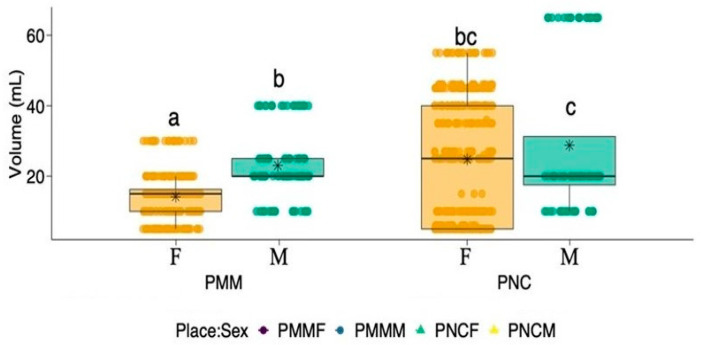
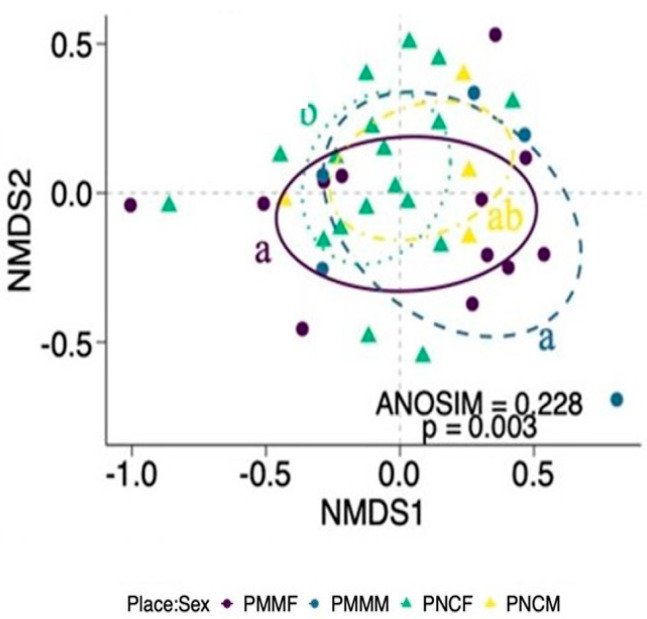
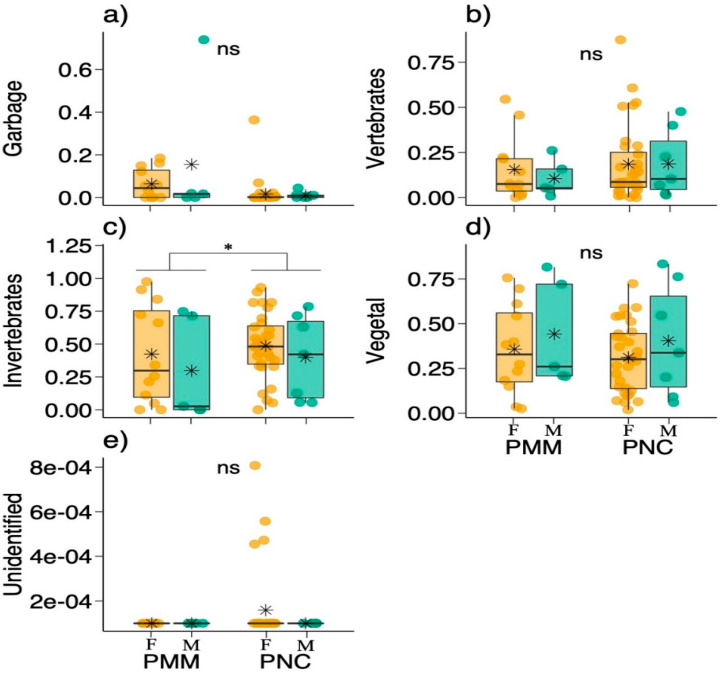
Wild animals that feed on garbage waste are a problem in ecological parks as it can substantially alter their food ecology. Wild coatis that occupy human recreation areas in parks are often observed feeding on garbage, but the ecological consequences are scarcely known. Forty-four fecal samples from females and 12 from males of wild coatis living in two ecological parks (Parque Municipal das Mangabeiras (PMM) and Parque Nacional do Caparaó (PNC)) were analyzed. Multivariate statistics were applied to evaluate the interaction between four variables (fecal volume, composition, place and sex of coatis). A significant interaction between the parks and sexes with regard to volume and food category was not found. Ungrouped analysis allowed for the identification of a decreasing gradient in volume from PNC males, followed by PNC females, PMM males, and PMM females. We did not find differences between categories of food between males and females from PNC and PMM, except for invertebrates. Females from PNC consumed more invertebrates than males and females of PMM, but we did not find differences from PNC males. The coatis of both parks primarily consume invertebrates and vegetables, but garbage residues were found in their feces. Garbage fragments, such as paper, glass, metal, plastic and rope, cause a risk to the health, compromising the conservation efforts of wild coatis. Actions are needed to prevent the access of coatis to dumps in both parks.
以垃圾废物为食的野生动物在生态公园中是个问题,因为这会极大地改变它们的食物生态。在公园人类游乐区域出没的野生南美浣熊经常被观察到以垃圾为食,但其生态后果却鲜为人知。对生活在两个生态公园(曼加贝拉斯市立公园(PMM)和卡帕劳国家公园(PNC))的野生南美浣熊的44份雌性粪便样本和12份雄性粪便样本进行了分析。应用多变量统计来评估四个变量(粪便体积、成分、南美浣熊的地点和性别)之间的相互作用。未发现公园和性别在体积和食物类别方面存在显著相互作用。非分组分析能够识别出从PNC雄性、PNC雌性、PMM雄性到PMM雌性的体积递减梯度。除了无脊椎动物外,我们未发现PNC和PMM的雄性和雌性在食物类别上存在差异。PNC的雌性比PMM的雄性和雌性消耗更多的无脊椎动物,但与PNC的雄性相比未发现差异。两个公园的南美浣熊主要以无脊椎动物和蔬菜为食,但在它们的粪便中发现了垃圾残渣。纸张、玻璃、金属、塑料和绳索等垃圾碎片对健康构成风险,危及野生南美浣熊的保护工作。需要采取行动防止南美浣熊进入两个公园的垃圾场。